




Going Beyond 2D: GPM Observations of Typhoon Sinlaku
In April 2026, Typhoon Sinlaku impacted the Pacific Islands of Guam, Saipan, and Tinian. As the storm approached the islands and made landfall, NASA's Global Precipitation Measurement mission (GPM) satellite and multi-satellite data-processing algorithms gave insights into the rain that fell from this powerful storm. Now, learn how GPM helps us go beyond individual snapshots of surface rainfall by observing Typhoon Sinlaku over time and through the depth of Earth's atmosphere.
The Time Dimension
Because of technological limitations, satellite instruments that see into a storm don't hover over one place on Earth. Instead, they capture a snapshot of a storm as the satellite rapidly orbits the planet at a speed of about 5 miles per second. To build up the life story of an individual storm, it is necessary to stitch together observations from many satellites. Since 2014, NASA has done so by running the IMERG multi-satellite precipitation-estimation algorithm, which NASA developed in collaboration with scientists at other agencies and universities.
The movie below shows seven days of rainfall from Typhoon Sinlaku. This animation is built up from estimates made every 30 minutes from April 10 through April 16. In this movie, the transparent gray clouds represent Geosynchronous infrared satellite observations and the rainfall rate shown in color comes from NASA's IMERG algorithm. These IMERG estimates can be viewed in NASA's RAIN-Global 2 web tool or on the WorldView webpage.
These 30-minute surface rainfall rates can be summed to arrive at the storm-total rainfall accumulation. The public, businesses, and disaster agencies care about storm totals, not just when a storm will hit, so accumulation comes up in weather discussions. At about 2PM EDT (01800 UTC) on April 13, the National Weather Service office for the island of Guam warned the public that Typhoon Sinlaku could bring 15 to 25 inches of rain to the nearby Pacific islands of Saipan and Tinian in the subsequent days. In its hurricane local statement, the Guam office said that passive-microwave satellite observations influenced their prediction.
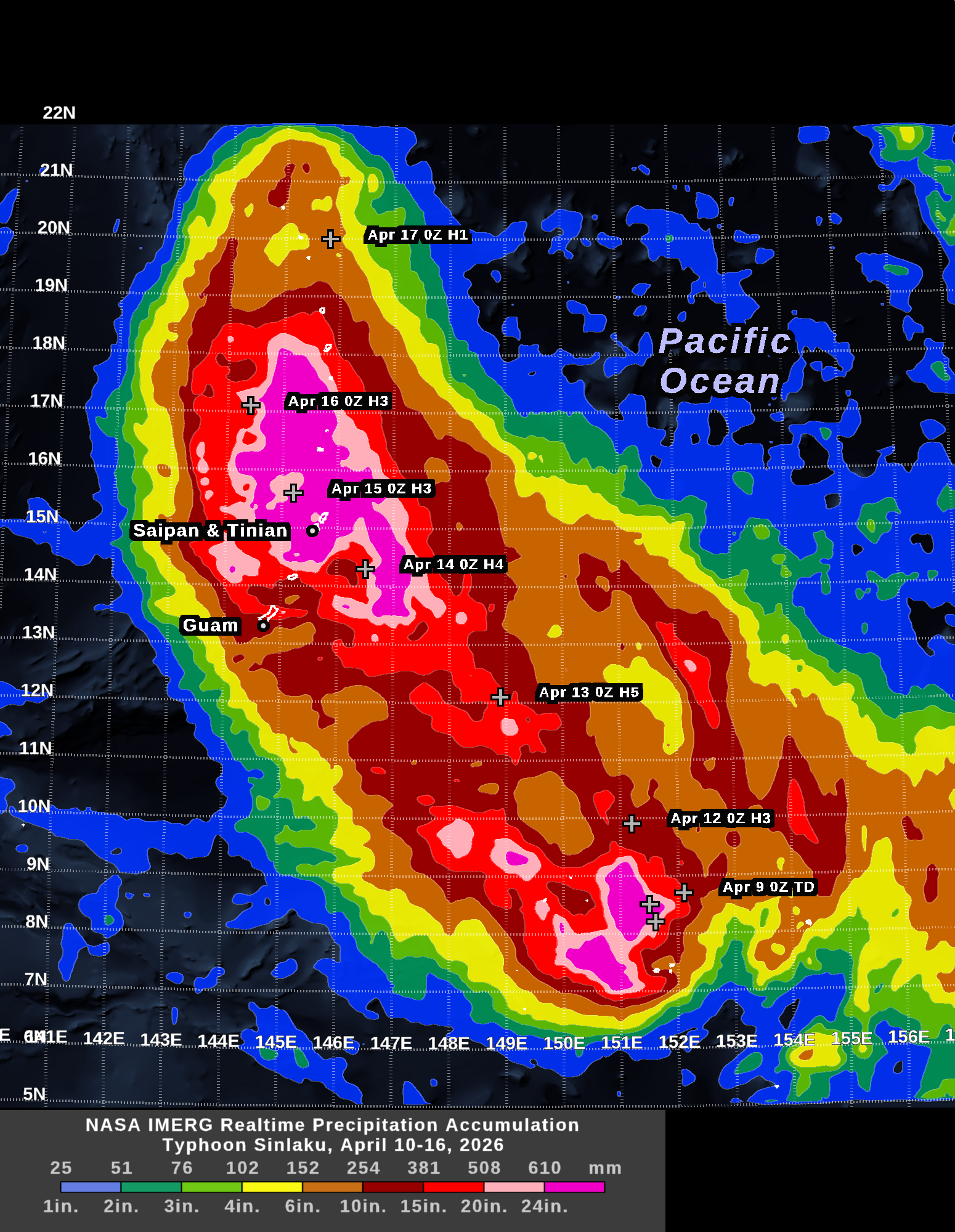
The 7-day accumulation shown above is one way to illustrate how the National Weather Service may have arrived at its 15-to-25-inch forecast. During the two days before Typhoon Sinlaku reached Saipan and Tinian, the IMERG algorithm estimated that the storm was dumping about 6 to 20 inches of rainfall along the portion of its track southeast of these islands. This range is shown in orange and red in the image. The typhoon's forward speed was cut in half around the time it started impacting Saipan and Tinian, which would increase the time it would spend over these islands. Other factors remaining equal, a slower forward speed would proportionally increase the expected rainfall total. Where the storm center passed with a slow forward motion (during April 14–15), IMERG estimated that the accumulation was 20 to 30 inches (pink and magenta in the image).
In the 7-day accumulation image, the location of Sinlaku's center is marked with a white plus sign at 0000 UTC, each day. The storm's strength is indicated by H1 through H5 for categories 1–5 on the Saffir-Simpson scale or by TD, which stands for Tropical Depression.
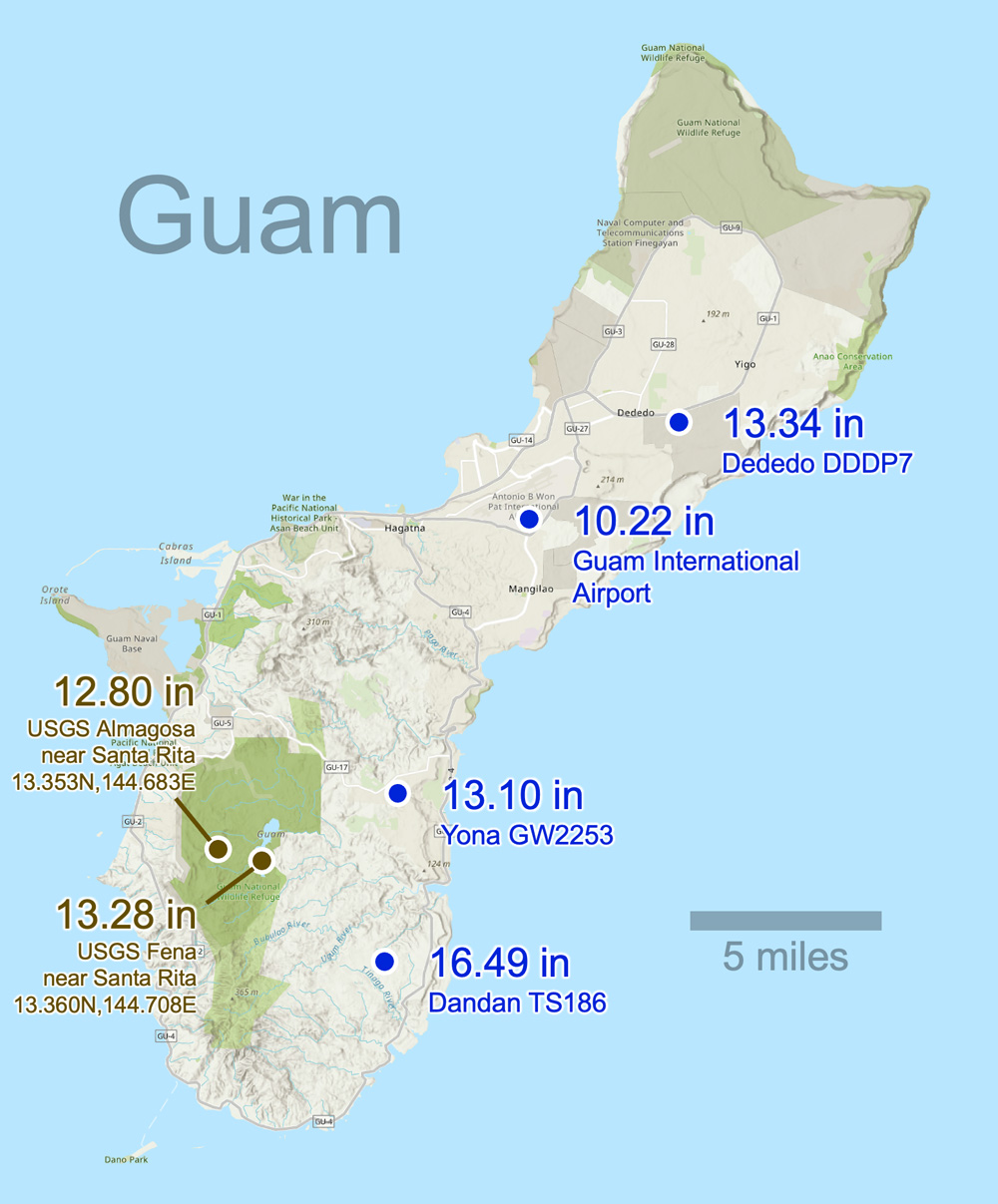
One way to increase confidence in these near real-time IMERG storm totals is to compare them to near real-time rain-gauge observations where available. Rain-gauge data is not available immediately following Typhoon Sinlaku's landfall for the two islands most severely impacted, Saipan and Tinian. However, just 130 miles to the south, several rain gauges in Guam continued to operate during the passage of Typhoon Sinlaku. Between April 9 and 17, the National Weather Service and the USGS reported that six rain gauges in Guam had accumulations of 10.2 to 16.5 inches, respectively, including at Almagosa, Dededo, and Santa Rita. The map below shows the location of these gauges. IMERG reported 10 to 20 inches of accumulation over Guam, which indicates good agreement with these gauges.
The Third Dimension
NASA's Global Precipitation Measurement (GPM) Measurement satellite carries a radar built by Japan that is currently the only instrument in space able to observe the three-dimensional structure of storms. A few other cloud or precipitation radars are also in space, but they collect only two-dimensional curtains of data with data collected along the satellite's direction of motion and vertically. The EarthCare and Tomorrow.IO satellites carry such 2D radars. Other satellite instruments collect different types of 2D data. Passive microwave instruments see into and through a storm, producing an image somewhat like a medical X-ray of the body. Infrared satellite instruments see only the top surface of a storm cloud, something like a hand-held infrared thermometer taking your temperature when pointed at your forehead.
The dual-frequency radar on the GPM satellite flew over Typhoon Sinlaku's eyewall on April 12, 2026. At 1208 UTC that day, the typhoon had reached category 5 on the Saffir-Simpson scale and would soon reach its peak wind intensity.
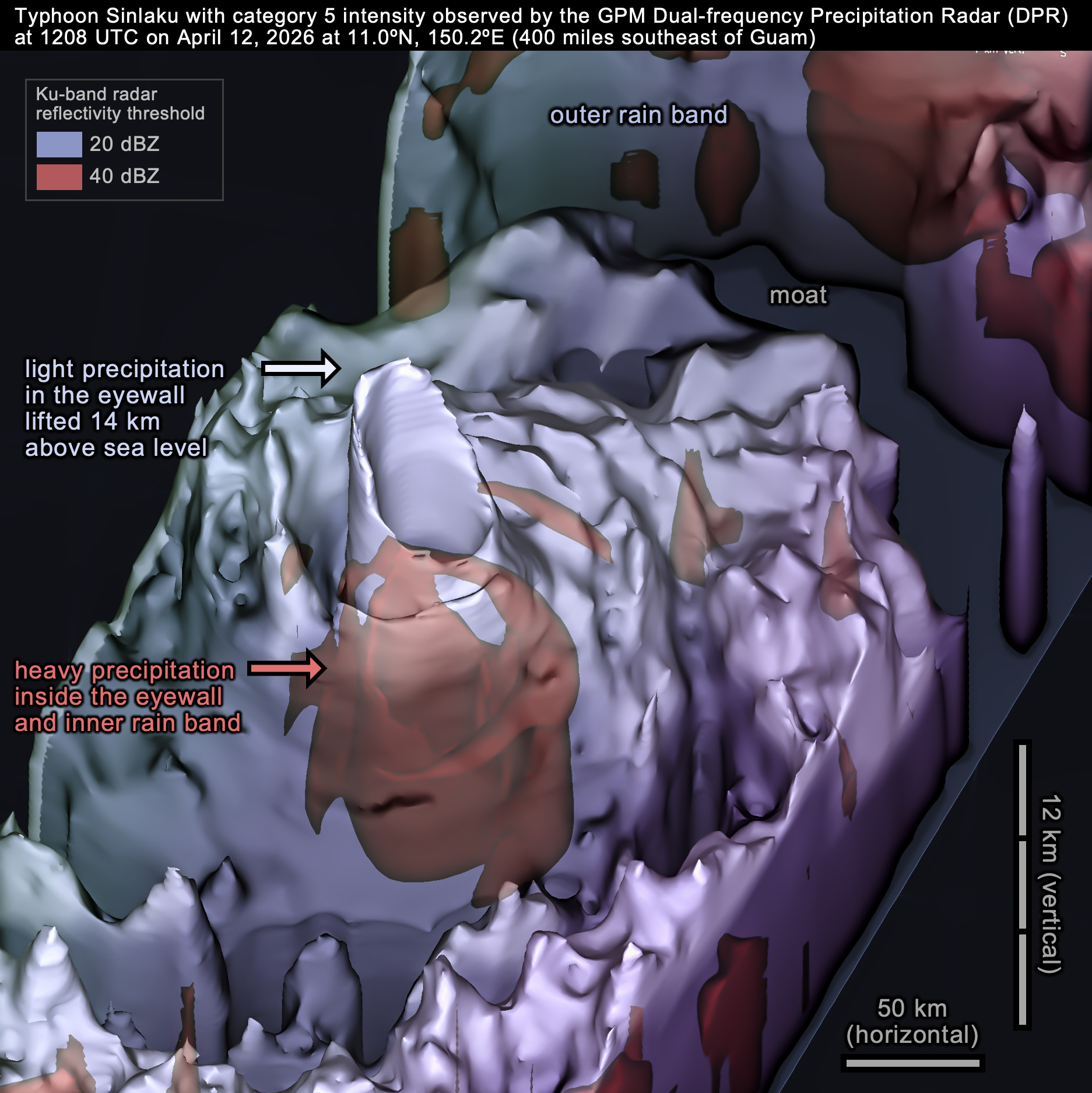
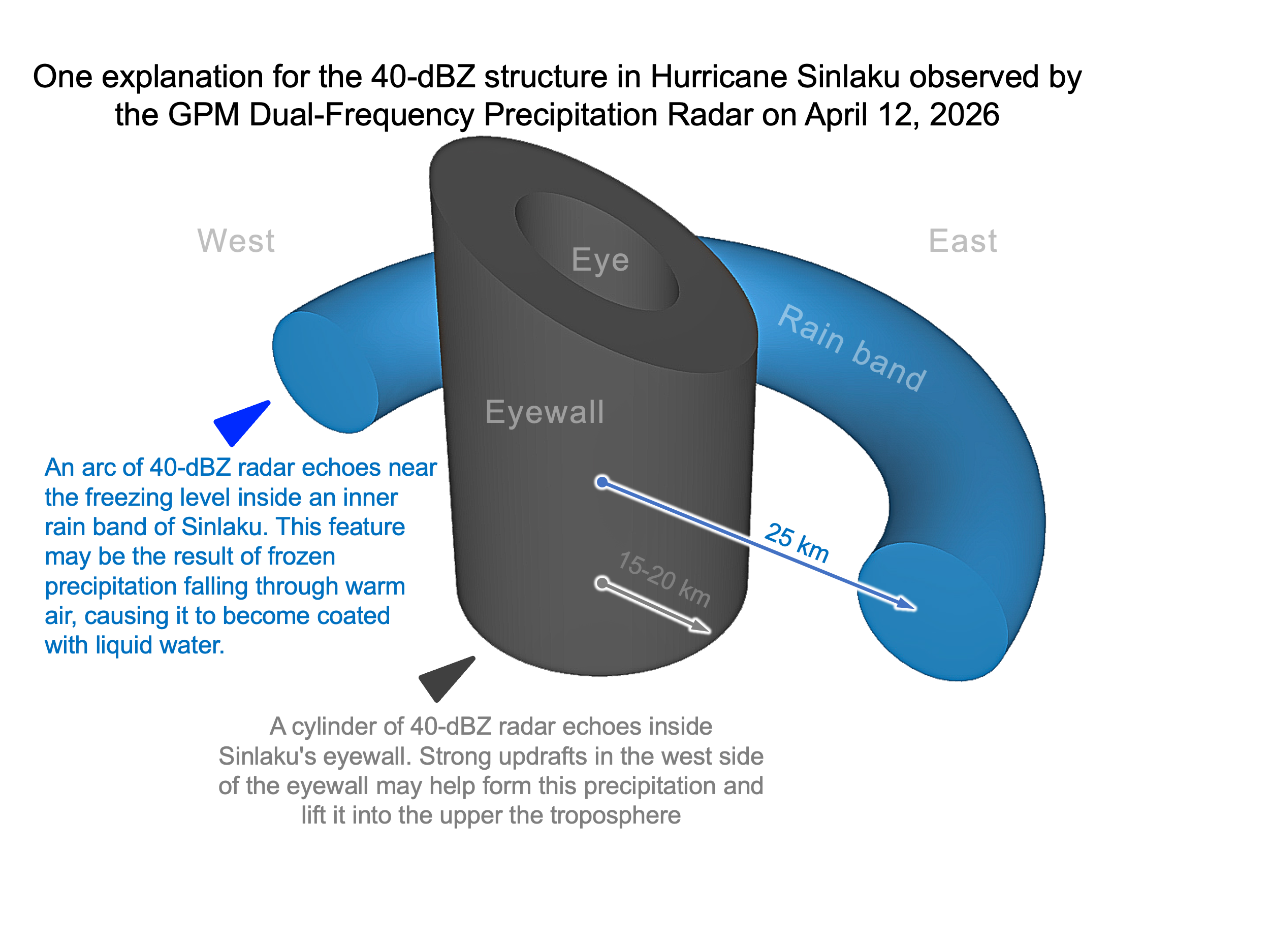
Above, the 3D image shows the radar-observed volume of the light precipitation inside Typhoon Sinlaku. Light precipitation is represented by the blue-gray surface. To a first approximation, the precipitation in the lower half of the hurricane (within 5 km of sea level) takes the form of raindrops. Above that, there are various forms of frozen precipitation because the atmosphere is so cold at those altitudes. The blue-gray surface is defined by a 20-dBZ radar-reflectivity threshold. Inside this surface, there is in inner volume of heavy precipitation that the image shows in red. The inner volume is defined by a stronger radar signal, i.e., a 40-dBZ threshold. Generally speaking, a radar signal this strong indicates heavy rainfall or large ice hydrometeors coated in liquid water as they fall through warm air.
One can gather clues about the updrafts and precipitation processes at work in the inner core of Typhoon Sinlaku by studying the shape of the radar echoes inside it. The following schematic diagram provides one interpretation of the 40-dBZ signal that the GPM DPR observed.
For more information about the GPM satellite and the IMERG algorithm, visit the GPM website: https://gpm.nasa.gov. Images and story by Owen Kelley (NASA/PPS/GMU). Animation by Jason West (NASA/PPS/KBR).