

GPM

GPM content

GPM Data Release Schedule Announced

The GPM Core Observatory satellite was successfully launched on February 27th, 2014. Data from the GPM Microwave Imager (GMI) and Dual-frequency Precipitation Radar (DPR) have the following release schedule. All data are freely available through the NASA's Precipitation Processing System at http://pps.gsfc.nasa.gov June 16th – GMI Level 1 Brightness Temperature data have been released. This includes GMI instrument swath data. July 14th – GMI Level 2 Precipitation Rate data will be released. This includes precipitation rates estimated using the Goddard Profiling algorithm (GPROF14) and are

First GPM Data Now Public

The first set of data from the Global Precipitation Measurement mission is now available to the public. The data set consists of GPM Microwave Imager instrument observations, called brightness temperatures. Brightness temperatures are a measurement of naturally occurring energy radiated, in this case, by precipitation particles like raindrops or snowflakes. Other data sets, like the rain rate information, will be released later this summer. By themselves, however, the brightness temperatures convey valuable data on the location and structure of storm systems – including tropical cyclones and
GPM Satellite Passes Check-out, Starts Mission
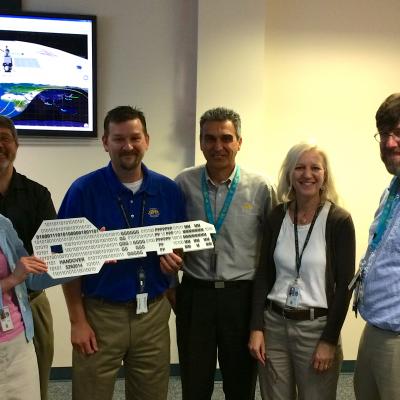
On May 29, GPM Deputy Project Manager Candace Carlisle (left) handed over the "key" to the GPM Core Observatory to GPM Mission Director James Pawloski (center, blue shirt). Also pictured, left to right, Wynn Watson, Art Azarbarzin, Gail Skofronick-Jackson and David Ward. Image Credit: NASA The new Global Precipitation Measurement Core Observatory satellite is now in the hands of the engineers who will fly the spacecraft and ensure the steady flow of data on rain and snow for the life of the mission. The official handover to the NASA / Goddard Earth Science Mission Operations team at NASA’s...

GPM Performs Maneuvers, Continues Calibration

The GPM spacecraft continues to perform normally. The GPM Microwave Imager and Dual-frequency Precipitation radar continue operations and calibration. The spacecraft performed two routine maneuvers. The first was a 180-degree yaw (left/right in the horizontal plane) turn. This is the second yaw turn that changes the orientation of the spacecraft; it is now flying forwards again. Yaw turns are performed approximately every 40 days for thermal control, as the angle between the spacecraft's orbit and the sun changes. This keeps the side of the spacecraft designed to remain cold from overheating
NASA Begins IPHEx Field Campaign
Rain, ice, hail, severe winds, thunderstorms, and heavy fog – the Appalachian Mountains in the southeast United States have it all. On May 1, NASA begins a campaign in western North Carolina to better understand the difficult-to-predict weather patterns of mountain regions. The field campaign serves as ground truth for measurements made by the Global Precipitation Measurement (GPM) mission's Core Observatory. GPM is an international satellite mission to observe rain and snow around the world. The advanced instruments on the GPM Core Observatory satellite, launched Feb. 27, provide the next...

GPM in Final Orbit, DPR Calibration Continues

The Global Precipitation Measurement mission's Core Observatory is performing normally. On April 2, the GPM Core Observatory fired its thrusters for an 80-second delta-V burn that accelerated the spacecraft and circularized its orbit. The Core Observatory is now flying in its final orbit, 253 miles (407 kilometers) above Earth's surface. Calibration of the Dual-frequency Precipitation Radar (DPR) and GPM Microwave Imager (GMI) continued. On March 30 and 31, additional DPR external calibrations took place using the Active Radar Calibration site in Tsukuba, Japan. For the March 31 calibration

Core Observatory Commissioning Continues

The Global Precipitation Measurement mission's Core Observatory commissioning activities continued normally this week. Both the GPM Microwave Imager and the Dual-frequency Precipitation Radar (DPR) are collecting science data and NASA and the Japan Aerospace Exploration Agency released the first images from the instruments on March 25. The DPR's functional checkout activities and internal calibration continued. The first external calibration using the Active Radar Calibration site in Tsukuba, Japan, was performed on March 23. A 120-second "Delta-V" burn was successfully completed Wednesday