
GPM

Content which is affiliated solely with the Global Precipitation Measurement Mission.

The Evolution of NASA Precipitation Data
NASA’s global precipitation data and data processing systems have come a long way from the launch of TRMM in 1997 to the ongoing GPM mission. Just before midnight Eastern Daylight Time on June 15, 2015, a fireball appeared over central Africa, streaked across Madagascar, and tracked across the uninhabited Southern Indian Ocean. This was the fiery end of the joint NASA/Japan Aerospace Exploration Agency (JAXA) Tropical Rainfall Measuring Mission (TRMM). TRMM’s homecoming after more than 17 years in orbit also marked the end of the first major satellite mission specifically designed to gather...

Tropical Storm Joaquin forms in the Western Atlantic
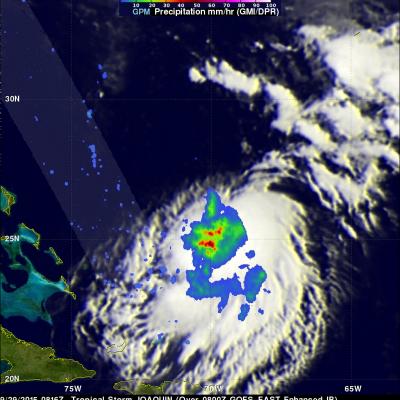
Tropical Storm Joaquin became the 10th named storm of the season after forming late last night (EDT) in the western Atlantic midway between the Bahamas and Bermuda from what was previously a tropical depression (#11), which itself had formed a day earlier from an area of low pressure that had been lingering in the region since Saturday. GPM captured this image of Joaquin early this morning at 8:16 UTC (4:16 am EDT) on the 29th of September as the storm was slowly drifting westward about 390 miles east of the northern Bahamas. The image shows rain rates derived from the GPM GMI (outer swath)
Tropical Storm Marty Tries to Strengthen South of Mexico

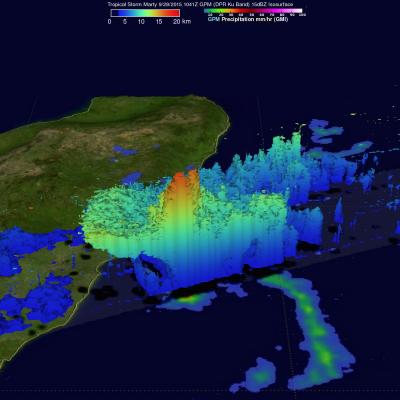
Tropical Storm Marty, which formed into an depression from an area of low pressure about 300 miles southwest of Acapulco, Mexico Saturday afternoon (local time), has been trying to strengthen while drifting slowly northward toward the southwest coast of Mexico. This first image was captured by NASA's GPM core satellite at 00:11 UTC 27 September (7:11 pm CDT 26 September) just a few hours after Marty had formed into a tropical depression. GPM shows substantial areas of rain on the eastern half of the storm, but more importantly, there is already evidence of curvature and banding within those

GPM Monitors New Tropical Storm Niala

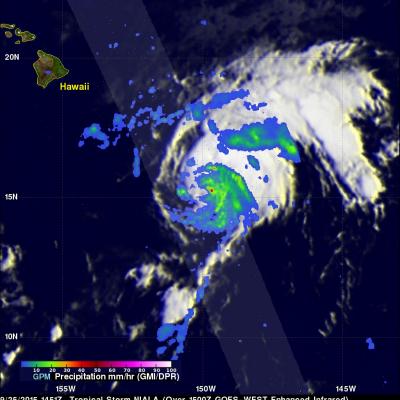
The GPM core observatory satellite flew directly above newly formed tropical storm NIALA (06C) on September 25, 2015 at 1451 UTC (4:41 AM HST). Rainfall data were collected by GPM's Microwave Imager (GMI) and Dual-Frequency Precipitation Radar (DPR) instruments showing that intense storms just northeast of NIALA's center of circulation were dropping rain at a rate of over 126 mm (4.96 inches) per hour. Another rain band wrapping around NIALA's northeastern side was found to contain rain falling at a rate of over 56 mm (2.2 inches) per hour. 3-D radar reflectivity data collected by GPM's radar

Ida Weakened by Strong Shear in the Atlantic

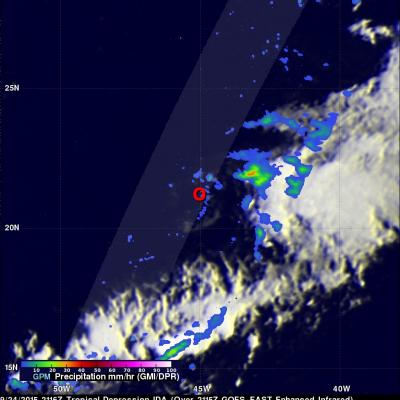
Tropical Depression Ida has struggled to maintain itself in the Central Atlantic well east of the Leeward Islands where it has been ravaged by strong wind shear. Since forming back on the 18th of September, Ida has not been able to strengthen beyond a moderate tropical storm, reaching a peak intensity of 45 knots (50 mph) early on the morning of the 21st before succumbing to the effects of strong northwesterly winds from an upper-level trough. Since that time, Ida has struggled maintain itself between a depression and a weak tropical storm, while being mired in the Central Atlantic. This most

Meandering Ida's Precipitation Measured By GPM

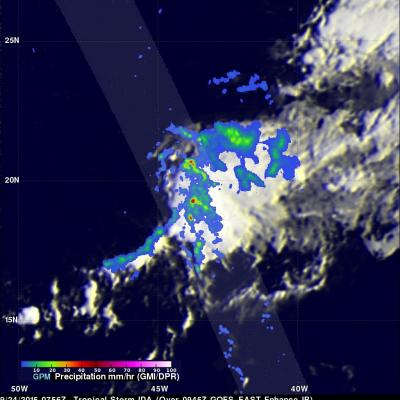
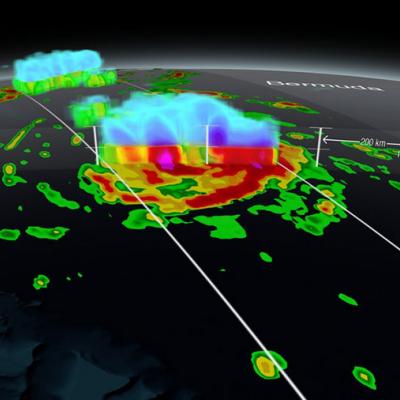
The GPM core observatory satellite had another good view of meandering tropical storm Ida located in the central Atlantic Ocean on September 24, 2015 at 0756 UTC (3:35 AM EDT). Measurements of precipitation by GPM's Microwave Imager (GMI) and Dual-Frequency Precipitation Radar (DPR) instruments showed that Ida still contained a few embedded strong convective thunderstorms that were dropping heavy rainfall. Some rainfall was measured by GPM's Ku Band radar falling at a rate of 122 mm (4.8 inches) per hour. GPM's 3-D radar reflectivity data (DPR Ku band) can be used to reveal the intensity of
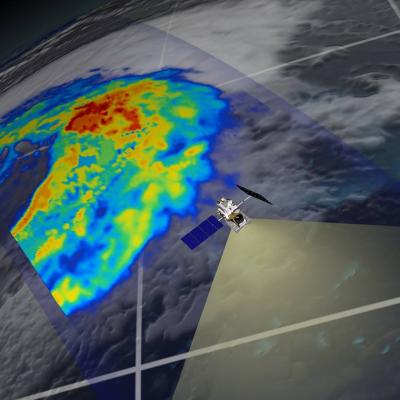
GPM flying over Earth with a data swath visualized.
LOADING Daily Precipitation 2mm 3mm 5mm 8mm 13mm 21mm 34mm 55mm 89mm 144mm 233mm 377mm Source: GPM Select Date: Select Dataset: GPM 30 Minute GPM 3 Hour GPM 1-Day GPM 3-Day GPM 7-Day Floods Nowcast Load Data Advanced Options Secondary Dataset: Floods Nowcast Subset Data to Viewport? (saves bandwidth) Dataset Info: Preview Image: - Downloads: - - - - - Search Locations Go Find Me Jump to Region North America South America Europe Africa Northern Asia Southern Asia

GPM Gets a Ton of Kilo

Submitted by JacobAdmin on
Video Embed

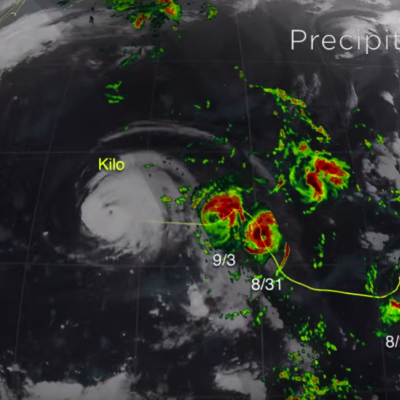
The Global Precipitation Measurement (GPM) mission core satellite provided many views of Tropical Cyclone Kilo over its very long life. GPM is a satellite co-managed by NASA and the Japan Aerospace Exploration Agency that has the ability to analyze rainfall and cloud heights. GPM was able to provide data on Kilo over its 21 day life-span. 

https://www.youtube.com/watch?v=8eIwMXnU8IA&feature=youtu.be
A narrated visualization of Typhoon Kilo. Click here for a full transcript. Click here to download this video in high resolution from the NASA Goddard Scientific Visualization Studio. The Global Precipitation Measurement (GPM) mission core satellite provided many views of Tropical Cyclone Kilo over its very long life. GPM is a satellite co-managed by NASA and the Japan Aerospace Exploration Agency that has the ability to analyze rainfall and cloud heights. GPM was able to provide data on Kilo over its 21 day life-span. The GPM core observatory satellite flew over Kilo on August 25, 2015 at...

GPM Sees Powerful Storms Within Tropical Storm Ida

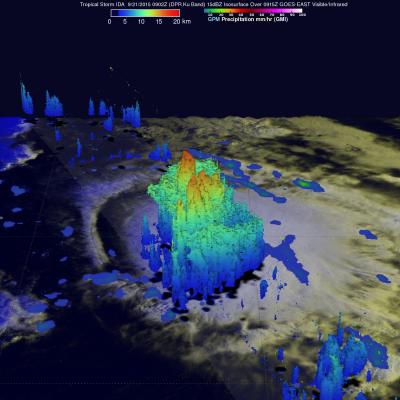
The GPM core observatory satellite found that tropical Storm IDA contained some very powerful convective thunderstorms when the satellite passed over on September 21, 2015 at 0902 UTC (05:02 AM EDT). The satellite passed directly above the most powerful storms within IDA where rain was measured by GPM's Microwave Imager (GMI) and Dual-Frequency Precipitation Radar (DPR) instruments. DPR found that some thunderstorms were dropping rain at a rate of over 142 mm (5.6 inches) per hour. GPM's DPR (Ku Band) radar data were used examine the 3-D structure of precipitation within tropical storm IDA