
Faces of GPM: Dr. Dalia Kirschbaum, GPM Applications Scientist

Submitted by JacobAdmin on
Video Embed

Dr. Kirschbaum discusses her role with GPM, how she became a scientist, and how remotely sensed satellite data can be used to study and evaluate natural hazards such as landslides.

This video is the first in a series called "Faces of GPM", which will interview several GPM team members to learn what it is like to be a NASA scientist or engineer.


Video Text:

Faces of GPM: Professor Steve Nesbitt, GPM Ground Validation Scientist

Submitted by JacobAdmin on
Video Embed

Profile of Steve Nesbitt, a professor of Atmospheric Sciences at the University of Illinois and a mission scientist on GPM ground validation field campaigns. Nesbitt uses the data collected to improve the representation of cloud microphysical processes using radars, aircraft probes, and surface instrumentation in satellite precipitation algorithms to improve global precipitation estimates.

Learn more about Faces of GPM

Video Text: 

GPM Core Observatory Completes Comprehensive Performance Testing

The GPM spacecraft oriented for inspections after its arrival in the clean room at Tanegashima Space Center. Image Credit: NASA / Michael Starobin On Dec. 15, the Global Precipitation Measurement Core Observatory team completed the post-shipment Comprehensive Performance Test with no significant problems. The testing took seven days to run through each of the spacecraft's systems and subsystems to ensure that the satellite is ready for space. The testing took place at GPM's launch site at Tanegashima Space Center in Japan, and was the first time all systems had been turned on since GPM's

Intensifying Tropical Cyclone Bruce

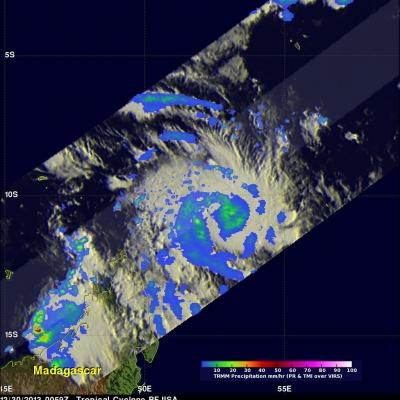
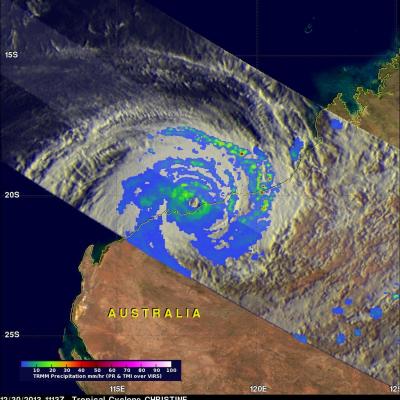
A powerful tropical cyclone called Bruce formed quickly after tropical cyclone Amara in the south Indian Ocean. Intensifying Tropical cyclone Bruce had winds of over 90kts (~103.5 mph) When the TRMM satellite passed over head on December 19, 2013 at 1800 UTC. A rainfall analysis from TRMM's Microwave Imager (TMI) and Precipitation Radar (PR) instruments is shown on the left overlaid on an enhanced infrared image from TRMM's Visible and InfraRed Scanner (VIRS). Bruce was found to have a well defined eye with rain falling at a rate of over 115 mm/hr (~4.5 inches). TRMM PR sliced through the