
Interactive visualization by Matt Lammers (KBRwyle / NASA GSFC)

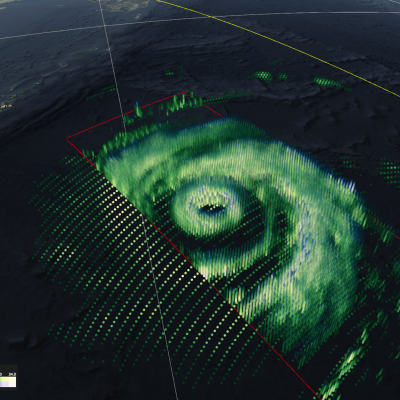
GPM Views Super Typhoon Maria Near Guam

View full screen in STORM Event Viewer. Rapidly intensifying after its genesis near Guam, Super Typhoon Maria featured winds near 130 knots as it spiraled through the waters of the Western Pacific Ocean. The DPR scan indicates deep convection in several parts of the outer bands, with the most intense precipitation rates from GMI concentrated in the eyewall. Maria is expected to continue intensifying over the next three days, then weaken slightly as it crosses through the Ryukyu Islands, possible near Okinawa. The long range forecast has it making landfall in Northern China, possibly still as a

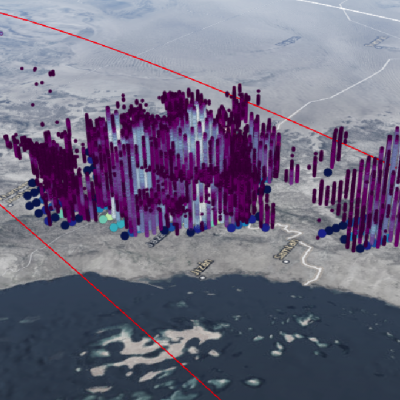
GPM Radar Views Powerful Convective Storms over Saudi Arabia

V iew full-screen in STORM Event Viewer Saudi Arabia is not thought of as a region rife with intense thunderstorms, but its southwestern region features an abrupt orographic incline from the Red Sea coast toward the interior. Here, warm moist air can be forceably lifted up the slope of the Sarawat Mountains resulting in torrential downpours and flash flooding. In this overflight, we see an occasion of this, with DPR cloud top heights up to 20km and 89 GHz brightness temperatures near 55K, suggesting the likelihood of hail within the deep convective plume.

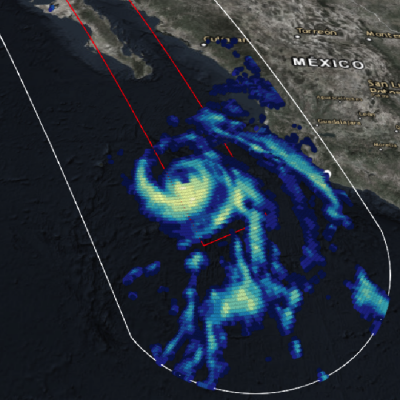
GPM Flies Over Hurricane Bud off the Coast of Mexico

View full-screen in STORM Event Viewer The GPM core observatory satellite passed above hurricane BUD in the eastern Pacific Ocean on June 12, 2018 at 5:27 PM MDT (2327 UTC). BUD's movement over colder waters had caused it's eye to become less defined. Data collected by GPM's Microwave Imager (GMI) showed that moderate to heavy precipitation was only present in the southeastern quadrant of the weakening hurricane. GPM's GMI also indicated that the heaviest rainfall in the area, of over 78 mm (3.1 inches) per hour, was occurring near Mexico's coastline well to the northeast of BUD's center of

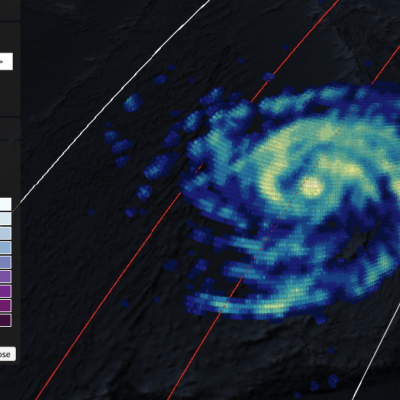
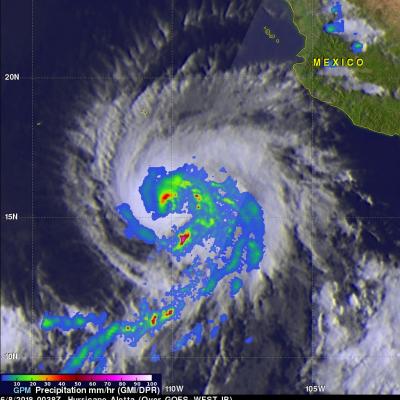
GPM Flies Over Intensifying Hurricane Aletta

As expected, tropical storm Aletta intensified and became a hurricane. Aletta was a powerful hurricane with winds of about 85 kts (98 mph) when the GPM core observatory satellite passed over head on June 7, 2018 at 18:38 PM MDT (June 8, 2018 at 0038 UTC). GPM's Microwave Imager (GMI) and Dual Frequency Precipitation Radar (DPR) instruments showed that hurricane Aletta contained powerful storms that were producing heavy precipitation. Very strong convective storms were producing heavy rainfall in Aletta's eye wall while the most extreme downpours were shown in a large feeder band wrapping

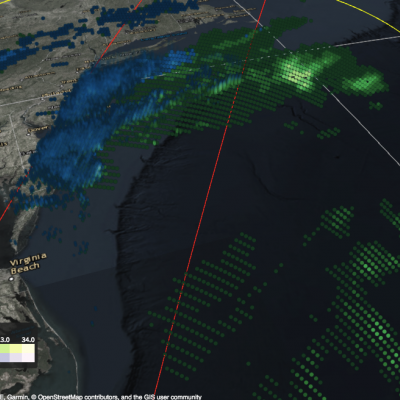
GPM Sees Fourth Nor'easter of 2018

More than 90,000 customers were without power overnight after another major nor’easter — the fourth in three weeks — pummeled areas of the U.S. east coast with as much as 19 inches of snow on the first full day of spring. GPM collected this precipitation data as it flew over the storm the evening of Wednesday March 21st, 2018 at 6:04pm ET.

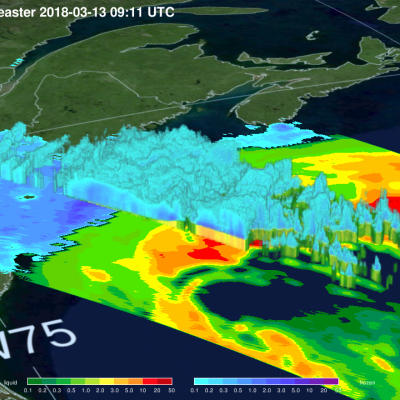
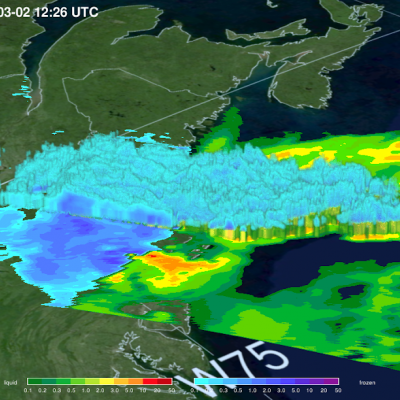
GPM Views Snow in Third Nor'easter of 2018

The GPM Core Observatory satellite flew over a powerful winter storm early on the morning of Tuesday March 13th, 2018, the third such "Nor'easter" to hit the U.S. east coast this year. GPM's Dual-frequency Precipitation Radar took 3D measurements as it flew over the storm, which show the boundary between liquid (green / yellow / red) and frozen (blue) precipitation. The storm is expected to last through most of Tuesday, disrupting road and air travel. Image and caption by Jacob Reed (Telophase / NASA GSFC

GPM Sees Tropical Cyclone Kelvin Develop Cloudless Eye After Landfall in Australia

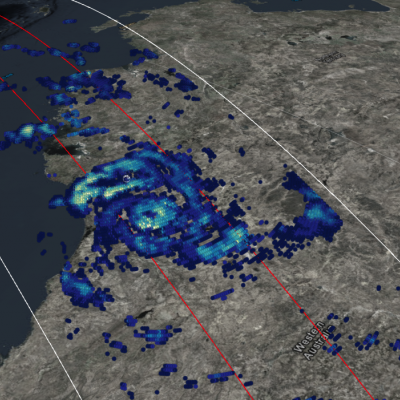
Tropical Cyclone Kelvin struck Northwestern Australia with winds reaching 54 knots as it crossed the Kimberley Coast. It brought flooding rains and damaging winds to the settlements and mining companies of the region. The storm intrigued meteorologists as it only developed a cloudless eye after making landfall, believed in part due to the heat flux generated by the warm desert the storm traveled over. View this visualization in full screen using STORM Event Viewer

Intensifying Hurricane Irma Checked By GPM Satellite

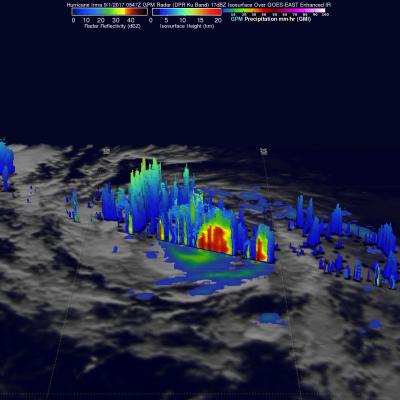
After forming in the eastern Atlantic Ocean on Wednesday tropical storm Irma strengthened and became a powerful category three hurricane on Thursday August 31, 2017. Hurricane Irma was moving west-northwestward with winds of about 115 mph (100 kts) when the GPM core Observatory satellite saw it on September 1, 2017 at 1:47 AM AST (0547 UTC). Data collected by GPM's Microwave Imager (GMI) and Dual-Frequency Precipitation Radar (DPR) instruments showed the locations and intensity of heavy precipitation within the hurricane. GPM's Radar (DPR Ku band) found that a powerful convective storm in a