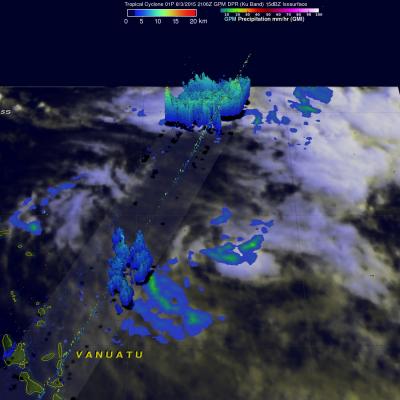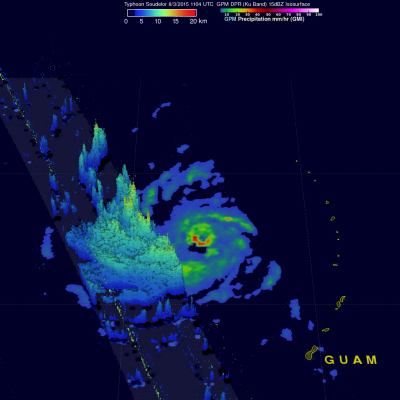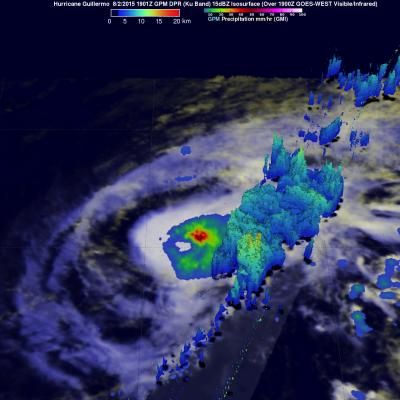

Hurricane Guillermo Heads Toward Hawaii

On July 29, 2015 tropical depression Nine-E formed in the eastern Pacific Ocean well southwest of the southern tip of Baja California. The tropical depression was in an area of warm ocean water which helped the tropical cyclone blossom into tropical storm Guillermo early on July 30, 2015. Guillermo is a hurricane today and is headed over the open waters of the Pacific Ocean toward the west-northwest. In about a week Guillermo may affect the Hawaiian Islands as a tropical storm. On July 31, 2015 at 0556 UTC Guillermo was about 319 km (~590 Nautical Miles) east-southeast of Hilo, Hawaii when the

GPM Sees Tropical Cyclone Drenching Bangladesh

Bangladesh was already soaked by monsoon rainfall before recently formed tropical storm Komen started drenching the area. The GPM core observatory satellite collected data above the tropical cyclone on on July 30, 2015 at 0436 UTC ( 10:36 AM BDT). GPM's Microwave Imager (GMI) measured rain falling at the extreme rate of close to 150 mm (5.9 inches) per hour in powerful storms over the Bay Of Bengal. A 3-D view of thunderstorm tops based on radar reflectivity day from GPM's Dual-Frequency Precipitation Radar (DPR) is shown here. DPR (Ku band) radar data were used in this simulated cross section

PPS Data Outage

Effective about 18 UTC July 21 the GPM MOC stopped sending data to the PPS. This was not a satellite or instrument issue. The problem appeared to be a network connection issue at the Emergency MOC which is currently receiving data as part of a monthly test of the backup facility. Effective 21:41 UTC the data flow from the MOC to PPS resumed. Apparently there was a major network issue on that part of the network. It has now been fixed and MOC is sending data again.

Delay in Some GMI and Combined

Starting at 16:33 UTC July 6 a filled log directory led to sh commands failing on redirecting logs to be created in that directory. A typo in the cleanup routine failed to clean our all the files after the normal 4 days. As a result they have been accumulating since the beginning of the mission. It is unexpected that the sh failed when it could not redirect anymore. All data products that failed have been created and put in the appropriate directories. However, this will mean a failure in the data latency requirements for some of the GMI L1B and GPROF and a few combined products.