
Typhoon Noul Beginning to Strengthen in the West Pacific

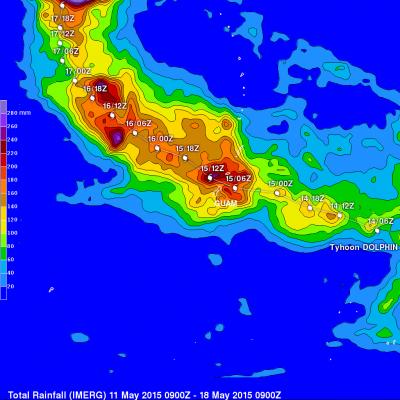
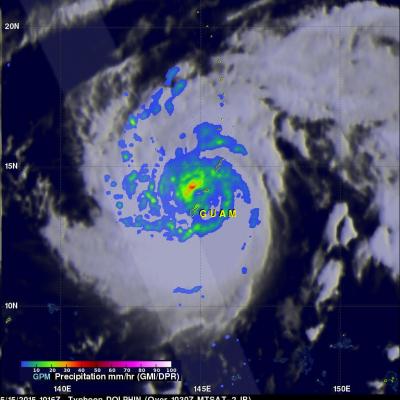
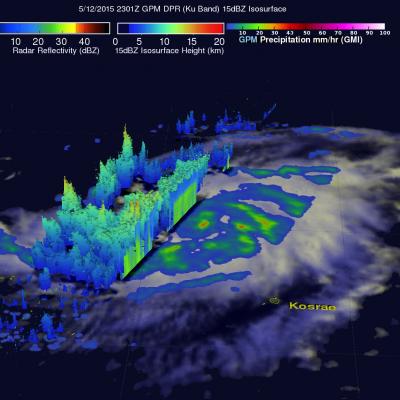
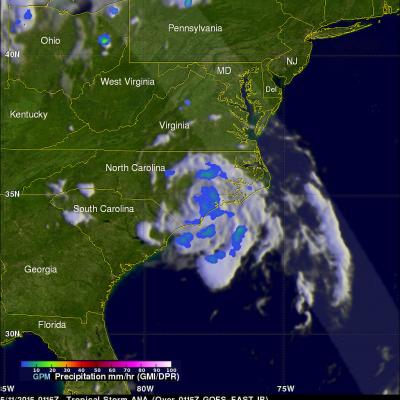
Since its formation as a tropical depression 3 days ago, Typhoon Noul has taken on a general westward motion while steadily working its way across the central-west Pacific. During this time, the system passed over Yap where it brought heavy rain and strong gusty winds. Thus far, Noul has been only slowly strengthening, becoming a minimal typhoon just one day ago. That appears likely to change, however, as the system now seems poised to intensify as it passes well north of Palau in the genearal direction of the Philippines. NASA's GPM Core observatory satellite captured this image of Noul as it

NASA IMERG Sees Australia's Bicoastal Rainfall

The rainfall accumulation analysis above was computed from data generated by the Integrated Multi-satellite Retrievals for GPM (IMERG) during the period from April 28 to May 3, 2015. During this period IMERG algorithms continuously merged and interpolated satellite passive microwave precipitation estimates and microwave-calibrated infrared (IR) satellite estimates over the entire globe. Rainfall from cyclone Quang fell over the west coast and a non-tropical system pounded the east coast of Australia simultaneously during the past weekend. Cyclone Quang formed in the South Indian Ocean

Recent 3B41RT and 3B42RT Files Reprocessed

NOAA has reprocessed the global IR data for 10 UTC 26 April through 14 UTC 27 April due to dropped images, and all 3B41RT and 3B42RT files for this time period have been reprocessed by PPS and are now available: 3B41RT.2015042610.7.bin.gz through 3B41RT.2015042714.7.bin.gz 3B42RT.2015042612.7.bin.gz through 3B42RT.2015042715.7.bin.gz Such partial dropouts in the IR data result in somewhat lower quality for IMERG Early and Late Runs, but are not cause for reprocessing.

GPM Sees Weekend Texas Tornadoes

Stormy spring weather over the Southwest popping up during the past weekend with at least twenty tornadoes sightings over Texas on Sunday April 26, 2015. The GPM core Observatory satellite had a good view of severe storms developing yesterday through central Texas when it flew over at 2134 UTC (4:42 PM CDT). Large hail and heavy rainfall was associated with some of these storms. This image shows a 3-D view of severe weather over Texas using data from the first space-borne Ku/Ka-band Dual-frequency Precipitation Radar (DPR) on board the GPM Core Observatory satellite. Ku Band radar from this

Scheduled NASA Network Outage Sunday 4/26/15

On Sunday, April 26, 2015, between the hours of 12 noon (17 UTC) and 12 midnight EDT (05 UTC April 27) , changes will be implemented to NASA’s Internet access. The purpose of this outage is to complete the Corporate Route Symmetry Project which is being implemented by the Communications Services Office (CSO). As a result of these changes, users can expect an outage to the below services during this time period. Services Affected: On Sunday, April 26, 2015, changes to NASA’s Internet Access will have the following impacts: Internet access to/from all NASA networks External Virtual Private