
GMI Production Halted for Deep Space Calibration

On December 8, 2014 and December 10, 2014 the GPM MOC will conduct deep space calibrations maneuvers that will assist in physically verifying GMI calibration changes and also help in further characterization of the GMI instrument itself. Special processing is required for the data collected during the DSC. Therefore, PPS production of Standard GMI products will be halted on Dec 8 at 20:30 UTC. Processing will resume during normal business hours on Dec 9. On December 10, the maneuver is scheduled to begin at 12:00 UTC. Depending on the arrival of the DSC data processing may again be halted

GPM Core Observatory Sees Hagupit's Eye

The GPM satellite flew almost directly above dangerous typhoon Hagupit on December 5, 2014 at 1032 UTC as the typhoon was approaching the Philippines. The GPM Microwave Imager (GMI) instrument measured rain falling at a rate of over 76 mm (almost 3 inches) per hour in the typhoon's eye wall. This 3-D view of Hagupit's precipitation structure was made using data from the Ku band on GPM's dual frequency radar instrument (DPR). DPR showed that some tall thunderstorm in Hagiput's eye wall were reaching heights of almost 15 km (about 9.3 miles). Click here to see a Low Resolution 640x360 simulated

Super Typhoon Hagupit Threatens Philippines

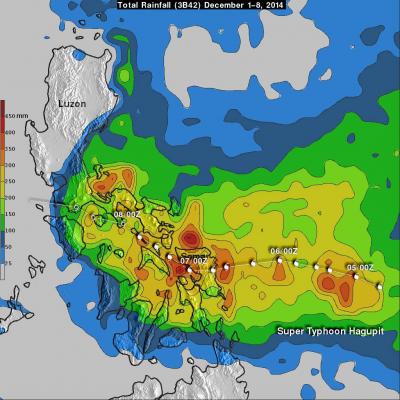
Super Typhoon Hagupit is threatening the Philippines a little over a year after deadly Super Typhoon Haiyan devastated the island nation in November 2013. Hagupit was weakening slightly from peak wind speeds of 155 kts (178 mph) when the GPM core observatory satellite passed over on December 4, 2014 at 2304 UTC in the image shown above. Hagupit had winds of about 125 kts (144 mph) when viewed by the TRMM satellite on December 5, 2014 at 0308 UTC in the image shown below. Rainfall data from these satellites are shown overlaid on daylight views from the MTSAT-2 satellite captured at close to the

Updated GPM Radiometer Products

The Precipitation Processing System (PPS) has begun producing updated GPM radiometer products as of 12/4/2014 due to an error discovered in the calculation of the Sun Angle in the PPS Geolocation Toolkit. This is considered a minor update with the Product Version being incremented in letter only. Please see the list of affected products here: http://pps.gsfc.nasa.gov/Documents/GPM_PPS_SunAngle_Products_20141204.p… For most radiometers the sun angle is used as ancillary information, but for the TRMM microwave imager (TMI) the correction also slightly impacts brightness temperature and

TRMM Precipitation Radar Data Suspended

The TRMM satellite is descending, and the users of TRMM Precipitation Radar (PR) data should be aware that the last production orbit of public PR data was orbit #96230 from October 7th, 2014. From that point forward, the TRMM PR data is suspended because no useful cloud data are being observed. It is possible that PR data will again be made available when TRMM descends to the vicinity of its at-launch altitude of 350 km. TRMM Microwave Imager (TMI) data will continue to be produced and publicly available during the descent of the spacecraft until it reaches its decommissioning altitude of