
Hurricanes

TRMM Views Irene Again Over Cape Hatteras
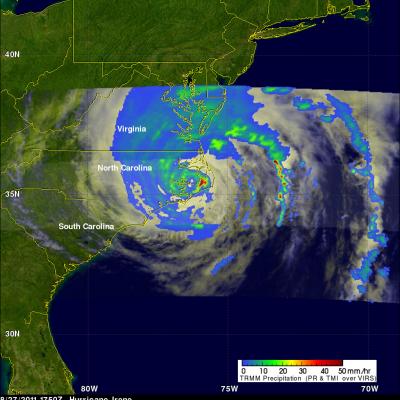
The TRMM satellite had another very good daytime view of hurricane Irene on 27 August 2011 1750 UTC (1:50 PM EDT). The rainfall analysis shown on the right was derived from TRMM's Microwave Imager (TMI) and Precipitation Radar (PR) data. It clearly shows the location of Irene's eye and the intense rainfall falling over Cape Hatteras east of the eye. Click here to see this image in Google Earth (kml).
TRMM sees Irene Approaching The Carolinas Coast

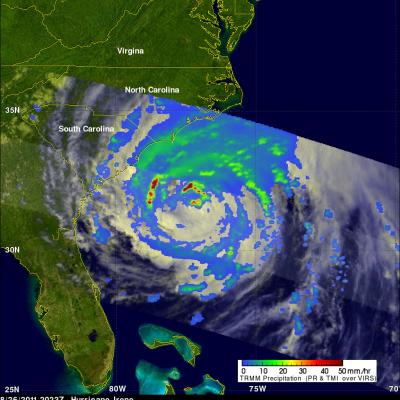
The TRMM satellite saw hurricane Irene again on 26 August 2011 at 2023 UTC (4:23 PM EDT) when winds had weakened to about 85 kts (~98mph). This TRMM pass showed no clear eye but bands of heavy rainfall north of the center. Irene was predicted by the NHC to weaken a little more before coming ashore in North Carolina. See the 26 August 2011 2023 UTC image in Google Earth (kml).

Hurricane Irene Passes Through Bahamas and Heads Toward Cape Hatteras

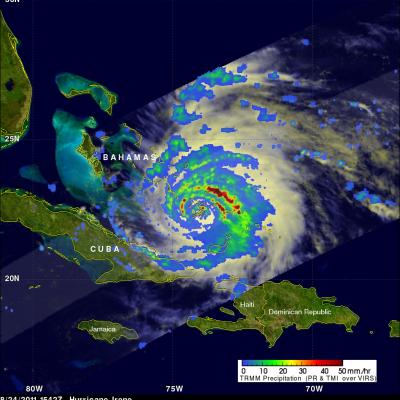
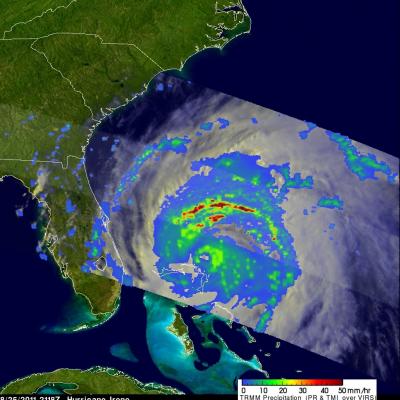
Hurricane Irene was seen affecting the Bahamas twice during the daytime by the TRMM satellite on Thursday 25 August 2011 at 1624 UTC ( 12:24 PM EDT) and at 2118 UTC ( 5:17 PM EDT). A rainfall analysis from TRMM's Microwave Imager (TMI) data shows that Irene's eye had moved to the north of the islands of the Bahamas by the second pass. TRMM' Precipitation Radar (PR) data shows that at this time Irene contained bands of intense thunderstorms dropping rain at the rate of over 50 mm/hr (~2 inches) north of the hurricane's eye. Irene weakened slightly today (Friday) from a category 3 to a strong
TRMM image of hurricane Irene intesifying as it nears the Bahamas
UPDATE: Monday, August 29th, 2011 Irene Drenches Northeastern United States UPDATE: Friday, August 26th, 2011 Irene Passes Through the Bahamas, Heads Towards Cape Hatterus Wednesday, August 24th, 2011 After becoming a small hurricane while passing over Puerto Rico, Irene re-emerged over the warm, open waters of the western Atlantic northwest of the Dominican Republic on the morning of August 22nd. The storm quickly showed signs of intensifying as deep convective towers arose near the center of Irene, releasing heat into the core of the system. In response, Irene's central pressure fell and...

Irene Gathers Strength, Takes Aim at the Bahamas

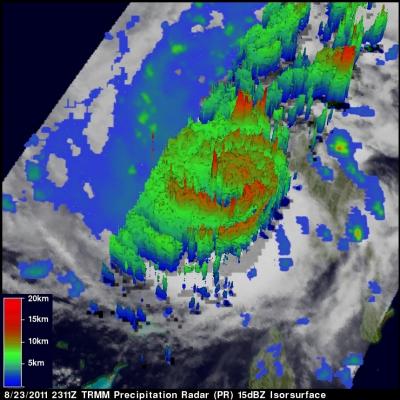
After becoming a small hurricane while passing over Puerto Rico, Irene re-emerged over the warm, open waters of the western Atlantic northwest of the Dominican Republic on the morning of August 22nd. The storm quickly showed signs of intensifying as deep convective towers arose near the center of Irene, releasing heat into the core of the system. In response, Irene's central pressure fell and winds intensified, making it a Category 2 storm on the Saffir-Simpson hurricane intensity scale with sustained winds reported at 85 knots (~100 mph) by the National Hurricane Center by the end of the day

TRMM Gets a Look at Irene, the First Hurricane of the Atlantic Season

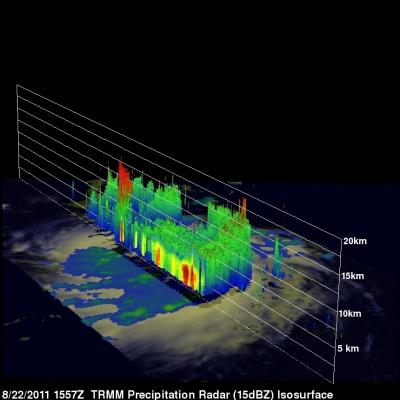
It's been a busy season so far in terms of tropical storms with seven named storms already in the Atlantic basin; however, none of them have had a very large impact as they have either been small, short-lived or remained at sea and none of them have intensified into a hurricane until now. Irene, which originated from a tropical wave that propagated off the west coast of Africa, became the 8th named storm of the season as it approached the Lesser Antilles on the 20th of August and the first hurricane of the season as it was passing over Puerto Rico on the morning of the 22nd. Now back over open

TRMM Views Hurricane Dora

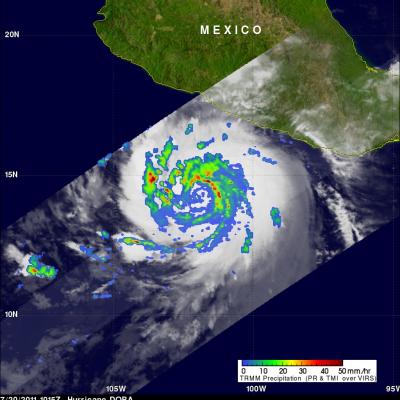
The TRMM satellite had an excellent view of hurricane Dora in the eastern Pacific Ocean southwest of Mexico when it passed over on 20 July 2011 at 1015 UTC. Dora is predicted to become a powerful category 3 hurricane but stay well off the Mexican coast.

TRMM Sees Adrian's Eye

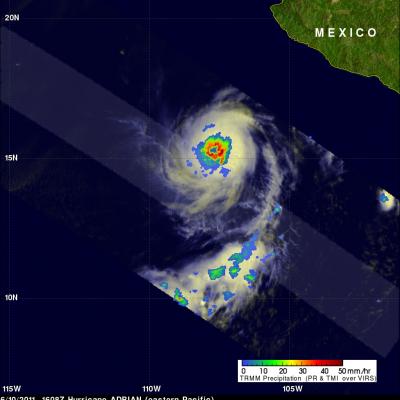
Hurricane Adrian's eye was clearly seen by the TRMM satellite when it passed over on 10 June 2011 at 1608 UTC. The heavy rainfall completely surrounding Adrian's well defined eye was revealed with TRMM Microwave Imager (TMI) data obtained at the same time. Hurricane Adrain, located southwest Mexico , was classified as a dangerous category 4 on the Saffir-Simpson scale with sustained wind speeds estimated at 115 kts (~132 mph).

Adrian now a Powerful Hurricane

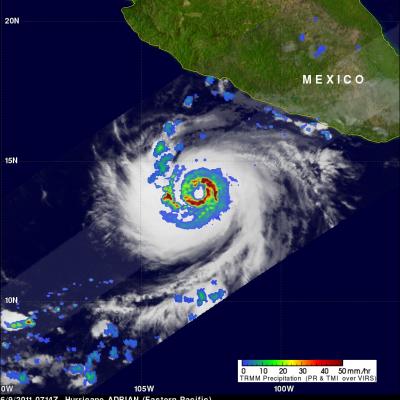
The TRMM satellite captured data used in this dramatic image of Hurricane Adrian when it passed directly above on 9 June 2011 at 0714 UTC. The increasingly powerful hurricane had sustained winds estimated to be close to 80 kts (~92 mph) at the time of this pass. TRMM's Precipitation Radar (PR) instrument revealed that beneath the clouds there were intense thunderstorms dropping rain at a rate of over 50 mm/hr (~2 inches) in a nearly circular eye wall. The PR also indicated that some thunderstorms in the eye wall were shooting up to heights above 15 km (~9.3 miles). Click here to see a