
GPM

GPM content

GPM Passes Over New Tropical Storm Blanka
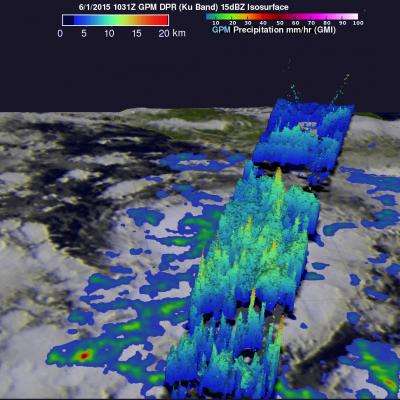
Today a new tropical storm called Blanka formed in the eastern Pacific Ocean off southwestern Mexico. The GPM core observatory satellite flew over the forming tropical storm on June 1, 2015 at 1031 UTC (5:31 AM CDT). Rainfall data collected by GPM's Microwave Imager (GMI) and Dual-Frequency Precipitation Radar (DPR) instruments are shown The location of Blanka's center of circulation within a large area of convective thunderstorms was clearly outlined by GPM's GMI derived rainfall. A 3-D view derived from DPR's Ku Band radar data shows that several areas of intense rainfall were located east
First 2015 Tropical Storm Forms In Eastern Pacific

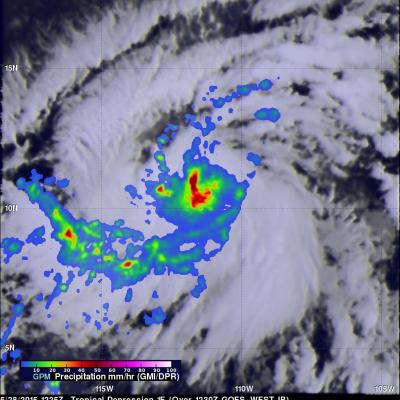
Tropical storm Andres became the first tropical storm of the the 2015 Eastern Pacific hurricane season today at 1500 UTC (9 AM MDT). The GPM core observatory satellite flew over the intensifying tropical cyclone (TD1E) at 1225 UTC ( 6:25 AM MDT). Rainfall data from GPM's Microwave Imager (GMI) and Dual-Frequency Precipitation Radar (Ku Band) instruments are shown overlaid on an enhanced GOES-EAST satellite infrared image received at 1230 UTC (6:30 AM MDT). Rain was found by GMI to be falling at a rate of over 60 mm (2.4 inches) per hour in powerful convective storms near Andres' center. Data

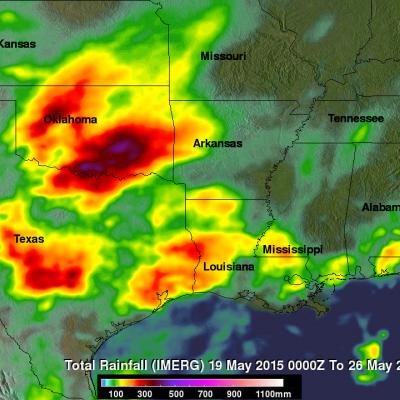
Severe Flooding Hits Central Texas, Oklahoma

A stagnant upper-air pattern that spread numerous storms and heavy rains from central Texas up into Oklahoma has resulted in record flooding for parts of the Lone Star State. One of the hardest hit areas was in Hays County Texas south of Austin where the Blanco River rose rapidly and set a new record crest at over 40 feet, 13 feet above flood stage, following a night of very heavy rain in the area, with over 12 inches reported locally in a short period of time, in an area already wet from previous storms. The combination of high pressure over the southeastern United States and a persistent

Typhoon Dolphin Weakening after Drenching Guam

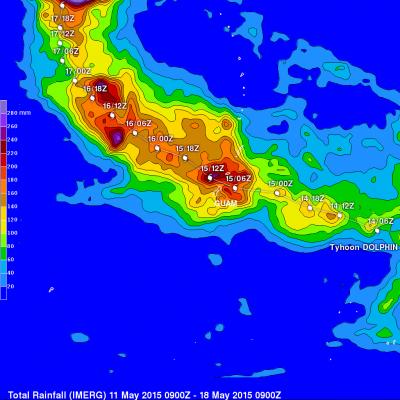
Typhoon Dolphin battered and drenched the islands of Guam and Rota as it passed over the channel between them last Saturday. Luckily for Guam, Dolphin's most powerful winds occurred after passing to the northwest of Guam. By May 16, 2015 Dolphin had winds estimated at 140 kts (161 mph) making it a category five super typhoon on the Saffir-Simpson hurricane wind scale. The GPM core observatory satellite flew above the weakening typhoon early this morning when winds had dropped to less than 100 kts (115 mph). GPM's Microwave Imager (GMI) found that Dolphin was dropping rain over the open waters
Engaging Citizen Scientists With GPM
Every morning at seven, Andrew Welch wakes up, cooks breakfast and checks the rain gauge sitting on a five-foot post in his backyard. He writes down the measurement, sends his kid off to school and then heads out to his workplace as a structural engineer. Welch is a citizen scientist. Around the world, hundreds of citizen scientists like him are collecting precipitation measurements from the ground that are useful for NASA’s Global Precipitation Measurement (GPM) mission. CoCoRaHS volunteers stand with Dr. Walt Petersen, far left, Dr. Jackson Tan, third from right, and Dr. Tiffany Moisan, far...

IMERG Dataset Back Online

The issues with NOAA's 4-km Merged IR data are closed and the IMERG Early and Late Runs have been restarted from the point at which they stopped. This will provide a continuous record for each, but it also means that it will take a while to process the backlog of data and catch up to the nominal latency.
GPM flying over Earth with a data swath visualized.
Deputy Project Manager, Global Precipitation Measurement (GPM) NASA/Goddard Space Flight Center Candace Carlisle has been the GPM Deputy Project Manager at NASA's Goddard Space Flight Center since 2006. Prior to GPM, she spent five years on the Space Technology 5 (ST5) project, first as Mission Systems Engineer, then as Deputy Project Manager. The ST5 spacecraft, as well as the launch vehicle support structure and deployment mechanisms, were built, tested, and operated in-house at Goddard. Candace’s previous experience includes six years on the Earth Science Data and Information System (ESDIS)...
GPM flying over Earth with a data swath visualized.
Project Manager, Global Precipitation Measurement (GPM) NASA/Goddard Space Flight Center Ardeshir (Art) Azarbarzin has been the Project Manager of GPM since 2006. Art obtained his college education from the University of Illinois, where he graduated with a B.S. in Electrical Engineering in 1978 and followed with a M.S. in Aeronautical & Astronautical Engineering in 1980. He began his career at Sundstrand Aviation, as the Design/Project Engineer for Cessna Jet Electro-mechanical Flap Actuation Project. Following that, he was the Systems Engineer for the C-130 Aircraft High Technology Test Bed...

TRMM Spacecraft Re-Entry

June 16, 2015, Update: The Tropical Rainfall Measuring Mission (TRMM) spacecraft re-entered the Earth’s atmosphere on June 15, 2015, at 11:55 p.m. EDT, over the South Indian Ocean, according to the U.S. Strategic Command’s Joint Functional Component Command for Space through the Joint Space Operations Center (JSpOC). The U.S. Space Surveillance Network, operated by the Defense Department's JSpOC, had been closely monitoring TRMM’s descent since the mission was ended in April. Most of the spacecraft was expected to burn up in the atmosphere during its uncontrolled re-entry. Learn more. ----