
TRMM

TRMM Content

Tropical Cyclones over Australia

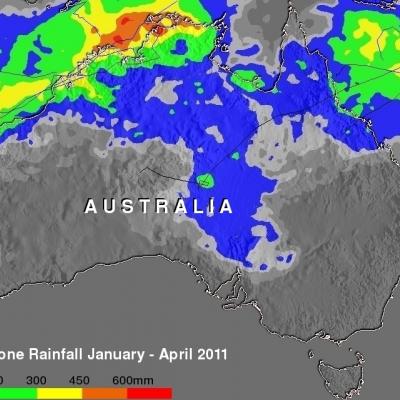
TRMM-based, near-real time Multi-satellite Precipitation Analysis (TMPA), data were used in the analysis above to show rainfall contributed by tropical cyclones that have affected Australia in 2011. The tracks of tropical cyclones are shown with thin black lines. The largest tropical cyclone rainfall contribution was over the coast of northwestern Australia with estimated totals of over 600 Millimeters (~23.6 inches). Cyclones Bianca, Carlos, Twenty, Errol and their remnants were close enough to the northwestern coast of Australia to add to these rainfall totals. Cyclones Zelia, Anthony and

Tropical Cyclone Errol Near Australia

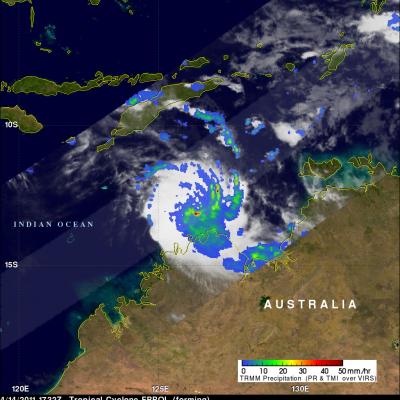
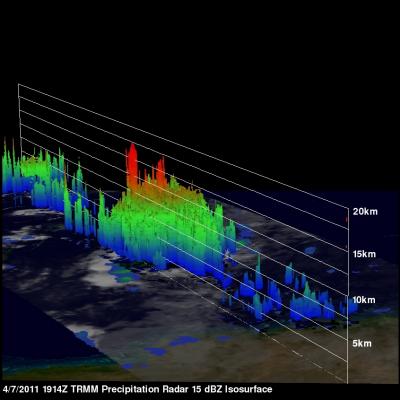
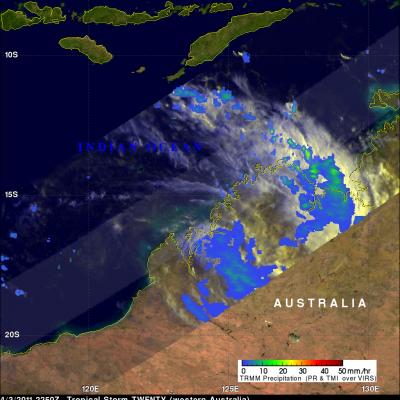
The South Indian Ocean tropical cyclone season is nearing it's end but another tropical cyclone called ERROL has developed northwest of Australia. The TRMM satellite flew over ERROL when it was getting organized on 14 April 2011 at 1732 UTC. The image on the left above shows an analysis of rainfall using data from TRMM's Microwave Imager (TMI) and Precipitation Radar (PR) instruments. The light swath shows the locations of some heavy thunderstorms as TRMM's PR crossed over ERROL's center of circulation. The image on the upper right shows a 3-D image of these thunderstorms made from those radar

TRMM Examines Another Potential Tropical Cyclone

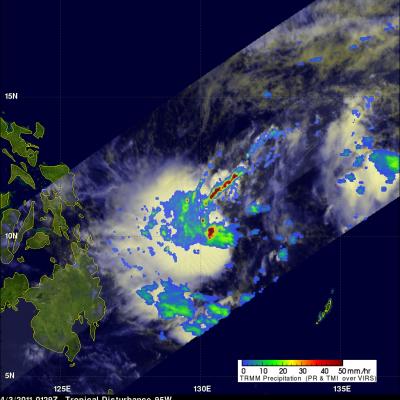
The Tropical Rainfall Measuring Mission (TRMM) satellite was placed into its low-earth orbit in November of 1997. Its primary mission has been to measure rainfall from space. TRMM has provided space borne rain radar and microwave radiometric data that measure the vertical and horizontal distribution of rainfall over the tropics. It has also been valuable for monitoring the development of tropical cyclones, especially over remote parts of the open ocean. The image on the right uses data captured by the TRMM satellite on 7 April 2011 at 1914 UTC. It shows a TRMM satellite view of rain intensity

TRMM Sees Deadly Rainfall over Thailand

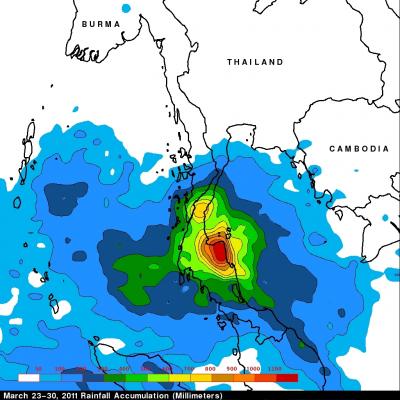
More than 15 people have been killed in Thailand over the past week due to flooding and mudslides caused by extremely heavy rainfall. The Multisatellite Precipitation Analysis (TMPA) analysis above was made using data that were calibrated with TRMM precipitation data. These data are calculated and stored at NASA Goddard Space Flight center and are available within a few hours after being received by satellites. This analysis shows that rainfall for the past week over the Malay Peninsula was particularly extreme with totals of almost 1200 mm (~47 inches). TRMM satellite data revealed that

Tropical Cyclone Bune

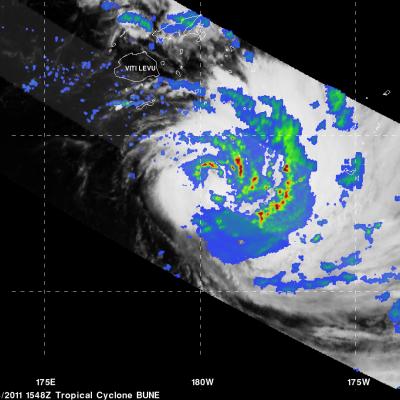
Tropical cyclone BUNE was southeast of the Fiji Islands and close to a category one on the Saffir-Simpson scale when the TRMM satellite passed above on 24 March 2011 at 1548 UTC. TRMM Microwave Imager (TMI) and Precipitation Radar (PR) data from this pass show that large rain bands around BUNE contained numerous intense thunderstorms. BUNE is expected to peak as a category two tropical cyclone with wind speeds of about 85 kts (~98 mph) on 26 March 2011 while moving over the open waters northeast of New Zealand.

TRMM Sees Diminished CHERENO (18S)

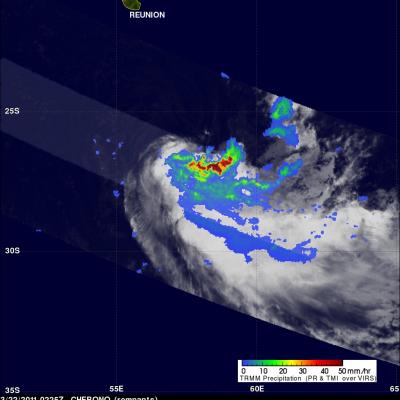
The TRMM satellite passed directly above the remnants of tropical cyclone CHERENO (18S) in the South Indian Ocean on 22 March 2011 at 0225 UTC. TRMM's Microwave Imager (TMI) and Precipitation Radar (PR) show that CHERENO, although weakened, still had some life and was producing very heavy rainfall of over 50 mm/hr (~2 inches) south-southeast of Reunion Island.

Rainfall Near ARANI Subsides

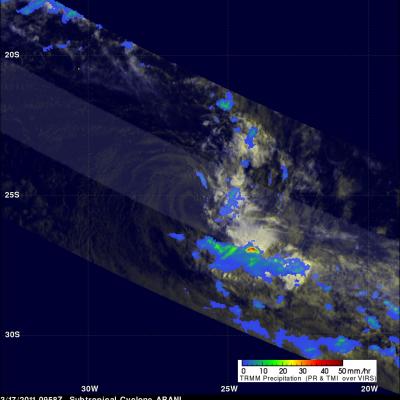
The image above shows subtropical cyclone ARANI as the TRMM satellite passed over head on 17 March 2011 at 0958 UTC. TRMM Microwave Imager (TMI) and Precipitation Radar (PR) data from that orbit show that moderate to heavy rainfall was only occurring to the southeast of ARANI at that time. TMI and PR rainfall data were overlaid on a combination visible and infrared image that used TRMM Visible and InfraRed Scanner (VIRS) data. Visible low level clouds from this image (shown in shades of yellow) are the only evidence for the location of ARANI's center of circulation. Click here to see earlier

TRMM Over Tropical Cyclone 18S

On 17 March 2011 at 0212 UTC the TRMM satellite passed over tropical cyclone 18S that had formed and was intensifying in the open waters of the South Indian Ocean. 18S was already well organized and TRMM's Precipitation Radar (PR) showed that powerful thunderstorm towers were located near 18S' center of circulation. These towers know as chimney clouds release a lot of energy and can serve to strengthen a tropical cyclone. 18S is expected to attain strong tropical storm intensity with wind speeds of at least 55 kts (~63 mph) in the next three days.