
TRMM

TRMM Content

TRMM Sees Strong Thunderstorms in ARANI

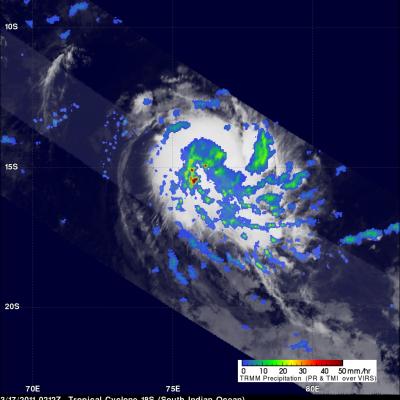
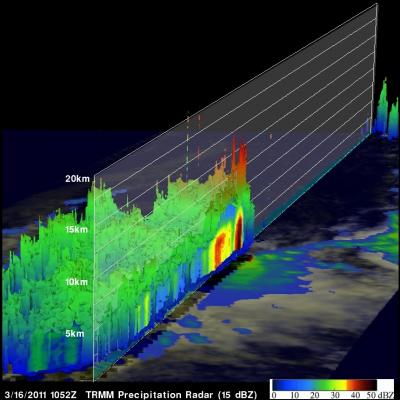
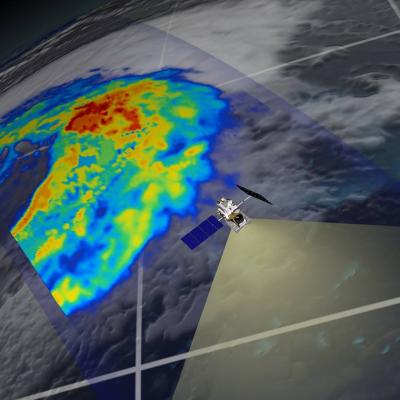
The TRMM satellite had another very good view of subtropical cyclone ARANI in the morning light on 16 March 2011 at 1052 UTC. This orbit showed that there were very heavy thunderstorms in the eastern half of the storm. TRMM's Precipitation Radar (PR) showed that some of these powerful storms were reaching to heights of over 14 km (~8.7 miles) above the surface of the south Atlantic Ocean.

Unusual Cyclone forms in South Atlantic

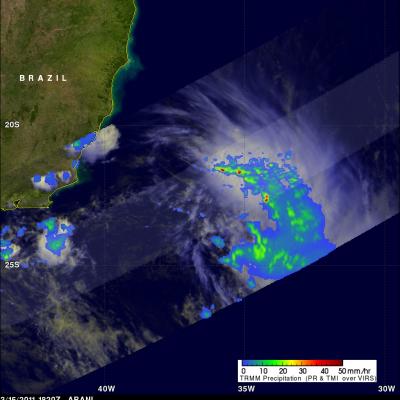
During the daytime on Tuesday 15 March 2011 at 1820 UTC the TRMM satellite flew over a rare cyclone labeled ARANI in the south Atlantic Ocean. ARANI has the appearance of a tropical cyclone but has been classified as a subtropical cyclone. NOAA's Satellite and Information Service classified ARANI as a T1 on the Dvorak intensity scale which would indicate an estimated wind speed of about 29 kts (~33 mph). TRMM's Microwave Imager (TMI) and Precipitation Radar (PR) data were used in the image on the right to show rainfall near ARANI. Tropical cyclones are very rare in the south Atlantic Ocean. In

Analysis of Heavy Rain over the Eastern United States

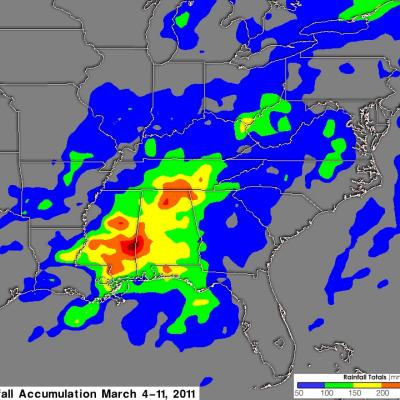
Although the heaviest rainfall over the past week was in the southern United States, flooding was reported in states from Louisiana to northern New York. The rainfall analysis above was made by merging precipitation data from multiple satellites. This Multisatellite Precipitation Analysis (TMPA) analysis used data products that were calibrated with TRMM precipitation data. These data products are calculated and stored at Goddard Space Flight center and are available within a few hours after being received by satellites. This analysis indicates that the greatest total rainfall for the past week
GPM flying over Earth with a data swath visualized.
The CERES instrument The Clouds and the Earth’s Radiant Energy System (CERES) instrument is one of five instruments that is being flown aboard the Tropical Rainfall Measuring Mission (TRMM) observatory. The data from the CERES instrument was used to study the energy exchanged between the Sun; the Earth’s atmosphere, surface and clouds; and space. However, it only operated during January - August of 1998, and March 2000, so the available data record is quite brief. Balancing the Earth's Energy Budget The Earth’s daily weather and climate are controlled by the balance between the amount of solar...
GPM flying over Earth with a data swath visualized.
The Lightning Imaging Sensor is a small, highly sophisticated instrument that detects and locates lightning over the tropical region of the globe. Looking down from a vantage point aboard the Tropical Rainfall Measuring Mission (TRMM) observatory, 250 miles (402 kilometers) above the Earth, the sensor provides information that could lead to future advanced lightning sensors capable of significantly improving weather "nowcasting." Using a vantage point in space, the Lightning Imaging Sensor promises to expand scientists' capabilities for surveying lightning and thunderstorm activity on a global...
GPM flying over Earth with a data swath visualized.
The Precipitation Radar was the first spaceborne instrument designed to provide three-dimensional maps of storm structure. These measurements yield invaluable information on the intensity and distribution of the rain, on the rain type, on the storm depth and on the height at which the snow melts into rain. The estimates of the heat released into the atmosphere at different heights based on these measurements can be used to improve models of the global atmospheric circulation. The Precipitation Radar has a horizontal resolution at the ground of about 3.1 miles (five kilometers) and a swath...
GPM flying over Earth with a data swath visualized.
The Tropical Rainfall Measuring Mission’s (TRMM) Microwave Imager (TMI) is a passive microwave sensor designed to provide quantitative rainfall information over a wide swath under the TRMM satellite. By carefully measuring the minute amounts of microwave energy emitted by the Earth and its atmosphere, TMI is able to quantify the water vapor, the cloud water, and the rainfall intensity in the atmosphere. It is a relatively small instrument that consumes little power. This, combined with the wide swath and the good, quantitative information regarding rainfall make TMI the "workhorse" of the rain...
GPM flying over Earth with a data swath visualized.
The Visible and Infrared Scanner (VIRS) is one of the primary instruments aboard the Tropical Rainfall Measuring Mission (TRMM) observatory. VIRS is one of the three instruments in the rain-measuring package and serves as a very indirect indicator of rainfall. It also ties in TRMM measurements with other measurements that are made routinely using the meteorological Polar Orbiting Environmental Satellites POES) and those that are made using the Geostationary Operational Environmental Satellites (GOES) operated by the United States. VIRS, as its name implies, senses radiation coming up from the...

More Tornadoes over the Southern United States

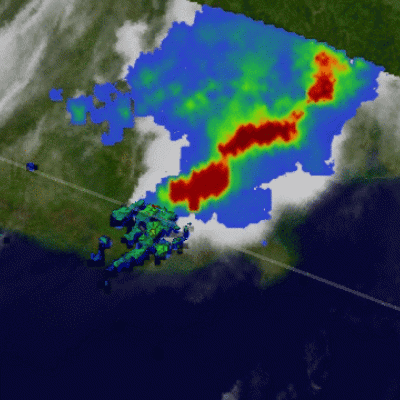
The TRMM satellite flew over tornadic thunderstorms for the second time in less than a week on 9 March 2011 at 1208 UTC ( 6:08 AM CST). By 1652Z (10:52 AM CST) NOAA had received 9 tornado sighting over Louisiana, Alabama and Florida. A precipitation analysis from TRMM's Microwave Imager (TMI) and Precipitation Radar (PR) (in the lighter swath) again showed extremely heavy rainfall near tornadic activity. TRMM's Precipitation Radar (PR) data were used in the image on the upper right to show a 3-D slice through a possible tornado.

TRMM Sees Deadly Louisiana Tornado

The TRMM satellite was flying high over head when it passed above tornadoes occurring in the state of Louisiana on 5 March 2011 at 1411 UTC (8:11 AM CST). The National Oceanic and Atmospheric Administration (NOAA) reported that seven tornadoes were spotted in Louisiana on that date. These tornadoes caused at least 15 injuries and one death with a tornado that hit in the northwest section of Rayne, Louisiana. The image on the left above shows a precipitation analysis using data collected with that TRMM orbit. TRMM's Microwave Imager (TMI) and Precipitation Radar (PR) (in the lighter swath)