
TRMM Sees Adrian's Eye

Hurricane Adrian's eye was clearly seen by the TRMM satellite when it passed over on 10 June 2011 at 1608 UTC. The heavy rainfall completely surrounding Adrian's well defined eye was revealed with TRMM Microwave Imager (TMI) data obtained at the same time. Hurricane Adrain, located southwest Mexico , was classified as a dangerous category 4 on the Saffir-Simpson scale with sustained wind speeds estimated at 115 kts (~132 mph).

Adrian now a Powerful Hurricane

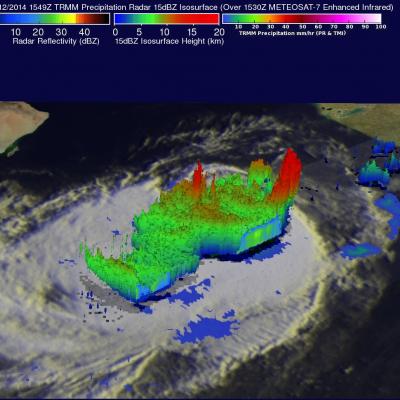
The TRMM satellite captured data used in this dramatic image of Hurricane Adrian when it passed directly above on 9 June 2011 at 0714 UTC. The increasingly powerful hurricane had sustained winds estimated to be close to 80 kts (~92 mph) at the time of this pass. TRMM's Precipitation Radar (PR) instrument revealed that beneath the clouds there were intense thunderstorms dropping rain at a rate of over 50 mm/hr (~2 inches) in a nearly circular eye wall. The PR also indicated that some thunderstorms in the eye wall were shooting up to heights above 15 km (~9.3 miles). Click here to see a

Tropical Storm Adrian Seen Forming

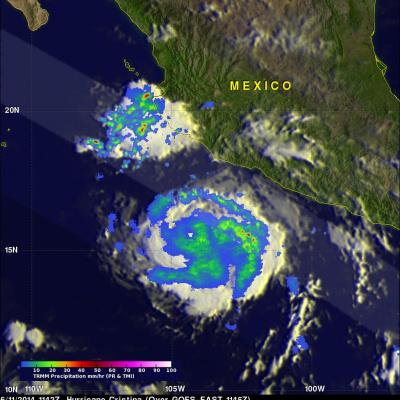
Tropical Depression ONE-E was well on it's way to becoming tropical storm ADRIAN when the TRMM satellite flew over again on 7 June 2011 at 1717 UTC. Rainfall data from TRMM's Microwave Imager (TMI) and Precipitation Radar (PR) show that bands of rainfall were starting to get organized. A red tropical storm symbol shows the location of the future storm's center of circulation. TRMM's PR showed thunderstorm towers as high as 15 km (~9.3 miles) in rain bands west of ADRIAN's center.

First 2011 East Pacific Tropical Depression (ONE-E)

As predicted ONE-E, the first tropical depression of 2011, formed in the eastern Pacific Ocean early this morning. The image above used data that the TRMM satellite received when it flew over at 0727 UTC on 7 June 2011. A red circle shows the location of ONE-E's center of circulation at that time. ONE-E is expected to intensify and become tropical storm Adrian tomorrow.

Persistant, Heavy Rains lead to Flooding in Haiti

A trough of low pressure draped across the Greater Antilles together with a persistent area of broad low pressure located in the western Caribbean combined to bring a weeks worth of steady and often heavy rains to the region. This resulted in flooding across portions of Haiti, Jamaica, the Dominican Republic, Puerto Rico, and the Virgin Islands. The Tropical Rainfall Measuring Mission satellite, which was launched in November of 1997 uses both passive and active sensors to measure rainfall over the global tropics from space. To increase the effective coverage, TRMM can be used to calibrate