
GPM Orbit Raise Burn #1 Complete

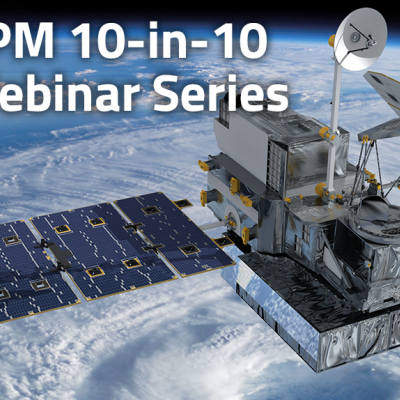
The GPM Mission Operations have successfully executed Orbit Raise Burn #1 for the GPM Core Observatory. The maneuver performance was NOMINAL. Burn #1 Start: 14:19:53 UTC 7 November Burn #1 End: 14:29:43 UTC 7 November Duration: 590 seconds Post-maneuver orbit determination and burn reconstruction have begun. Burn efficiency will be presented at the CAM tomorrow morning and used in the prediction for Orbit Raise Burn #2 (and final), for which the timing is: Planned Burn #2 Start: 17:23:16 UTC 8 November Planned Burn #2 End: 17:33:06 UTC 8 November Planned Duration: 590 seconds Note that DPR
A collection of screenshots from the GPM Mentorship program
Mentors Aaron Funk Ali Tokay Andrea Portier Amita Mehta Andrey Savtchenko Ankita Pradhan Ardeshir Ebtehaj Becky Adams-Selin Chuntao Liu Courtney Schumacher Ibrahim N. Mohammed Jackson Tan Joe Turk Linda Bogerd Lisa Milani Marcelo Uriburu Quirno Mei Han Mircea Grecu Pierre Kirstetter Sarah Ringerud Vasco Mantas Yagmur Derin Zhong Liu Aaron Funk Affiliation: Texas A&M University, Texas, USA Project Mentees: Clara Avila Dea Permata; Kaman Ghimire Why are you participating in this program as a mentor? I enjoy sharing any knowledge I've gained throughout my career with others, so the GPM Mentorship
A collection of screenshots from the GPM Mentorship program
Sections Alan Vaz Lopez - Characterizing Tropical Droughts Using GPM Data Amy Molina Estrada - Improving Water Resource Management Practices using GPM Ana Maria Pinilla - Hydrological Modeling with GPM IMERG Chetan Gurung - Investigating Diurnal Cycle of Precipitation in the Amazon Rainforest Carlo Montes - Using IMERG in Monitoring Rainfall and the Midsummer Drought in Honduras Clara Avila Dea Permata - Evaluation of Rainfall During the Borneo Vortex Event using IMERG and DPR Daniel Aduragbemi Aderotoye - Investigation of the Performance of IMERG over Nigeria Edson Baptista - Impact of
A collection of screenshots from the GPM Mentorship program
In 2023, NASA’s Global Precipitation Measurement Mission Applications Team and University of Coimbra’s Earth and Space Science Center (CITEUC Portugal) collaborated to host the second edition of the GPM Mentorship Program. The initiative supported new and existing user communities, providing a tailored hands-on learning experience in using GPM data for applications. It gave participants an overview of state-of-the-art GPM satellite-based precipitation estimates and provided users with examples of applying GPM data to support real-world problems. The program offered a free, online, and
GPM Overpass of Hurricane Otis
After rapidly intensifying overnight, Hurricane Otis made landfall near Acapulco, Mexico around 1:25 a.m. CDT (06:25 UTC) on Wednesday Oct. 25 as a powerful Category 5 hurricane. Otis had maximum sustained winds estimated at 165 mph by the National Hurricane Center (NHC), making it the first Category 5 as well as the most powerful storm to hit the Pacific coast of Mexico on record. Otis formed into a tropical depression (TD 18-E) on the morning of Sunday Oct. 22 about 530 miles (850 km) south-southeast of Acapulco from a broad area of low pressure. The depression was moving slowly northward