
Irma’s Heavy Rainfall Measured With GPM IMERG

Hurricane Irma dropped extremely heavy rain at times during it’s trek from near the Cape Verdi Islands through the northern Leeward islands, Cuba and the southeastern United States. Over 16 inches (406 mm) of rain was reported in Guantanamo, in the easternmost province of Cuba, as the category five hurricane battered the country. Almost 16 inches (406 mm) of rain was also reported at Fort Pierce on the eastern side of Florida. Charleston, South Carolina reported 6 inches (152.4 mm) of rain in 24 hour. This heavy rainfall plus storm surge flooding caused the worst flooding in Charleston since

Intensifying Tropical Storm Jose

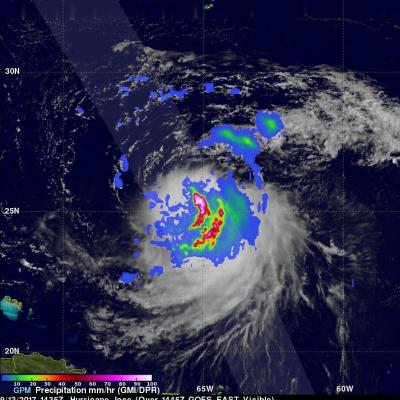
On September 5, 2017 tropical Storm Jose became the tenth named storm of the Atlantic hurricane season. The GPM core observatory satellite passed above the intensifying tropical cyclone on September 6, 2017 at 00:45 AM AST (0435 UTC). Data collected by GPM's Microwave Imager (GMI) at that time showed that weak bands of rain were starting to develop around Jose's center of circulation. GPM's Dual-Frequency Precipitation Radar (DPR) data swath revealed the location of heavy rain in a feeder band on Jose's western side. DPR found that rain in this area was falling at a rate of over 5.3 inches
GPM Satellite Probes Dangerous Category Five Hurricane Irma

The GPM core observatory satellite had an exceptional view of hurricane Irma's eye when it flew above on September 5, 2017 at 12:52 PM AST (1652 UTC). This image shows a rainfall analysis that was derived from GPM's Microwave Imager (GMI) and Dual-Frequency Precipitation Radar (DPR) data. Irma was approaching the Leeward Islands with maximum sustained winds of about 178 mph (155 kts). This made Irma a dangerous category five hurricane on the Saffir-Simpson hurricane wind scale. Intense rainfall is shown within Irma's nearly circular eye. GPM's DPR (shown in lighter shades) uncloaked
GPM Sees Potential Tropical Depression Developing In The Gulf Of Mexico

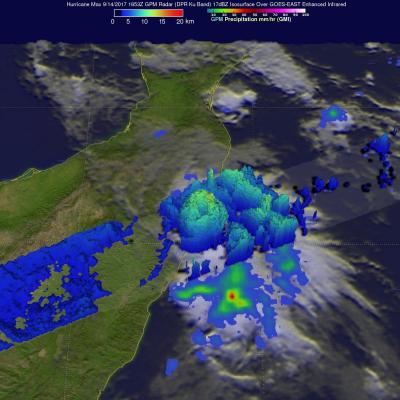
The GPM Core Observatory satellite had an excellent view of a potential tropical depression developing in the Gulf Of Mexico on September 5, 2017 at 3:34 AM CDT (0834 UTC). GPM found that powerful convective storms were dropping heavy rainfall in the Gulf of Mexico east Mexico's coast. GPM's Dual-Frequency Precipitation Radar (DPR) instrument measured rain falling at a rate of over 9.2 inches (233 mm) per hour in an intense band of storms. GPM's Radar (DPR Ku Band) data was used to examine the 3-D structure of precipitation in this area of strong convective storms. GPM's DPR showed that storm