Articles

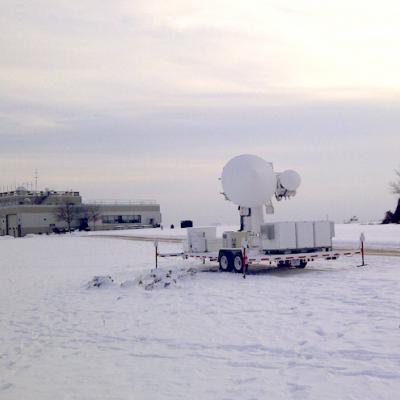
NASA's D3R radar at the GCPEx field campaign.
By Ellen Gray, NASA Goddard Space Flight Center Original www.nasa.gov Feature (published 1/31/12) Predicting the future is always a tricky business -- just watch a TV weather report. Weather forecasts have come a long way, but almost every season there's a snowstorm that seems to come out of nowhere, or one that's forecast as 'the big one' that turns out to be a total bust. In the last ten years, scientists have shown that it is possible to detect falling snow and measure surface snowpack information from the vantage point of space. But there remains much that is unknown about the fluffy white...

GCPEx logo on falling snow background
By Ellen Gray, NASA Goddard Space Flight Center Original www.nasa.gov Press Release (published 1/12/12) Beginning Jan. 17, NASA will fly an airborne science laboratory above Canadian snowstorms to tackle a difficult challenge facing the upcoming Global Precipitation Measurement (GPM) satellite mission -- measuring snowfall from space. GPM is an international satellite mission that will set a new standard for precipitation measurements from space, providing next-generation observations of worldwide rain and snow every three hours. It is also the first mission designed to detect falling snow...
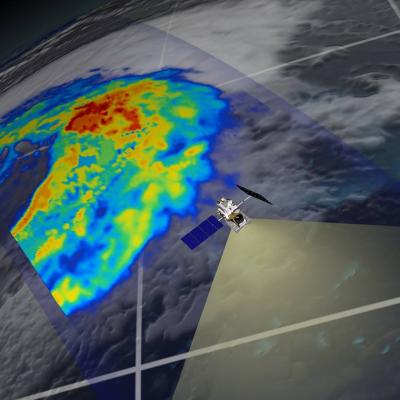
GPM flying over Earth with a data swath visualized.
The GCPEx observing strategy framework is designed to use a combination of multi-frequency radar, particle imaging and water equivalent-measuring surface instrumentation in conjunction with airborne dual-frequency radar, high frequency radiometer and in situ microphysics observations arranged in stacked altitude patterns to provide the most complete coupled sampling of surface and in-cloud microphysical properties possible. The resulting 3D volumes will be combined to provide a fundamental description of snowfall physics at the ground and through the atmospheric column, and to create an...
GPM flying over Earth with a data swath visualized.
The primary objectives of GCPEx are to obtain coordinated high quality in situ and remote sensing observations of falling snow events in a northern latitude climate. Such systems are prevalent in the Ontario region in the December- February timeframe where monthly mean snowfall amounts are approximately 40, 30 and 25 cm/month for December, January and February, respectively. Furthermore, the primary choice for DC-8 operations (Bangor, Maine) will allow potential sampling of Nor’Eastern Blizzards and heavy snow events over St. Johns Newfoundland (site of current NCAR snowfall measurements...
GPM flying over Earth with a data swath visualized.
To augment the observations and provide additional test cases for synthetic algorithm development and satellite simulator testing, a number of modeling activities are also planned. Cloud resolving model simulate frozen precipitation events using the GSFC-Weather Research and Forecasting (WRF) will be performed, initialized and forced by appropriate NWP forecast models. The GSFC WRF has single-moment Goddard Microphysics and spectral-bin microphysics. All of the microphysical schemes have their own set of unique capabilities and assumptions, and all will be tested by the GPM groups. In turn...