

GPM

GPM content

Media are invited to go behind the scenes of a comprehensive field campaign focused on yielding new insights into global precipitation at a special event on Nov. 11, 2015.  NASA's DC-8 deploys to Iceland on a mission to study Arctic polar winds. NASA's DC-8 flying laboratory will be featured as part of a special media event on Nov. 11, 2015 focused on the Olympic Mountain Experiment (OLYMPEX), an Earth science campaign aimed at validating Global Precipitation Measurement. Credits: NASA Photo / Carla Thomas
Media are invited to go behind the scenes of a comprehensive field campaign focused on yielding new insights into global precipitation at a special event on Nov. 11, 2015. NASA's DC-8 flying laboratory will be featured as part of a special media event on Nov. 11, 2015 focused on the Olympic Mountain Experiment (OLYMPEX), an Earth science campaign aimed at validating Global Precipitation Measurement. Credits: NASA Photo / Carla Thomas Held in collaboration with the University of Washington, NASA's Olympic Mountain Experiment (OLYMPEX) is an Earth science campaign aimed at validating Global...

GPM Sees Tropical Cyclone Chapala Threatening Yemen
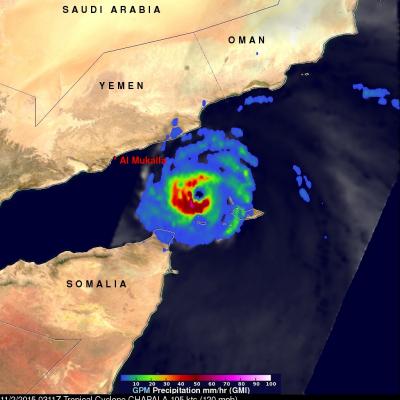
Tropical cyclone Chapala had entered the Gulf Of Aden when the GPM core Observatory satellite passed over on November 2, 1015 at 0311 UTC. Chapala still had maximum sustained winds estimated at about 105kts (121 mph) making it a category three tropical cyclone on the Saffir-Simpson hurricane wind scale. GPM's Microwave Imager (GMI) found that Chapala was dropping rainfall at a rate of over 65 mm (2.6 inches) per hour in intense storms southwest of Chapala's well defined eye. The Joint Typhoon Warning Center (JTWC) predicts that Chapala will weaken before landfall. Chapala is expected to have
GPM Sees Chapala Traveling Toward Yemen

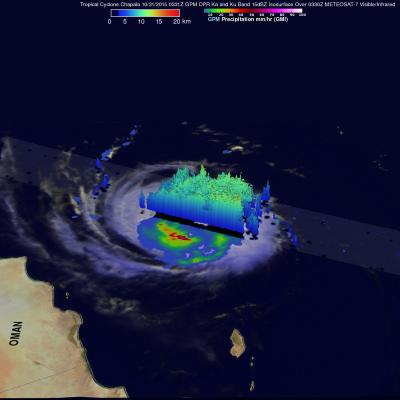
Powerful tropical cyclone Chapala continues moving inexorably toward Yemen. Chapala has weakened from category four intensity a couple days ago while maintaining a course that steers it toward Yemen. The GPM core observatory satellite had a good look at tropical cyclone Chapala on October 31, 2015 at 0331 UTC. GPM's rainfall data are shown overlaid on a 0330Z METEOSAT-7 Visible/Infrared image. At that time Chapala was a very powerful tropical cyclone with maximum sustained winds of about 117 kts (135 mph). GPM's Microwave Imager (GMI) instrument measured rain dropping at a rate of over 88 mm

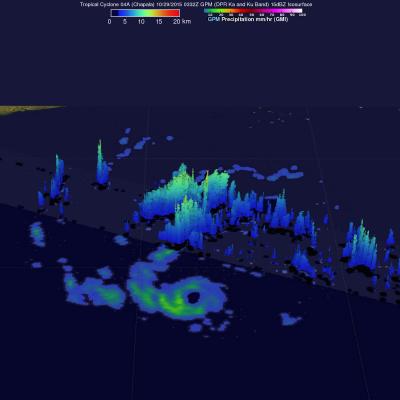
GPM Examines Tropical Cyclone Chapala

Tropical Cyclone Chapala developed in the very warm waters of the Arabian Sea west of India on October 28, 2015. These images show rainfall derived from data collected by GPM's Microwave Imager (GMI) and Dual-Frequency Precipitation Radar (DPR) instruments. The GPM core observatory satellite had good views of the tropical cyclone on October 29, 2015 at 0332 and 1456 UTC. GPM's rainfall from the first pass show that Chapala was close to hurricane intensity with the location of a developing eye clearly shown by GMI. By the second pass Chapala's maximum sustained winds were estimated at 65 kts

Patricia Remnants Combine With Storm System Over Texas

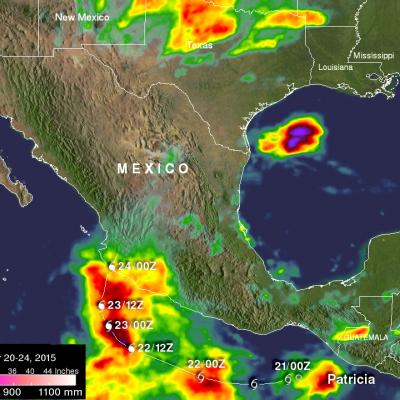
Patricia, the most powerful hurricane on record in the Western Hemisphere, quickly lost power as it moved over Mexico. Then an upper-level low pressure system and the remnants of hurricane Patricia combined to cause very heavy rain in Texas. On Sunday October 25, 2015 eastern Texas, Louisiana and Mississippi were also warned of flooding as extreme rainfall moved eastward along the Gulf Coast.

Weakening Tropical Storm Olaf Examined By GPM

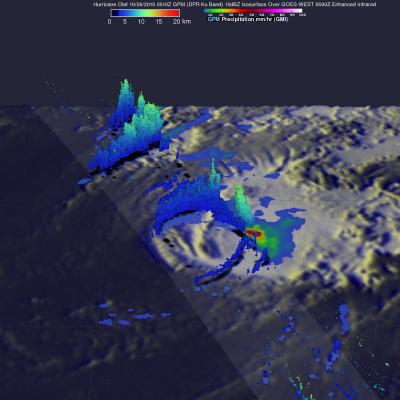
After maintaining hurricane intensity for over a week former category four hurricane Olaf is now a weakening tropical storm. The GPM core observatory satellite flew above Olaf on October 26, 2015 at 0510Z. Rainfall derived from data collected by GPM's Microwave Imager (GMI) and Dual-Frequency Precipitation Radar (DPR) instruments is shown here. Olaf had moved over cooler waters that were sapping the tropical cyclone's energy. GPM's GMI found that storms located in a small area within Olaf were still dropping rain at a rate of over 65 mm (2.6 inches) per hour. GPM's radar (DPR Ku band) sliced
Hurricane Patricia Makes Landfall in Mexico
The eye of hurricane Patricia hit the Mexican coast on October 23, 2015 at approximately 6:15 PM CDT(2315 UTC)near Cuixmala, Mexico. The maximum winds at that time were estimated to be 143 kts (165 mph). Patricia is weakening rapidly but continued heavy rain is expected to cause flash floods and mudslides in the Mexican states of Nayarit, Jalisco, Colima, Michoacan and Guerrero through Saturday October 24, 2015. Over the weekend the remants of Patricia are also expected to add to the extreme rainfall in Texas. Rainfall from a stalled front that has been causing flooding in northern and central...

GPM Sees Patricia Becoming A Hurricane

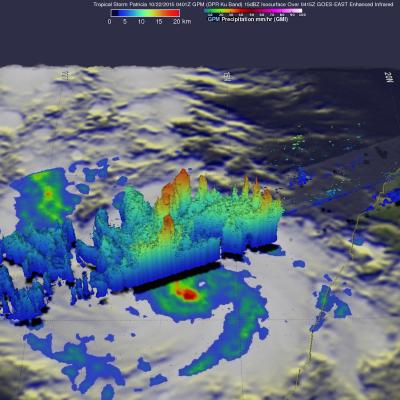
During the night tropical storm Patricia became much better organized and was upgraded to a hurricane. The GPM core observatory satellite flew above the intensifying tropical cyclone on October 22, 2015 at 0401 UTC. Patricia was still a tropical storm with maximum sustained winds estimated at 55 kts (63 mph) at that time but rainfall derived from GPM's Microwave Imager (GMI) and Dual-Frequency Precipitation Radar (DPR) instruments showed that an eye was forming. The National Hurricane Center (NHC) 0400 AM CTD discussion said that, "... 37 GHz GPM image showed a cyan ring around the eye, which

Tropical Storm Patricia Forms Off Mexican Coast

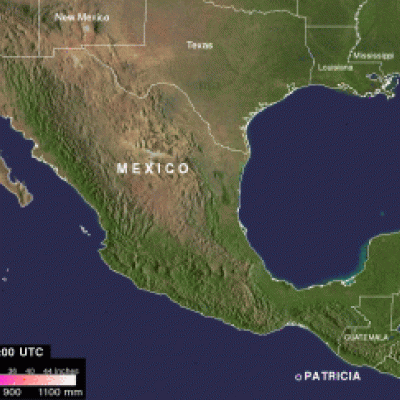
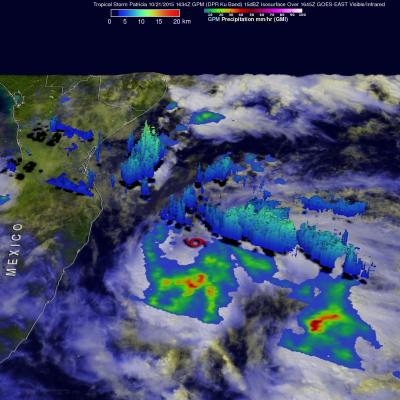
Tropical Depression Twenty-E (TD20E) formed on October 20, 2015 off the Mexican coast southeast of Puerto Escondido, Mexico. Later that evening TD20E was upgraded to tropical storm Patricia. On October 21, 2015 at 1634 UTC (11:34 AM CDT) the GPM core observatory satellite flew over tropical storm Patricia. GPM's Microwave Imager (GMI) instrument had good coverage of the rainfall associated with the tropical storm. Rainfall data derived from GMI are shown overlaid on a GOES-EAST Visible/Infrared image captured at 1645 UTC (11:45 AM CDT). GPM's Dual-Frequency Precipitation Radar (DPR) instrument

GPM Checks on Cat 4 Hurricane Olaf

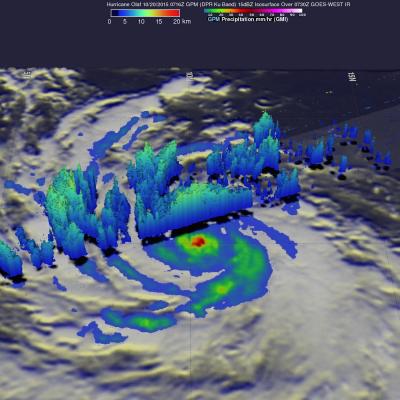
On October 19, 2015 Hurricane Olaf became the eighth category four hurricane in the busy 2015 Eastern Pacific hurricane season. The GPM core observatory satellite had a good look at the distribution of rainfall around powerful hurricane Olaf on October 20, 2015 at 0716 UTC. At that time Olaf had sustained winds estimated at over 130 kts (150 mph). GPM's Microwave Imager (GMI) and Dual-Frequency Precipitation Radar (DPR) measured the intensity of rainfall within the hurricane. GPM's GMI found rain falling at a rate of over 71.5 mm (2.8 inches) per hour in Olaf's eye wall. The DPR instrument