
GPM

Content which is affiliated solely with the Global Precipitation Measurement Mission.

Operational Hydrological Forecasting during the IPHEx-IOP Campaign – Meet the Challenge

Submitted by LisaN on
Publication Year
Authors
Tao, J., D. Wu, J. Gourley, S. Q. Zhang, W. Crow, C. Peters-Lidard, and A. P. Barros
Journal
J. Hydrology
Volume
541(Pt. A)
Page Numbers
434-456
DOI
10.1016/j.jhydrol.2016.02.019
Mission Affiliation
Major Category
Understanding How Low-Level Clouds and Fog Modify the Diurnal Cycle of Orographic Precipitation Using In Situ and Satellite Observations

Submitted by LisaN on
Publication Year
Authors
Duan, Y. and A. P. Barros
Journal
Rem. Sens.
Volume
9
Page Numbers
920
DOI
10.3390/rs9090920
Mission Affiliation
Major Category

IMERG Measures Rainfall From Tropical Storm Philippe Plus Northeast Low

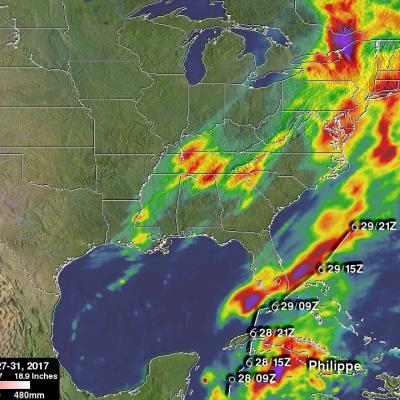
NASA's Integrated Multi-satellitE Retrievals (IMERG) data were used in this analysis to show total rainfall accumulation estimates during the period from October 27 - 31, 2017. Tropical storm Philippe formed and dissipated during that period. The tropical storm formed over the western Caribbean from tropical depression eighteen on October 28, 2017. Philippe then drenched western Cuba as it moved toward the northeast. It dropped a reported 10 inches (254 mm) of rain over southeastern Florida before dissipating in the Atlantic Ocean. Moisture from Philippe's remnants added to heavy rainfall

Powerful Northeastern Storm Examined By GPM Satellite

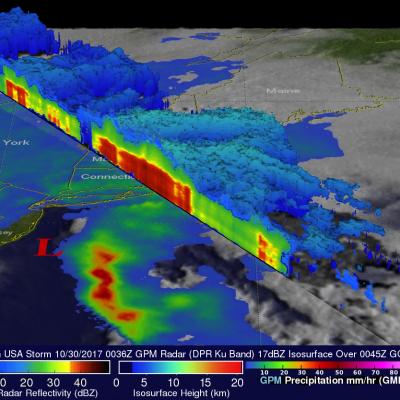
The GPM satellite showed the distribution and intensity of precipitation on the eastern side of the low pressure center. The approximate location of the storm's center at the time of the GPM pass is shown with a large red "L". GPM's Microwave Imager (GMI) showed that a large area of intense rain was located in the Atlantic east of the low's center. GMI estimated that rain in that area was falling at rates of greater than 2 inches (51 mm) per hour. GPM's Precipitation Radar (DPR) instrument showed that the low was dropping rain at a rate of over 4.92 inches (125 mm) per hour in a small area

GPM Measures Tropical Storm Saola's Rainfall

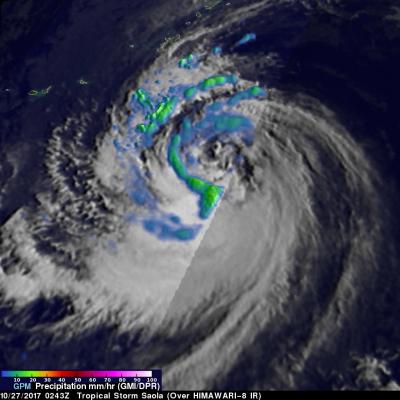
The GPM core observatory had a fairly good view of tropical storm Saola on October 27, 2017 at 0243 UTC. This image shows the GPM satellite's coverage (lighter shades) of surface rainfall around tropical storm Saola. GPM's Microwave Imager (GMI) and Dual-Frequency Precipitation Radar (DPR) instruments received data showing the intensity of rainfall over the western half of tropical storm Saola. GPM's radar (DPR Ku Band) discovered that rain was falling at a rate of over 66 mm (2.6 inches) per hour in feeder bands wrapping around that side of the tropical storm. The most intense convective

Restart of NOAA-19 MHS in IMERG

25 October 2017 At about 4:57 UTC on 9 October 2017 the NOAA-19 MHS precipitation estimates started displaying artifacts, which was eventually traced to the instrument going into safe mode without shutting down data delivery. Since this happened over the long Columbus Day weekend, it took until 01:47 UTC on 10 October 2017 to shut down the data stream, so the Early and Late IMERG have these (very obvious) artifacts for almost 24 hours. No reprocessing is planned. The sensor resumed operations at 17:31:08 UTC on 16 October 2017, but because the basis for the safe mode was unknown, GPM chose to

GPM Observes Another Typhoon That May Threaten Japan

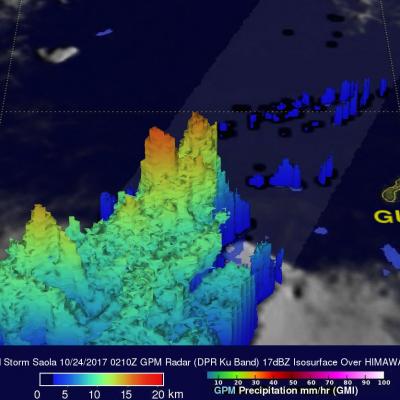
The GPM core observatory satellite passed above recently formed tropical storm Saola on October 24, 2017 at 0210 UTC. Tropical storm Saola was located west of Guam and was moving toward the northwest. Very heavy rainfall was measured by GPM's Microwave Imager (GMI) and Dual-Frequency Precipitation Radar (DPR) instruments in powerful convective storms to the southwest of Saola's center. GPM's radar (DPR Ku band) found that some storms in this cluster were dropping rain at a rate of greater than 252 mm (9.92 inches) per hour. This 3-D view of the powerful storms southwest of Paola's center of