
Tropical Cyclone Formation

The TRMM satellite flew above northern Australia on March 14, 2014 at 0500 UTC capturing data used in the image on the right. Very strong convective storms in this area are the remnants of tropical cyclone GILLIAN and may signal a rebirth. TRMM's Precipitation Radar (PR) instrument found rain falling at the rate of over 116 mm/hr (~4.5 inches) in these powerful storms in the northeastern Gulf Of Carpentaria. TRMM PR data were also used in this 3-D view of the strong convective storms in the northern Gulf Of Carpentaria. Some towering convective storms were found to be very energetic. Several

Calibrating Thrusters, Verifying Science Data

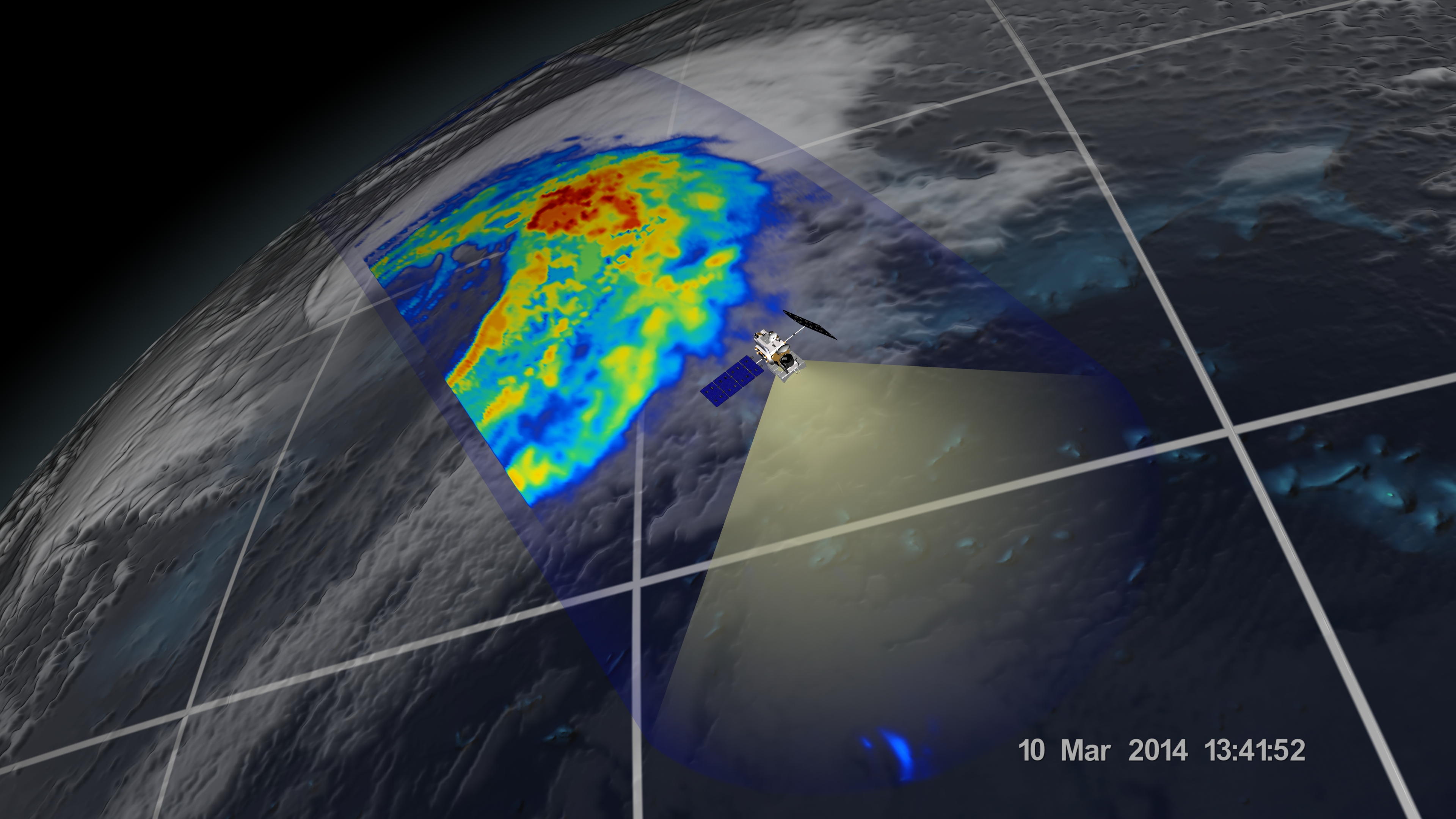
The Global Precipitation Measurement mission's Core Observatory is performing normally. On March 12, the GPM Core Observatory fired its thrusters for a 30-second check-out of their performance. The burn, called a delta-v, changes the velocity of the spacecraft to adjust the altitude of its orbit. This week's short maneuver did not greatly alter the satellite's orbit but was used instead for further calibration of the thrusters. Functional checkout activities and internal calibration of the Dual-frequency Precipitation Radar continued this week. Both DPR and the GPM Microwave Imager have begun

Deadly Tropical Cyclone Lusi

Tropical cyclone LUSI recently caused the deaths of at least three people as it moved through the island nation of Vanuatu in the South Pacific Ocean. The TRMM satellite flew above tropical cyclone LUSI on March 12, 2014 at 0342 UTC. A rainfall analysis made from TRMM's Microwave Imager (TMI) and Precipitation Radar (PR) data is shown overlaid on an enhanced visible/infrared image from TRMM's Visible and InfraRed Scanner (VIRS). TRMM PR data revealed with this analysis that rain was falling at a rate of over 97 mm/hr (~3.8 inches) in rain bands rotating around LUSI's center. TRMM's

High Level Of Tropical Cyclone Activity South Of The Equator

Tropical cylone activity has recently increased in the the Southern Hemisphere. On March 10, 2014 the TRMM satellite viewed three tropical storms within two hours. The images above use data received by the TRMM satellite when it flew above tropical storm HADI on March 10, 2014 at 0528 UTC. TRMM found that almost all heavy rainfall with HADI was located in the Coral Sea well off the northeastern coast of Australia. Data from TRMM's Precipitation Radar (PR) instrument were used in the image on the right to show the 3-D structure within the tropical storm. Tropical storm LUSI was located near

DPR Activated, in Checkout

On Saturday, March 8, just after 10 a.m. EST, the second of the two science instruments aboard the Global Precipitation Measurement (GPM) mission's Core Observatory was activated, and the teams in the mission operations center and launch support room at NASA's Goddard Space Flight Center in Greenbelt, Md., began the instrument's checkout period. DPR functional checkout activities and internal calibrations continued on Sunday and will continue this week and next. DPR data is being sent through the Precipitation Processing System at Goddard to the Japan Aerospace Exploration Agency (JAXA)