
Tropical Wave (90L) Forming in the Caribbean

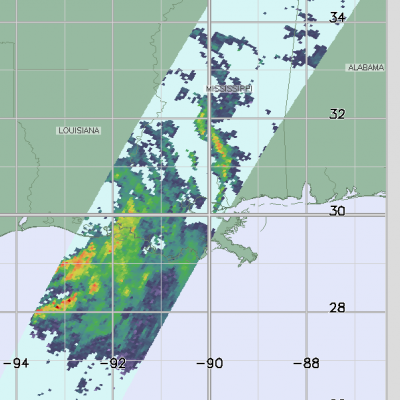
On 26 July at 1435 UTC (10:35 AM EDT) the TRMM satellite passed above a tropical wave in the Caribbean Sea southwest of Cuba. On 27 July this area was given a high (80%) probability of development into a tropical cyclone by the National Hurricane Center (NHC). TRMM's Precipitation Radar (PR) data indicates that a convective tower within this area of disturbed weather reached to heights of over 15 km (~9.3 miles).

TRMM Precipitation Radar Sees Two Tropical Storms Developing

The TRMM satellite saw two tropical storms in the western Pacific Ocean as they were in early stages of development. These 3-D views were made from TRMM's Precipitation Radar (PR) data collected on 25 July 2011 at 1631 UTC and 26 July 2011 at 0049 UTC. Those data show that developing tropical storms NOCK-TEN (10W) and 11W both had towering convective storms near their centers of circulation that extended to heights above 15km (~9.3 miles). These tall towers are associated with convective bursts and can be a sign of future strengthening because they indicate areas where energy is being released

GMI Completes Pre-Environmental Review

The GPM Microwave Imager (GMI) successfully completed Pre-Environmental Review (PER) on July 19-20, 2011, at Ball Aerospace in Colorado, which marks another key milestone for the GMI instrument. The GMI will undergo acoustic testing, vibration testing, and electromagnetic and thermal vacuum testing starting in August 2011. The GMI instrument is a multi-channel, conical-scanning, microwave radiometer, enabling the GPM Core Observatory to serve as a radiometric reference and also a transfer standard for the other GPM constellation members. Learn more about the GMI