Typhoon MA-ON Threatening Japan

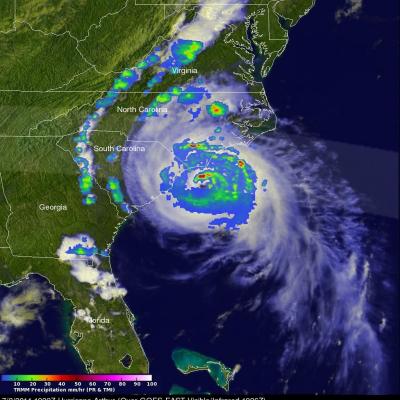
Typhoon MA-ON was a category 2 typhoon on the Saffir/Simpson scale with wind speeds of about 85 kts (~98 mph) when the TRMM satellite captured those data shown above on 18 July 2011 at 0316 UTC. MA-ON had weakened considerably from a very powerful category four typhoon with wind speeds of 115 kts (~132 mph) on 15 July 2011. TRMM's Microwave Imager (TMI) and Precipitation Radar (PR) data were used to produce the rainfall analysis shown above. This TRMM analysis shows that MA-ON still contained organized bands of very intense rainfall with the most intense precipitation located in the eastern

GPM Core Observatory Centrifuge Testing

Photograph of the GPM core propulsion system attached to a large centrifuge
Image Caption
The GPM Core Observatory undergoing centrifuge testing at Goddard Space Flight Center.

NASA technicians spun the Global Precipitation Measurement (GPM) satellite up to just over 10 RPM in Goddard Space Flight Center’s High-Capacity Centrifuge facility March 31. At that speed, the spin exerted a lateral pressure of 2.4 G’s, or 2.4 times the force of gravity on the satellite.

Spin tests such as these are used to determine whether the forces of launch could adversely affect hardware we put into space, and to test spacecraft chassis design.

NPOL Ground Validation Instrument

The NPOL instrument, a large circular radar dish under a blue sky
Image Caption
The NASA NPOL radar is a research grade S-band, scanning dual-polarimetric radar.

The NPOL underwent a complete antenna system upgrade in 2010 and is one of two fully transportable research-grade S-band systems in the world.  It is used to make accurate volumetric measurements of precipitation including rainfall rate, particle size distributions, water contents and precipitation type.