
Peru's Deadly Rainfall Examined With NASA's GPM Data

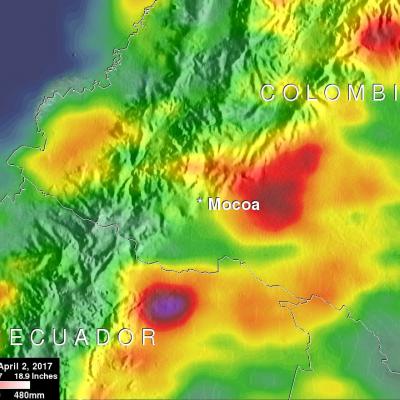
This year unusually heavy rainfall has caused extensive flooding and loss of life in Peru. Extreme flooding and frequent landslides that occurred this month have forced many from their homes. An El Niño like condition with warm ocean waters developed near Peru's coast. This extremely warm water off Peru's western coast has been blamed for promoting the development of these storms. Equatorial sea surface temperatures (SSTs) are about average elsewhere in the central and east central Pacific. This image shows the locations of storms that were dropping heavy rainfall over northwestern Peru when

PPS Releases GPM IMERG V04 Final Data Products

PPS is announcing the release of GPM IMERG V04 Final products today, Wednesday March 22, 2017. Version 04 IMERG data is available on PPS's arthurhou ftp archive for the dates of March 2014 - July 2015. Processing will continue over the next several weeks until the data has been made available up to the present. This data can be found at: ftp://arthurhou.pps.eosdis.nasa.gov/gpmallversions/V04 Individual data orders, subsets or subscription orders can also be set up through PPS's STORM: https://storm.pps.eosdis.nasa.gov/storm/ Release notes and ATBD documentation for IMERG V04 can be found at

Replacement GPM Ka/Ku L1B products (2017-03-19) for orbit 17356

PPS received replacement GPM Ka/Ku L1B products from JAXA and will reprocess the affected data. If you have already obtained products with orbit #17356 from our archive or through a standing order, etc., please discard and use the replacement products. PPS has replaced the following GPM Ka/Ku L1B data: GPMCOR_KUR_1703190533_0705_017356_1BS_DUB_04A.h5 GPMCOR_KAR_1703190533_0705_017356_1BS_DAB_04A.h5 ------------------------------------- PPS will reprocess these affected downstream products shortly. 2A.GPM.Ka.V6-20160118.20170319-S053318-E070552.017356.V04A.HDF5 2A.GPM.Ku.V6-20160118.20170319

GPM Sees Powerful Convective Storms In The Timor Sea

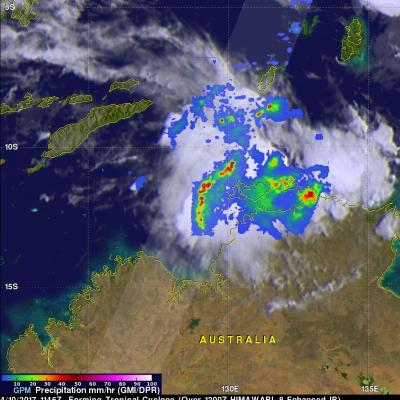
The GPM core observatory satellite passed above some energetic storms in the Timor Sea north of Australia on March 20, 2017 at 0726 UTC. These powerful storms were being invigorated by very warm sea surface temperatures and low vertical wind shear aloft. Balmy water in the Timor Sea was reaching temperatures of 30 to 32 degrees Celcius (86 to 89.6 Fahrenheit). Data collected by GPM's Microwave Imager (GMI) and Dual-Frequency Precipitation Radar (DPR) instruments showed that these storms contained some very heavy downpours. GPM's DPR found rain falling at a rate of over 238 mm (9.4 inches) per

Increased Latencies on GPM Products Due to TDRSS Safe Hold

On the afternoon of March 16, one of the TDRSS data relay satellites went into safe hold. This has reduced the relay satellites available for downloading the data from the GPM core satellite to the ground station at White Sands, NM. It means that times between download contacts have increased. No data is lost but data latency has been greatly affected for the GPM near-realtime core satellite products: GMI and DPR. We understand that this increase in latency will be the norm for the next couple of days. There are NO issues with the GPM core satellite or its sensors. Also there are NO issues