
Extreme Weather

Extreme weather news and updates.

GPM Looks at Historic Flooding from Slow-Moving Maryland Storms

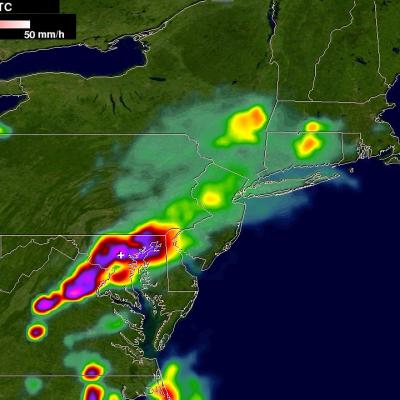
NASA analyzed rainfall data from slow-moving storms that triggered flash floods over parts of central Maryland and caused devastating flooding in historic Ellicott City, Maryland. A slow-moving line of heavy thunderstorms dumped as much as 6 to 7 inches of rain in about two hours' time during the evening of Saturday, July 30, over parts of Howard County in central Maryland, resulting in severe local flash flooding. The hardest hit area was the historic town of Ellicott City, where two people were trapped in their cars and drowned. The town suffered substantial damage to many buildings

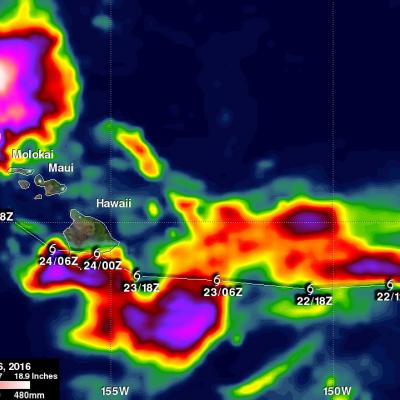
IMERG Shows Darby's Rainfall Over The Hawaiian Islands

Most of the Hawaiian Islands were spared serious damage from tropical storm Darby. The location of Darby's track through the Hawaiian Islands resulted in the islands of Hawaii and Oahu being the most affected. Flash flooding was common on Oahu due to a reported 177.8 mm (7 inches) of rain drenching the island. Interstate H-1 was flooded in some locations. Lightning damage was reported in Kaneohe on the windward side of Oahu. Estimates of rainfall accompanying tropical storm Darby were produced using NASA's Integrated Multi-satellitE Retrievals for GPM (IMERG) data. These IMERG rainfall

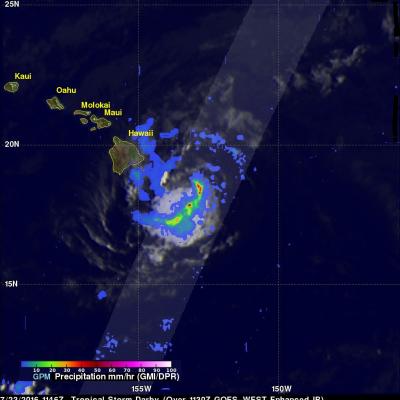
Tropical Storm Darby Brings Occasionally Heavy Rain To The Hawaiian Islands

Tropical storm Darby has caused some heavy rainfall in the Hawaiian Islands since hitting the big island (Hawaii) on Saturday July 23, 2016. After hitting the big island Darby passed to the south of Molokai and Maui. Rain falling at a rate of 25.4 mm (1 inch) to 50.8 mm (2 inches) per hour was reported on the island of Oahu as Darby passed to the southwest of the island. The National Weather Service office in Honolulu reported that parts of Interstate H-1 that serves the southern side of Oahu was closed due to flooding on Sunday night. Darby is affecting northern Kaui today. The GPM core

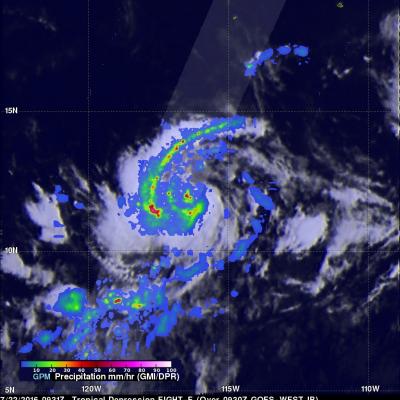
GPM Observes Newly Formed Tropical Depression Eight-E

The eastern Pacific Ocean continues to show that it's environment is favorable for the birth of tropical cyclones. Tropical Depression EIGHT-E (TD08E) quickly followed tropical storm FRANK as the latest example of tropical cyclogenesis in the eastern Pacific Ocean. The GPM core observatory satellite examined TD08E when it flew directly above on July 22, 2016 at 0931 UTC. At that time maximum sustained winds were only estimated to be about 30 kts (34.5 mph). Rainfall was examined in TD08E using data collected by GPM's Microwave Imager (GMI) and Dual-Frequency Precipitation Radar (DPR)

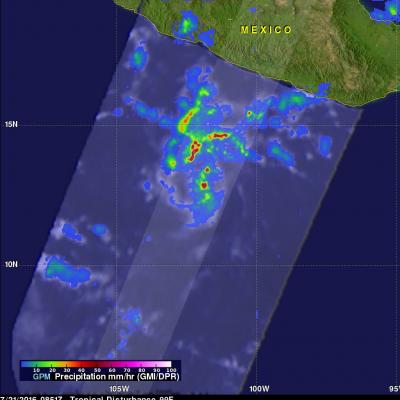
GPM Sights Another Forming Tropical Cyclone

The eastern Pacific Ocean continues to spawn tropical cyclones. Seven named tropical cyclones have already formed in the Eastern Pacific ocean this year. The National Hurricane Center (NHC) has indicated that another tropical cyclone is likely to form in a broad area of low pressure southwest of Acapulco, Mexico. The GPM core observatory satellite flew directly above this increasingly organized stormy area on July 21, 2016 at 0851Z. GPM found that powerful thunderstorms in that area contained intense showers. Rain was measured by GPM's Dual-Frequency Precipitation Radar (DPR) instrument

GPM Used To Evaluate Tropical Storm Estelle

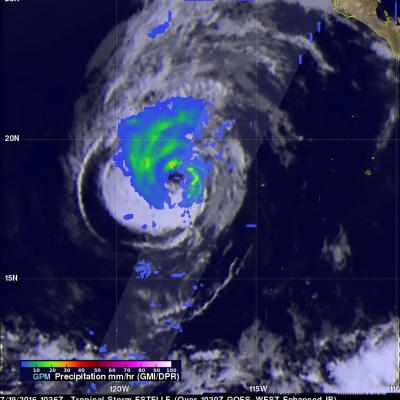
The GPM core observatory satellite traveled above tropical storm Estelle on July 19, 2016 at 1036 UTC. This pass showed that Estelle contained well organized convective bands that were producing precipitation within the storm. Precipitation within Estelle was analyzed using data collected by GPM's Microwave Imager (GMI) and Dual-Frequency Precipitation Radar (DPR) instruments. GPM's radar (DPR Ku band) data were used to perform a 3-D examination of the precipitation on the eastern side of tropical storm Estelle. Some rainfall was measured by DPR falling at a rate of over 65 mm (2.6 inches) per

Southern Hemisphere Tropical Cyclone Abela Viewed By GPM

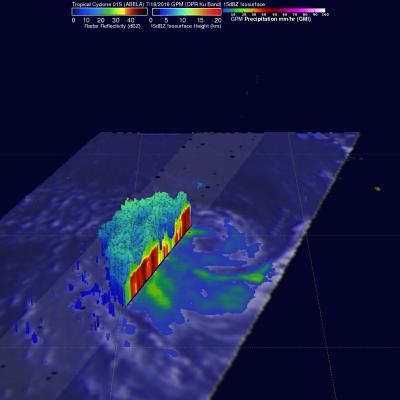
Tropical cyclone 01S (Abela) formed in the South Indian Ocean on July 16, 2016. Abela was the first tropical Cyclone to form in July over the South Indian Ocean since 2007 so it is a little unusual. The GPM core observatory satellite recently had two good views of Abela. GPM saw the newly formed tropical cyclone on Jul 16, 2016 at 2216 UTC. Precipitation data collected by GPM's Microwave Imager (GMI) and Dual-Frequency Precipitation Radar (DPR) instruments showed that ABELA contained a large area of rainfall on July 16, 2016. Then again on July 18, 2016 at 2206 the satellite passed above after

GPM Sees Tropical Depression SIX-E Forming

A large area of low pressure in the eastern Pacific Ocean was sufficiently organized and developed that the National Hurricane Center (NHC) designated it as tropical depression SIX-E on July 15, 2016 at 1500Z (9:00 AM MDT). With the development of tropical depression SIX-E there are currently three active tropical systems in the eastern Pacific Ocean. The GPM core observatory had a good view of forming tropical depression SIX-E when it flew over on July 15, 2016 at 1056 UTC (4:56 AM MDT). Precipitation data were calculated from data collected by GPM's Microwave Imager (GMI) and Dual-Frequency

Rainfall Measured By GPM In Weakening Tropical Storm Celia

Celia was a powerful hurricane with winds of 85 kts (98 mph) a couple days ago but has recently been moving over cooler ocean waters that are contributing to a weakening trend. Hurricane Celia had weakened to a tropical storm with winds of about 45 kts (52 mph) when the GPM core observatory satellite flew over on July 14, 2016 at 0001 UTC. GPM found that convective storms were mainly located to the north and northeast of Celia's center of circulation. GPM's Microwave Imager (GMI) and Dual-Frequency Precipitation Radar (DPR) found that rain was falling at over 164 mm (6.4 inches) per hour

Forming Tropical Storm Darby Analyzed By GPM

Tropical storm Darby became the fourth eastern Pacific Ocean tropical storm to form on July 12, 2016. Last year was an El Nino year and this year is transitioning to a La Nina year with cooler sea surface temperatures (SST) expanding across the eastern equatorial Pacific Ocean. Fewer tropical storms are normally expected to develop in the eastern Pacific Ocean during La Nina years but so far this year tropical cyclones are forming in the eastern Pacific Ocean at about the same pace as last year. The GPM core observatory satellite flew above tropical depression five (TD05E) on July 12, 2016 at