
GPM

Content which is affiliated solely with the Global Precipitation Measurement Mission.

GPM Flies Over Flooding Rainfall in Washington DC
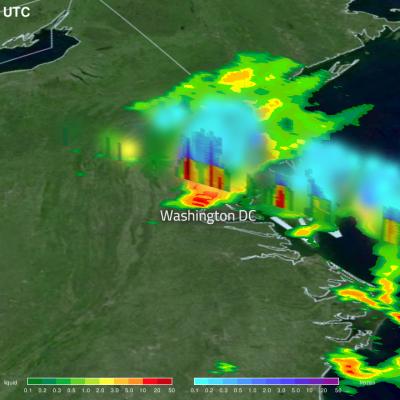
Washington DC experienced extreme rainfall the morning of July 8th, 2019 when a cluster of slow-moving thunderstorms moving through the area tapped into a very moist airmass to produce extremely heavy rains, which resulted in flash flooding throughout the region. The storms were triggered by a nearby frontal boundary. The GPM Core Observatory passed over this storm system at 8:51am ET, with its Dual-frequency Precipitation Radar measuring rainfall rates in excess of 100 mm/hr in some areas. Reagan National Airport (DCA) also reported receiving 80 mm of rainfall in one hour, corroborating the
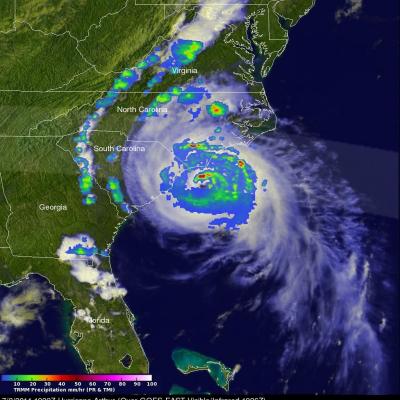
5 Year Anniversary of Hurricane Arthur
TRMM overpass of Hurricane Arthur from July 3, 2014. View fullscreen in STORM Event Viewer June marks the official start of the Atlantic hurricane season. And although strong tropical cyclones are rare in June in the Atlantic, it will soon be the 5-year anniversary of Hurricane Arthur, which became a tropical depression in very late June 2014 before hitting the Outer Banks of North Carolina as a Category 2 hurricane in early July. As with most storms early in the season, Arthur formed not from a tropical wave moving off the coast of Africa but from an old frontal boundary that stalls off the...
How TRMM and GPM Study Latent Heating
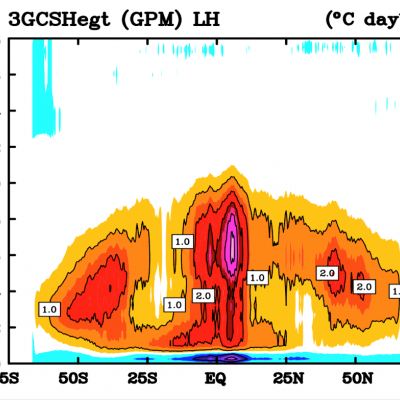
Latent heating (LH) arises predominantly from the release of heat associated with the condensation of water vapor into cloud droplets in clouds with active updrafts. Other sources of LH include ice deposition and freezing, while evaporation, melting and sublimation induce cooling, but condensation is the dominant heating term. Like a hot-air balloon, LH can keep air parcels warmer than their surrounding environment and therefore rising. On a large scale, LH is responsible for driving the ascending branch of the Hadley Circulation. LH is also an important component in the dynamics of a regional...
Using GPM Data to Understand Hurricanes
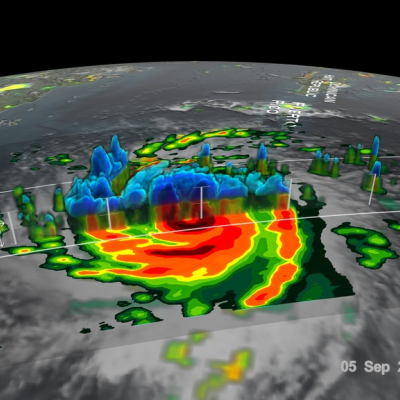
The 2019 Atlantic "hurricane season" is officially upon us and runs through November 30th. Did you know that GPM data play a fundamental role in the ability to monitor existing storm activity such as capturing the location and intensity of rainfall inside a storm, as well as improving weather and precipitation forecasts through assimilation of instantaneous precipitation information? Here are a few applications of GPM data used to study hurricanes and how the data was then used for decision-making. Monitoring Irma with GPM This image shows rainfall analysis that was derived from GPM's GMI data...
Date Last Updated
July 1st, 2024
Document Description

This document describes the basic idea of DPR data processing. It was originally written for the algorithm used in the at-launch version (V03). The algorithm has been modified and improved since then. Although the basic idea of data processing remains the same, the actual flow of processing, in particular that in the solver module, has changed substantially. As a result, some part of description in Section 3.1 may not be relevant any more.

File Downloads
Date Last Updated
October 6th, 2020
Document Description

The Integrated Multi-satelliE Retrievals for GPM (*IMERG*) is the unified U.S. algorithm that provides the multi-satellite precipitation product for the U.S. GPM team.  The precipitation estimates from the various precipitation-relevant satellite passive microwave (PMW) sensors comprising the GPM constellation are computed using the 2017 version of the Goddard Profiling Algorithm (GPROF2017), then gridded, intercalibrated to the GPM Combined Radar Radiometer Analysis product (with GPCP climatological calibration), and combined into half-hourly 0.1°x0.1° fields.

File Downloads
Date Last Updated
January 3rd, 2020
Document Description

This document describes the algorithm and processing sequence for the Integrated Multi-satellitE Retrievals for GPM (IMERG).  This algorithm is intended to intercalibrate, merge, and interpolate “all” satellite microwave precipitation estimates, together with microwave-calibrated infrared (IR) satellite estimates, precipitation gauge analyses, and potentially other precipitation estimators at fine time and space scales for the TRMM and GPM eras over the entire globe.

File Downloads
Date Last Updated
October 6th, 2020
Document Description

In IMERG up through V05, the cloud motion vector computation approach used is that pioneered in CMORPH (Joyce et al. 2011), in which motion vectors are computed from 4-km geosynchronous infrared (GEO-IR) brightness temperatures. Hence, the motion vectors reflect cloud top motions. However, there are two main limitations in using GEO-IR. The first limitation is that cloud top motions may not match precipitation motions due to both wind shear and the growth and decay of precipitation systems.

NASA Reveals Heavy Rainfall in Tropical Cyclone Fani

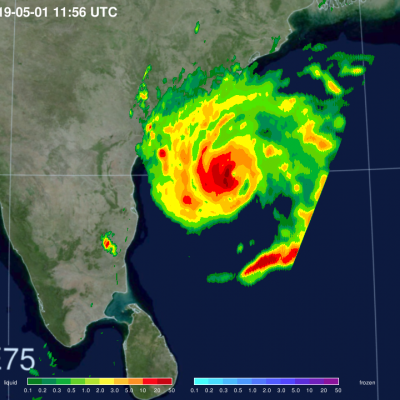
Satellite data revealed heavy rainfall in powerful Tropical Cyclone Fani before it made landfall in northeastern India. Fani brought that soaking rain to the region and continues to drop heavy rainfall on May 3, as it moves toward Bangladesh. NASA’s GPM or Global Precipitation Measurement mission satellite provides information on precipitation from its orbit in space. On May 1 at 7:56 a.m. EDT (1156 UTC), the GPM Core Observatory captured an overpass of the powerful storm as it continued strengthening and moving toward landfall. A 3D image and a color-enhanced rainfall image were created at

GPM Flies Over Developing Tropical Storm Idai Twice

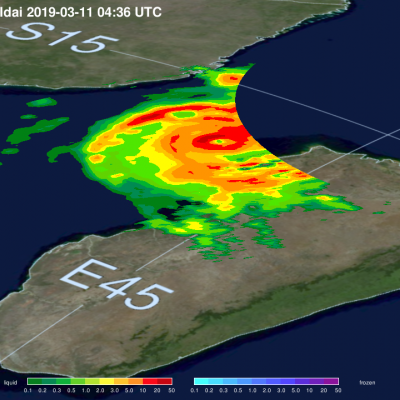
Intense Tropical Cyclone Idai started as a tropical depression on the 4th of March, 2019, off the coast of Mozambique. After making landfall over Mozambique it turned back over the Mozambique Channel and strengthened to become a tropical cyclone on the 10th of March. The GPM satellite captured the cyclone with both the GPM Microwave Imager (GMI) and the Dual-frequency Precipitation Radar (DPR) on the 11th of March at 04:36 UTC when the storm was in the middle on the Mozambique Channel. The DPR captured a well-developed eye, seen at the center of the image. It flew over the storm once again at