
Potential Tropical Cyclone Development In The Caribbean

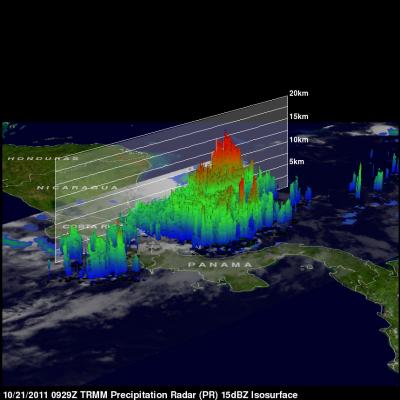
The TRMM satellite passed over an area of disturbed weather in the southern Caribbean Sea between Nicaragua and Jamaica on 21 October 2011 at 0929 UTC. The National Hurricane Center (NHC) has given this area a high chance (60%) of becoming a tropical cyclone over the weekend. Data from TRMM's Precipitation Radar (PR) instrument were used to make the 3-D image above that shows that a cluster of strong convective storms in the southern part of this area were higher than 15 km (~9.3 miles). The heavy rainfall in this area of deep convection releases heat, known as latent heating, into these

TRMM Used to Examine the Bay of Bengal Tropical Cyclone

The accurate measurement of the tropical rainfall around the globe is one of the main objectives of the TRMM satellite. The TRMM satellite has also proven useful for global monitoring of tropical cyclone development. The images above were made from data received by the TRMM satellite when it passed over tropical cyclone 02B in the eastern Bay Of Bengal on 19 October 2011 at 2340 UTC. The image above shows a rainfall analysis that was made from TRMM's Microwave Imager (TMI) and Precipitation Radar (PR) data. It shows that moderate to heavy rainfall associated with 02B was extending

Testing GPM on the High Capacity Centrifuge

Submitted by JacobAdmin on

(ambient audio only)

GPM moves from the clean room to the test chamber on a dolly without wheels. Compressed air is pumped out under airpads that float the Spacecraft on a bed of air. The wind generated when the centrifuge moves at its maximum speed are more than 200 mph - that's tornado speed. But since they move with the centrifuge the satellites tested only feel 20 mph winds. Leaning outward at 45 degrees for one test orientation, GPM comes within 28 inches of the wall. When lifted onto the platform it cleared the ceiling by only five inches.