
India's Deadly Monsoon Rainfall Measured With GPM IMERG

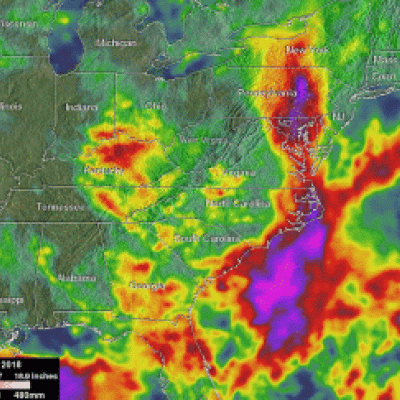
India's southwest monsoon (summer rainy season) normally occurs between June and September. This year's monsoon has been assessed as average but India's Meteorological Department statistics show that daily mean rainfall for the country has recently been above normal. At least 15 people were killed by floods and landslides in India on Wednesday July 11, 2018. So far this year, close to 200 deaths may have resulted from India's heavy monsoon rainfall. These estimates of rainfall accumulation were constructed using data from NASA's Integrated Multi-satellitE Retrievals for GPM (IMERG). Algorithms

Typhoon Maria Makes Landfall

After striking the Ryukyu Islands of Japan and grazing Taiwan with torrential rains, Typhoon Maria made landfall just north of the populous city of Fuzhou, China with sustained winds of 95 knots and a broad shield of precipitation. The storm appears lopsided in the GMI, with much of the deep convection offshore, however, it is still likely to bring a brief period of flooding rains to this part of China before dissipating. View fullscreen in STORM Event Viewer

GPM IMERG Analyzes Rainfall from Powerful Typhoon Prapiroon

The image above shows estimates of accumulated rainfall using IMERG (Integrated Multi-satellitE Retrievals for GPM) data formed during the period from June 28-July 6, 2018. Typhoon PRAPIROON developed in the northwest pacific Ocean east-northeast of the Philippines on June 28, 2018. PRAPIROON became a typhoon on July 2nd as it approached the Korea Strait between Japan and Korea. Stormy weather had already produced heavy rainfall in Korea and Japan before typhoon PRAPIROON moved through the area. IMERG estimates indicated that PRAPIROON and other stormy weather dumped over 512 mm (20.2 inches)

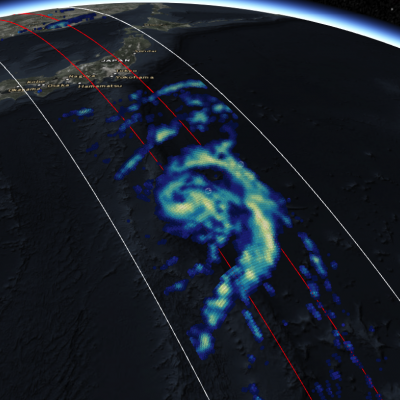
GPM Views Super Typhoon Maria Near Guam

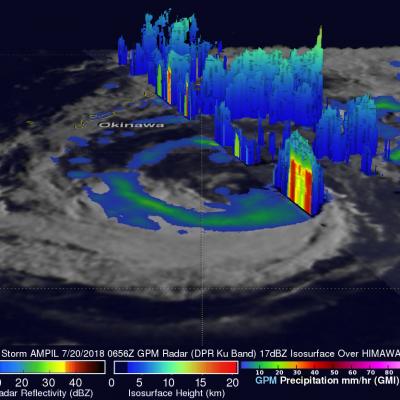
View full screen in STORM Event Viewer. Rapidly intensifying after its genesis near Guam, Super Typhoon Maria featured winds near 130 knots as it spiraled through the waters of the Western Pacific Ocean. The DPR scan indicates deep convection in several parts of the outer bands, with the most intense precipitation rates from GMI concentrated in the eyewall. Maria is expected to continue intensifying over the next three days, then weaken slightly as it crosses through the Ryukyu Islands, possible near Okinawa. The long range forecast has it making landfall in Northern China, possibly still as a