
Oklahoma Mesoscale Convective System (MCS) Examined With GPM

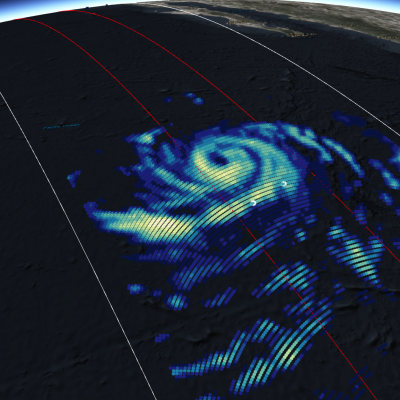
The GPM Core observatory satellite's passed over Oklahoma on Monday, June 25, 2018 04:08 AM CDT (0508 UTC). The satellite makes measurements of precipitation with it's GPM's Microwave Imager (GMI) and Dual-Frequency Precipitation Radar (DPR) instruments every 95 minutes as it orbits the earth at 252.3 miles (407 km). The area covered by GPM's radar is shown in lighter shades. GPM passed directly over the center of a Mesoscale Convective System (MCS) that was moving across Oklahoma. GPM found that the MCS contained some intense storms. GPM's DPR can make accurate rainfall measurements along it

Southern Texas' Flooding Rainfall Examined With IMERG

Extremely heavy rainfall caused a flash flood emergency over southern Texas this week. More than 15 inches (381 mm) of rain fell in Hidalgo County, Texas since Tuesday June 19, 2018. The Governor of Texas declared a state of emergency for six counties in South Texas Thursday afternoon. Heavy rain had ended Friday morning but occasional showers were still occurring over southern Texas. At 4:28 AM CDT Friday June 22, 2018 the National Weather Service in Brownsville, Texas issued a "Flood Warning for Urban Areas and Small Streams in... Southwestern Hidalgo County in Deep South Texas..."

GPM Satellite Probes Storms In The Western Gulf Of Mexico

A mid-level and surface trough over southern Texas is producing heavy rainfall. Heavy rainfall is expected to continue in the area through Wednesday evening. On June 19, 2018 at 3:37 PM CDT ( 2037 UTC) the GPM core observatory satellite passed over the western Gulf Of Mexico. This GPM pass revealed extreme rainfall that was being produced by a tropical disturbance in the northwestern Gulf Of Mexico. GPM's Microwave Imager (GMI) and Dual Frequency Precipitation Radar (DPR) instruments probed powerful storms that were dropping rain at a rate of 3.5 inches (88 mm) per hour. The GPM satellite's

Hurricane Bud's Rainfall Measured with GPM IMERG

Beneficial rainfall from hurricane Bud's remnants has spread into the Desert Southwest. This rainfall may be helpful in an area that has been experiencing exceptional drought accompanied by wildfires. Bud's rainfall may also signal the beginning of the summer monsoon over the Desert Southwest. The image above shows estimates of accumulated rainfall using IMERG (Integrated Multi-satellitE Retrievals for GPM) data generated during the period from June 9-18, 2018. This rainfall occurred during the period when Bud formed southwest of Mexico, intensified into a powerful category four hurricane

PPS Systems Downtime - Sunday June 17, 2018 - Planned GPM servers upgrade

On Sunday June 17, 2018 PPS System Programmers and staff will be performing an important scheduled GPM archive server upgrade. Due to this upgrade process, most PPS systems and services will be unavailable for most or all of that day starting at 9:00 AM (EDT) and lasting until late afternoon or longer depending upon the upgrade circumstances. -It is important to note that GPM (NRT) near realtime services (SDPS and ftp://jsimpson.pps.eosdis.nasa.gov/) will remain available and unaffected during this period. -PPS's Aeolus server ( ftp://aeolus.pps.eosdis.nasa.gov/) will only provide near real