
Extreme Florida Rainfall Examined With GPM
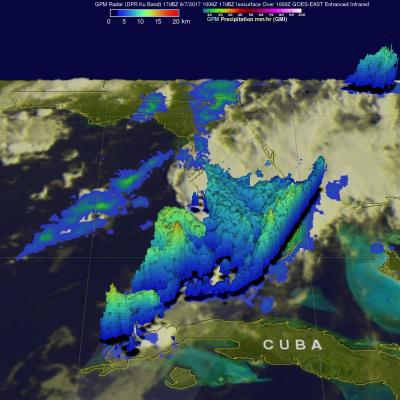
Extremely heavy rain has recently fallen over Florida. Over 19 inches (482 mm) of rain has fallen in southeastern Florida during the past seven days. Record rainfall has been reported in Fort Lauderdale and West Palm. This extreme rainfall has led to flooding and flight cancellations. The GPM core observatory satellite flew above southern Florida on Wednesday June 7, 2017 at 6:06 AM EDT ( 1006 UTC). Data collected by GPM's Microwave Imager (GMI) and Dual-Frequency Precipitation Radar (DPR) instruments revealed the intensity of rainfall within powerful storms that were drenching southern
IMERG Shows Heavy Rainfall From Southwest India To Northeast India

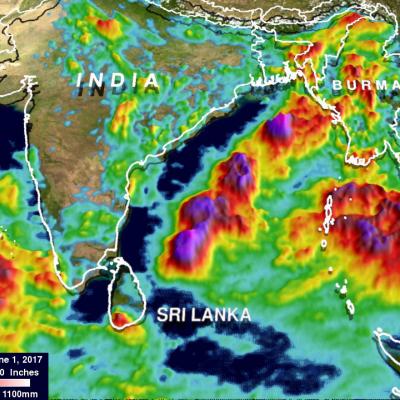
In the past couple weeks rainfall has had a significant impact on Sri Lanka, southwestern India, Bangladesh and eastern India. Monsoon rainfall caused widespread flooding, devastating mudslides and displacements of many thousands of people in Sri Lanka. Over 200 people's deaths have now been attributed to this disaster. Then cyclone Mora formed in the Bay Of Bengal on May 27, 2017. Heavy rain from Mora and it's remnants moved over southeastern Bangladesh and northeastern India. Monsoon rainfall also started to move into southern India. This rainfall analysis was derived from NASA's Integrated

Status of IMERG v04 Products

In an effort to keep users informed, below is the current status of the IMERG V04 products. Summary 1. As of 02:20 UTC on 9 May 2017, IMERG Early and Late are running in V04 with backward compatibility adjustments to V05 inputs. 2. From that point to about 11:30 UTC on 12 May 2017, there are long, thin streaks of artifacts in IMERG Early and Late due to GPROF-ATMS. 3. From that point to about 15:00 UTC on 30 May 2017, there are unrealistically large areas of light rain in moist tropical ocean areas in IMERG Early and Late due to GPROF-ATMS and GPROF-MHS. Thereafter, the content of microwave

Cyclone Mora Examined By GPM

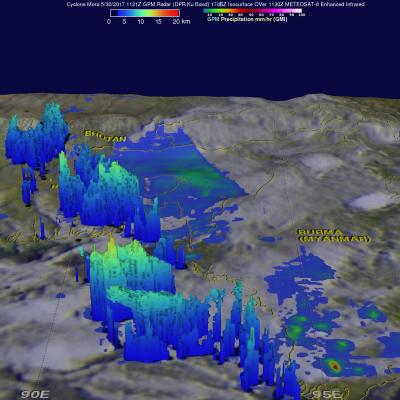
The GPM core observatory satellite passed over cyclone Mora on May 30, 2017 at 1121 UTC. Mora had passed into southeastern Bangladesh less than six hours earlier. Maximum sustained winds within Mora were estimated to be about 55 kts (63 mph) when GPM passed above. Data received by GPM's Microwave Imager (GMI) and Dual-Frequency Precipitation Radar (DPR) instruments revealed the location and intensity of rainfall around the dissipating cyclone. GPM's radar swath, shown in lighter shades, covered the area west of the dissipating cyclone's center. GPM's DPR found that rain was still falling at a

Heavy Rainfall Induced Landslide Observed By IMERG

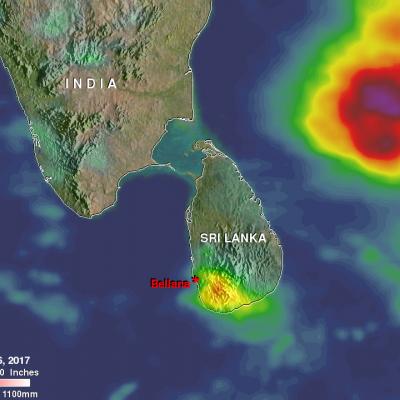
More than 90 people have been reported killed and over 100 missing due to a landslide in the village of Bellana, in the Kalutara district of Sri Lanka. Heavy monsoon rainfall over the past few days caused the disaster. Heavy rainfall is shown over the southwestern Bay Of Bengal in this analysis of rainfall accumulation using NASA's Integrated Multi-satellitE Retrievals for GPM (IMERG) data. This IMERG analysis included the period from May 23 to early May 26, 2017. The maximum IMERG rainfall accumulation estimates in this area were shown in the Bay Of Bengal to the northeast of Sri Lanka where