
Extreme Weather

Extreme weather news and updates.

GPM Sees Typhoon Malakas Starting To Batter Japan
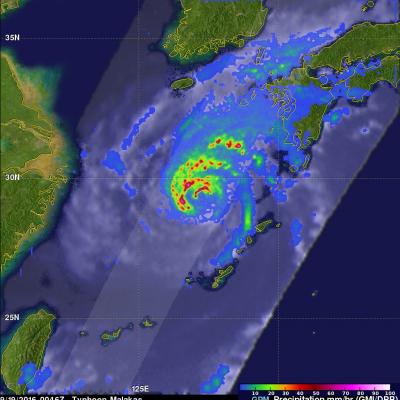
September 19, 2016 0046 UTC September 19, 2016 1031 UTC After causing high winds and heavy rainfall over northern Taiwan, typhoon Malakas is now starting to batter the islands of southern Japan. The GPM core observatory satellite passed above typhoon Malakas twice on September 19, 2016. The first time was at 0046 UTC when the typhoon was starting to cause light to moderate rainfall over the island of Kyushu. At 1031 UTC GPM showed that moderate to heavy rainfall was moving over Kyushu and the typhoon's appearance had changed significantly. The change in appearance was credited to increased
3D Precipitation Structure Within Hurricane Orlene Examined By GPM Satellite

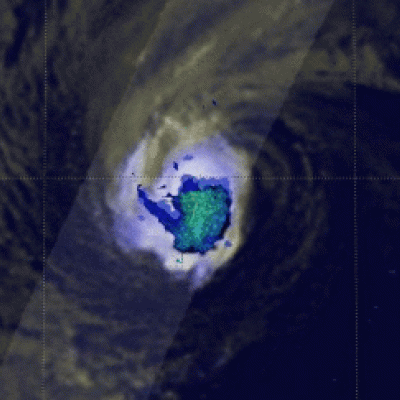
Orlene, the 9th hurricane of the 2016 eastern Pacific season has weakened to a tropical storm. The GPM core observatory satellite flew over on September 15, 2016 at 1801 UTC when Orlene was still a hurricane with winds reaching about 70 kts (81 mph). Hurricane Orlene's rainfall was examined in 3-D using data collected by the GPM satellite's Dual-Frequency Precipitation Radar (DPR). This digital "CAT scan" like view inside hurricane Orlene shows the locations of the most intense rainfall. An area of heavy downpours was uncovered near the center of Orlene's center of circulation. Radar

GPM Observes Weakening Tropical Storm Julia

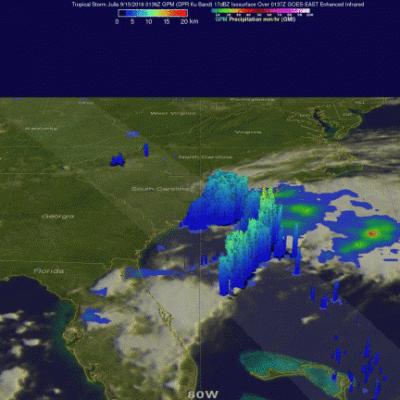
Tropical storm Julia was recently downgraded to a tropical depression. The GPM core observatory satellite had an excellent view of tropical storm Julia on September 14, 2016 at 9:36 PM EDT ( September 15, 2016 0136 UTC). Julia was barely a tropical storm at that time with maximum sustained winds of about 40 mph ( 35 kts). Over the past few days Julia has dropped heavy rain along the Atlantic coastline from northeastern Florida to North Carolina. Some areas have received over 8 inches (203 inches) during the past few days. The GPM satellite measured Julia's rainfall and found that intense

GPM Takes Parting Look At Hermine

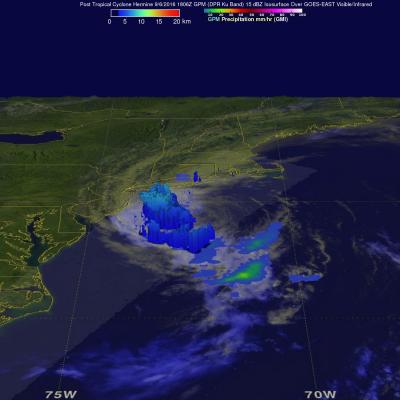
Post Tropical Cyclone Hermine was still rotating in the Atlantic Ocean east of New Jersey when the the GPM core observatory satellite flew above on September 6, 2016 at 2:05 PM EDT ( 1806 UTC). Hermine's power was greatly dissipated from the hurricane that hit Florida on September 2, 2016. Hermine still had maximum sustained winds of about 58 mph (50 kts). Hermine was also still producing some light to moderate showers. Precipitation data shown here were derived from GPM's Microwave Imager (GMI) and Dual-Frequency Precipitation Radar (DPR) instruments. Those data showed that rain was falling
NASA Sees Hermine's Twin Towers
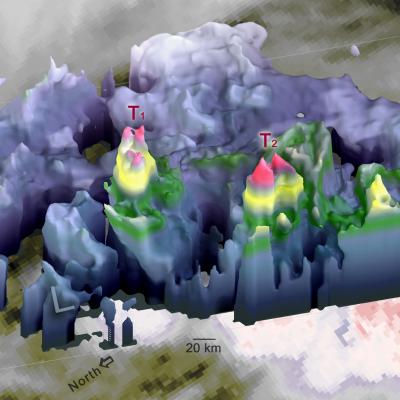
In order for Hermine or any other tropical depression, to intensify there must be a pathway for heat energy from the ocean surface to enter the atmosphere. For Hermine, the conduit may have been one of the two "hot towers" that the Global Precipitation Measurement mission or GPM core satellite observed on Aug. 31 at 4:09 p.m. EDT (2009 UTC). GPM's DPR instrument saw strong storms near the center of Tropical Depression Hermine on the evening of Aug. 31. Two "hot towers" are seen to the right of the low pressure center (south and east of the center), which are labeled "T1" and "T2." The "L"...

GPM Sees Increasingly Organized Tropical Storm Hermine

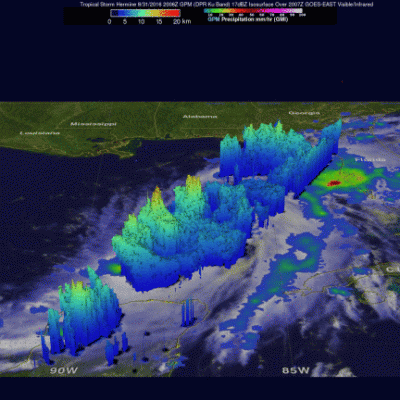
Tropical Depression Nine was upgraded to Tropical Storm Hermine on Wednesday August 31, 2016 at 2 PM EDT (1800 UTC). The GPM core observatory satellite passed directly above newly designated tropical storm Hermine on August 31, 2016 at 4:06 PM EDT (20:06 UTC). Rainfall data derived from GPM's Microwave (GMI) and Dual-Frequency Precipitation Radar (DPR) instruments showed that precipitation intensity had increased and moved into western Florida. Rainfall measured by GPM's DPR had increased to a rate of over 9.9 inches (251 mm) per hour in very powerful storms in the Gulf Of Mexico northwest of

Intensifying Tropical Depression Nine Checked By GPM

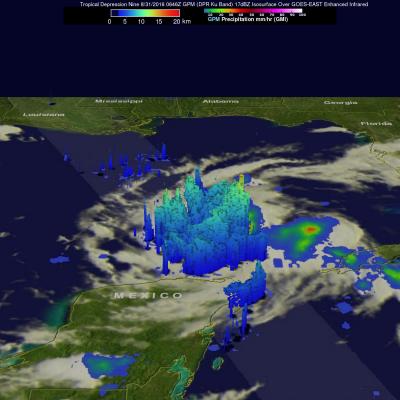
The National Hurricane Center (NHC) expects Tropical Depression Nine to intensify over the next day or so. Vertical wind shear is predicted to be low and the tropical depression is moving over warmer water. Both of these factors will provide fuel for intensification. The GPM core observatory satellite scanned the tropical depression on August 31, 2016 at 2:46 AM EDT (0646 UTC). GPM's Microwave Imager (GMI) and Dual-Frequency Precipitation Radar (DPR) instruments saw heavy rainfall in strong convective storms in the Gulf Of Mexico northwest of Cuba. GPM's DPR found that some of these intense

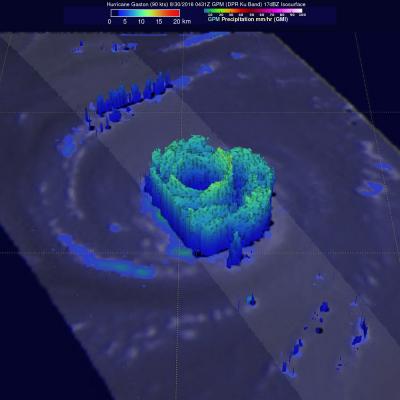
GPM Views Hurricane Gaston Eye Wall Replacement

Hurricane Gaston was located in the central Atlantic Ocean west of Bermuda when the GPM core observatory satellite passed over on August 30, 2016 at 00:31 AM EDT (0431 UTC). Gaston was a category two on the Saffir-Simpson hurricane wind scale with maximum sustained winds of about 103.5 mph (90 kts). GPM happened to fly over as Gaston was undergoing an eye wall replacement. Intense rainfall was clearly shown by GPM in rain bands of both the inner and the outer replacement eye walls. Precipitation was calculated from data collected by GPM's Microwave Imager (GMI) and Dual-Frequency Precipitation

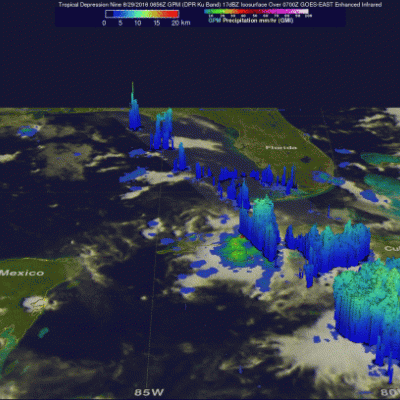
Tropical Depression Nine Forms

The frequency of tropical cyclone formation has definitely increased in the Atlantic Ocean basin. A tropical wave that the National Hurricane Center (NHC) had been monitoring for development since it left the African coast almost two weeks ago was upgraded to Tropical Depression Nine (TD09L) on August 28, 2016. The low pressure became a little better organized after moving into the Florida Strait and that led to the upgrade. The GPM core observatory satellite passed above the still relatively poorly organized tropical depression on August 29, 2016 at 2:56 AM EDT (0656 UTC). Maximum sustained

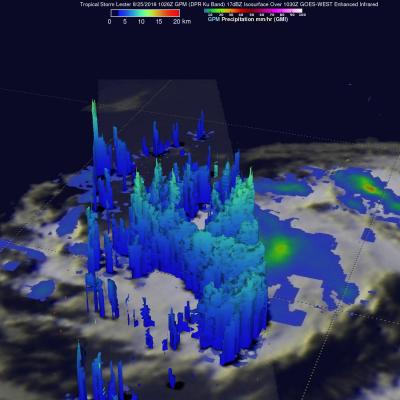
GPM Examines Tropical Storm Lester

Lester became the 12rd named storm of the 2016 eastern Pacific Ocean hurricane today. Lester was far away from the Mexican coast early today and headed toward the west-northwest. Low vertical wind shear and warm sea surface temperatures are expected to assist Lester's intensification to hurricane status tomorrow. Tropical storm Lester had wind speeds of about 35 kts (40 mph) when the GPM core observatory satellite passed over on August 25, 2016 at 1026 UTC. Data from GPM satellite's Microwave Imager (GMI) and Dual-Frequency Precipitation Radar (DPR) instruments showed that Lester was getting