
Images and caption by Hal Pierce (SSAI/NASA GSFC)

GPM Sees Carlos Moving Past Reunion Island
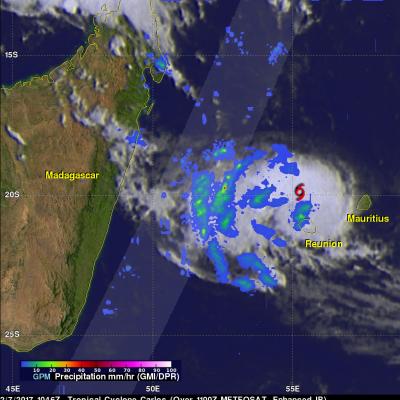
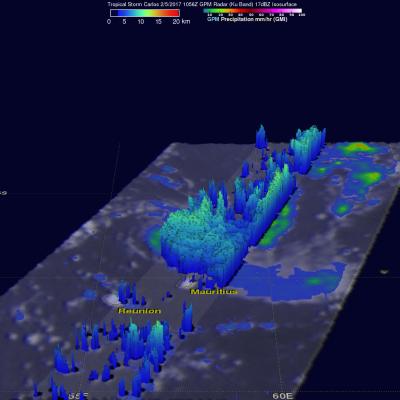
The GPM core observatory satellite flew above tropical cyclone Carlos on February 7, 2017 at 1056 UTC. Carlos was moving past Reunion Island with maximum sustained winds estimated at 45 kts (51.8 mph). GPM's Microwave Imager (GMI) and Dual-Frequency Precipitation Radar (DPR) data show that rain bands west of Carlos' center were producing heavy rainfall. GPM's DPR swath is shown in a lighter shade. DPR measured a few downpours in the bands west of the Carlos' center of circulation dropping rain at a rate of over 120 mm (4.7 inches) per hour. GPM's radar (DPR Ku Band) found that a few storm tops
Tropical Storm Carlos Forms

Tropical storm Carlos formed in the Southwest Indian Ocean north of the French Islands of Reunion and Mauritius on February 4, 2017 (UTC). This ended an unusual drought of tropical cyclone formation in that part of the Indian Ocean that began in July 2016. NASA's GPM core observatory satellite flew above tropical storm Carlos on February 5, 2017 at 1056 UTC when Carlos had maximum sustained winds of about 45 kts (51.8 mph). GPM collected data that showed the intensity and structure of precipitation within Carlos. GPM's Dual-Frequency Precipitation Radar (DPR) measured rain falling at a rate of

GPM Sees Possible Tropical Cyclone Developing Near Australia

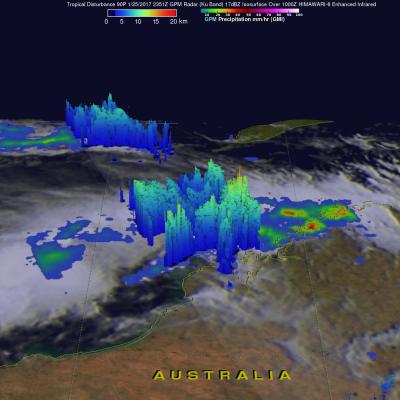
So far this year no tropical cyclones have developed in the Southwest Indian Ocean. The Joint Typhoon Warning Center (JTWC) recently warned that a low moving westward over northwestern Australia may soon become a tropical cyclone. Warm Indian Ocean waters and low vertical wind shear are providing a good environment for tropical cyclone development. The GPM satellite flew over northwestern Australia on January 25, 2017 at 2351 UTC. GPM's Microwave Imager (GMI) and Dual-Frequency Precipitation Radar (DPR) measured precipitation within strong convection in the Indian Ocean northwest of the lows

Mudslides & Flooding Produced By Extreme Rainfall Over Southern California

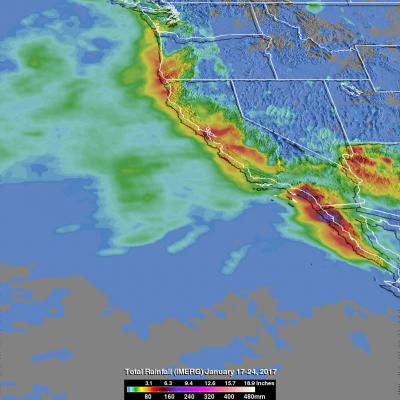
It is sunny in southern California today but recent unusually heavy rainfall led to rock slides, mudslides and flooding in that part of the country. Rainfall of almost 4 inches (101.6 mm) in one day was reported in Long Beach, California. Some highways in the area were flooded due to intense downpours. Rainfall since the fall of 2016 has improved drought conditions over northern California but Southern California has been slower to improve because of the exceptional rainfall deficit in that area. NASA's Integrated Multi-satellitE Retrievals for GPM (IMERG) were used to estimate the total

Deadly Torrential Rain Hits Southern Thailand

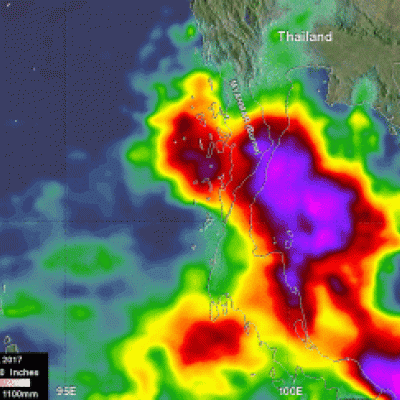
Widespread flooding has recently caused the deaths of dozens of people in southern Thailand. Frequent and persistent downpours have resulted in record rainfall totals. NASA's Integrated Multi-satellitE Retrievals for GPM (IMERG) were used to estimate the total amount of rain that fell over southern Thailand during the past week. Extreme rainfall totals of over 700 mm (27.6 inches) were shown over the Gulf of Thailand. The highest rainfall total estimates over land were greater than 500 mm (19.7 inches) on the eastern coast of the Malay Peninsula in the Bang Saphan district. Rainfall has

Deadly Tornadoes & Flooding Hits The Southeast

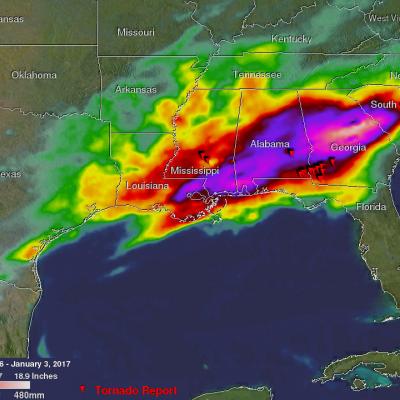
Severe thunderstorms spawned tornadoes and generated flooding rainfall over the Southeast on Monday evening. At least twelve tornadoes were reported with twisters spotted in Mississippi, Alabama and Georgia. Four deaths in Alabama and one in Florida have been blamed on this violent weather. Total rainfall was measured from December 30, 2016 through early January 3, 2017 using precipitation estimates from NASA's Integrated Multi-satelliE Retrievals for GPM (IMERG) data. IMERG data are produced using data from the satellites in the GPM Constellation, and is calibrated with measurements from the

Typhoon Nock-ten's Rainfall Measured By IMERG

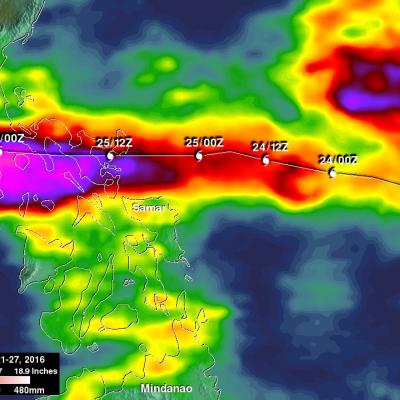
Heavy rainfall and winds from super typhoon Nock-ten caused the deaths of at least six people as it roared through the Philippines. Data generated by NASA's Integrated Multi-satellitE Retrievals for GPM (IMERG) were used to estimate the total amount of rain that super typhoon Nock-ten dropped as it approached and traveled over the Philippines. Nock-ten’s approximate locations and appropriate tropical cyclone symbols at 0000Z and 1200Z are shown overlaid in white on IMERG rainfall estimate images. This IMERG analysis shows estimated rainfall totals using NASA's IMERG data produced during the

Intensifying Tropical Storm Nock-ten Heads Toward Philippines

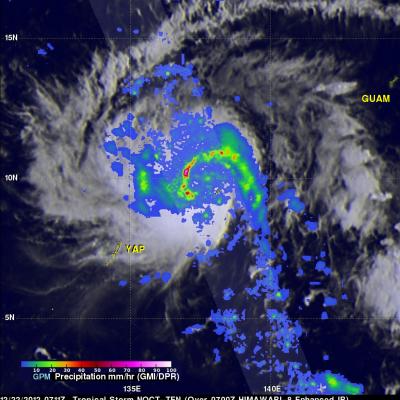
Heavy precipitation and strong winds from typhoon Nock-ten are expected over the Philippines for several days as the country is celebrating the Christmas holiday. Tropical storm Nock-ten is predicted by the Joint Typhoon Warning Center (JTWC) to strengthen into a powerful typhoon with winds of about 105 kts (121 mph) before it reaches the Philippines. Nock-ten is predicted to weaken after hitting the eastern Philippines but still have winds of over 80 kts (92 mph) as it travels close to Manila, the country's capital. The GPM core observatory satellite had a good view of Nock-ten when it passed

GPM Finds Rainfall Increasing With Tropical Cyclone Yvette

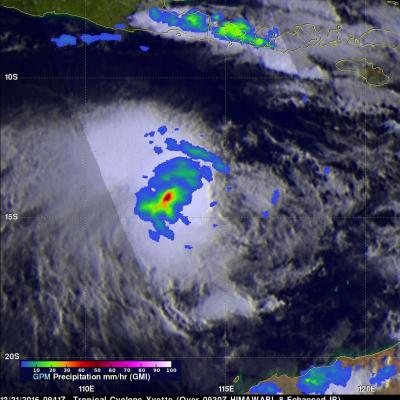
The GPM core observatory satellite again flew over tropical cyclone Evette (02S), located off the northwestern coast of Australia, on December 21, 2016 at 0941 UTC. Maximum sustained winds had increased to about 40 kts (46 mph). The GPM satellite's Microwave Imager (GMI) revealed that the area of continuous rainfall around Yvette's center of circulation had increased in size. Convective storms were shown by GPM to be dropping rain at rates of over 60 mm (2.4 inches) per hour. Tropical cyclone Yvette is predicted to intensify slightly by tomorrow to about 50 kts (58 mph). Yvette continues to be

Tropical Cyclone 02S Formation Observed By GPM

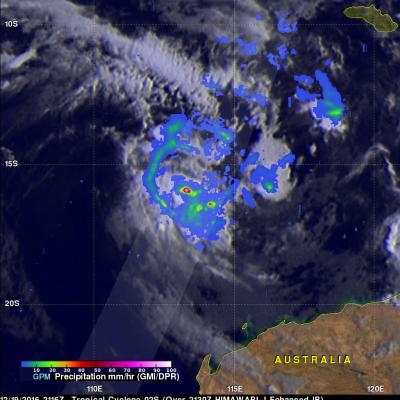
Australia is normally affected by 11 cyclones a year but only three formed during Australia's last summer. This year sea surface temperatures in the tropical waters around Australia are much warmer so an average tropical cyclone is forecast by the Bureau of Meteorology (BOM). Tropical cyclone 02S formed in the Indian Ocean northwest of Australia yesterday. Another tropical cyclone is also expected to form soon in an area of intense convection west-northwest of Darwin, Australia. The GPM core observatory satellite flew above tropical cyclone 02S just a few hours after it's formation on December