
Document Description

Excerpt:

Tropical Storm Ophelia Forms

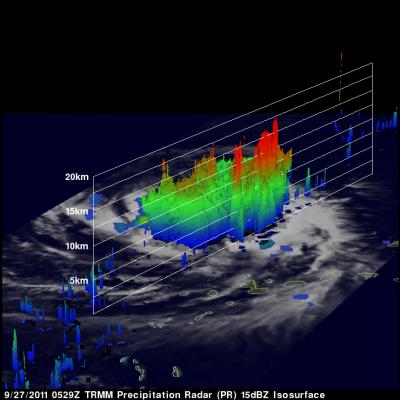
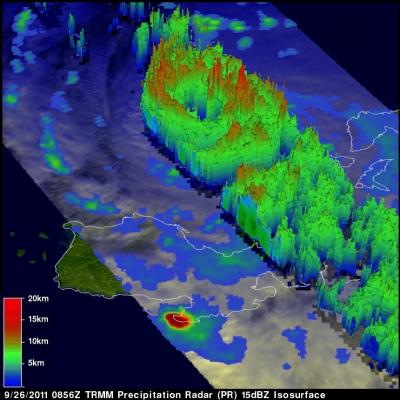
The TRMM satellite passed over newly formed tropical storm Ophelia in the Atlantic Ocean on September 2011 at 0752 UTC ( 4:52 AM EDT). TRMM shows that Ophelia isn't very well organized and contains only a few scattered areas of heavy rainfall. The National Hurricane Center (NHC) has predicted that Ophelia will remain a tropical storm with wind speeds reaching a maximum of 50 kts (~58 mph).

Two Tropical Cyclones Near Japan

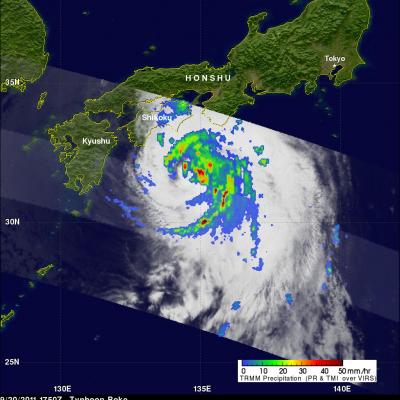
The TRMM satellite flew over two tropical cyclones near Japan on 18 September 2011. Typhoon Sonca, shown above, was seen off the east coast of the main Japanese island of Honshu at 1805 UTC while moving away from Japan toward the north-east. Sonca was still a powerful typhoon with wind speeds of about 85 knots (~98 mph) at that time but Sonca weakened to a tropical storm on 19 September 2011 while moving over the colder waters of the northern Pacific Ocean to the north-east of Japan. TRMM saw tropical storm Roke a little later at 1840 UTC. TRMM Precipitation Radar (PR) data shows that Roke

Maria Moving to the West of Bermuda

The TRMM satellite traveled above tropical storm Maria on Thursday 15 September 2011 at 1001 UTC ( 6:01 AM EDT). Maria's organization had improved over that seen by TRMM earlier in the week due to favorable (warmer) sea surface temperatures and lower upper level wind shear. A rainfall analysis from TRMM's Precipitation Radar (PR), displayed in a lighter swath, shows that powerful convective storms were dropping rainfall at a rate of over 50mm/hr (~2 inches) northwest of Maria's center of circulation. A large area of rainfall containing bands of heavier rainfall was also shown by TRMM's

TRMM Sees Disorganized Tropical Storm Maria

The TRMM satellite passed over tropical storm Maria on 12 September 2011 at 1249 UTC (8:49 AM EDT). This TRMM pass shows that tropical storm Maria's center of circulation was exposed and displaced well to the west of deep convection. A red tropical storm symbol was overlaid on the image derived from this TRMM pass to show the location of Maria's center of circulation. With this pass TRMM's Precipitation Radar (PR), shown in the lighter swath, scanned directly above the deep convection east of Maria's center. Those data showed that some rainfall in this area was very intense with rates of over