
SSMIS Outage Affecting TMPA and IMERG

FNMOC is behind in providing the SSMIS data used in IMERG. Therefore, the Early and possibly Late IMERG products will contain less satellite estimates and be of somewhat lesser quality. FNMOC stopped providing data around 00 UTC today (8 September 2016), meaning there has been no data available from the three operational SSMIS sensors to the TMPA-RT datasets. As a result, more lower-quality IR-based estimates are being used. In addition, if there are dropouts in the IR data, there is a higher probability that gaps will appear in the combined product, 3B42RT. We will update the situation when

GPM Takes Parting Look At Hermine

Post Tropical Cyclone Hermine was still rotating in the Atlantic Ocean east of New Jersey when the the GPM core observatory satellite flew above on September 6, 2016 at 2:05 PM EDT ( 1806 UTC). Hermine's power was greatly dissipated from the hurricane that hit Florida on September 2, 2016. Hermine still had maximum sustained winds of about 58 mph (50 kts). Hermine was also still producing some light to moderate showers. Precipitation data shown here were derived from GPM's Microwave Imager (GMI) and Dual-Frequency Precipitation Radar (DPR) instruments. Those data showed that rain was falling

GPM Sees Increasingly Organized Tropical Storm Hermine

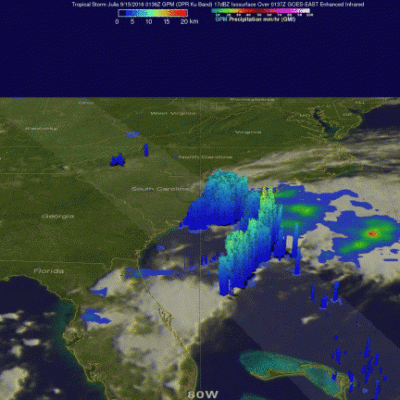
Tropical Depression Nine was upgraded to Tropical Storm Hermine on Wednesday August 31, 2016 at 2 PM EDT (1800 UTC). The GPM core observatory satellite passed directly above newly designated tropical storm Hermine on August 31, 2016 at 4:06 PM EDT (20:06 UTC). Rainfall data derived from GPM's Microwave (GMI) and Dual-Frequency Precipitation Radar (DPR) instruments showed that precipitation intensity had increased and moved into western Florida. Rainfall measured by GPM's DPR had increased to a rate of over 9.9 inches (251 mm) per hour in very powerful storms in the Gulf Of Mexico northwest of

Intensifying Tropical Depression Nine Checked By GPM

The National Hurricane Center (NHC) expects Tropical Depression Nine to intensify over the next day or so. Vertical wind shear is predicted to be low and the tropical depression is moving over warmer water. Both of these factors will provide fuel for intensification. The GPM core observatory satellite scanned the tropical depression on August 31, 2016 at 2:46 AM EDT (0646 UTC). GPM's Microwave Imager (GMI) and Dual-Frequency Precipitation Radar (DPR) instruments saw heavy rainfall in strong convective storms in the Gulf Of Mexico northwest of Cuba. GPM's DPR found that some of these intense

PPS Releases Level 2-Level 3 GPROF MHS Version 04A Data

Level 2 and Level 3 GPROG MHS Version V04A products, starting from February 01, 2014 are in production and will be available to our registered users at: ftp://arthurhou.pps.eosdis.nasa.gov/ This data can also be ordered through PPS's STORM https://storm-pps.gsfc.nasa.gov/storm/ To register with PPS to obtain data, please visit: https://registration.pps.eosdis.nasa.gov/registration/ The DataType designation for these products are as follows: 2AGPROFMETOPAMHS 2AGPROFMETOPBMHS 2AGPROFNOAA18MHS 2AGPROFNOAA19MHS 3GPROFMETOPAMHS_DAY 3GPROFMETOPBMHS_DAY 3GPROFNOAA18MHS_DAY 3GPROFNOAA19MHS_DAY