
F17 SSMIS Data Processing on Hold

There continues to be intermittent anomalies in the F17 37v channel. The science team is in the process of making a decision on how to proceed forward with the F17 SSMIS data. PPS will be halting L1C forward production of the F17 data until a decision is reached. Please note that this information pertains only to the PPS Standard Research products. Additional information will be sent for NRT (Near realtime) as appropriate. We apologize for any inconvenience or problems that this may cause and appreciate your continued patience. We will send notification updates whenever we receive new

Tropical Cyclone Fantala's Changes Observed By GPM

As expected, tropical cyclone Fantala reversed course and moved southeastward almost directly over it's earlier track. The tropical cyclone's intensity also fluctuated. Maximum winds dropped significantly as Fantala moved southeastward but have rebounded somewhat today. The GPM core observatory satellite flew over the tropical cyclone on April 19, 2016 at 1346Z when winds had dropped to about 95 kts (109 mph). At that time GPM's Microwave Imager (GMI) and Dual-Frequency Precipitation Radar (DPR) found that Fantala still contained extremely heavy rainfall in storms spiraling into the tropical

Slow-moving Frontal System Brings Heavy Rains, Flooding to Parts of Texas

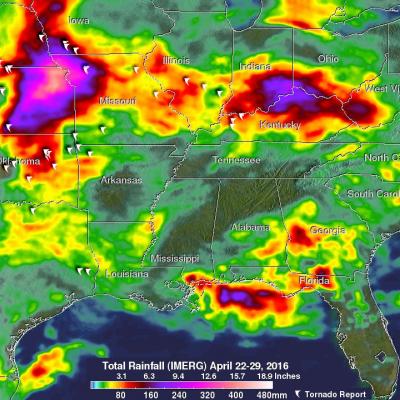
A slow-moving frontal system associated with a stagnant upper-air pattern set the stage for heavy rains and flooding early this week from East Texas all the way up through the Central and Northern Plains. The hardest hit region was in and around the Houston area. On Monday, the National Weather Service reported that Houston International Airport broke its all time daily rainfall record with 9.92 inches of rain. Elsewhere in Harris County, over 17 inches of rain was recorded as of Monday evening. The main culprit was a stationary upper-level low pressure center spinning over the Central Rockies

IMERG Early/Late Run Precipitation Anomalies

Beginning on April 6, anomalies in the input SSMIS F17 precipitation estimates were detected in the IMERG Early and Late runs. These anomalies manifest as episodic “swath shaped” areas of high precipitation over land which appear to affect most orbits to some degree. The root cause is degradation in the 37 GHz V polarization channel. On April 13 the issue was somewhat mitigated but we continue to monitor the situation. Please let us know if you detect these (or other anomalies) in the IMERG Early and Late Runs after April 13.

GPM Views Increasingly Powerful Tropical Cyclone Fantala

Tropical cyclone Fantala has continued to intensify while moving westward over the open waters of the South Indian Ocean. The GPM core observatory satellite passed directly over Fantala's eye on April 14, 2016 at 0148 UTC. At that time the tropical cyclone had maximum sustained winds estimated at 90 kts (104 mph) making in the equivalent of a category two tropical cyclone on the Saffir-Simpson hurricane wind scale. GPM's Microwave Imager (GMI) and Dual-Frequency Precipitation Radar (DPR) instruments again captured data that were used to estimate rainfall within Fantala. Rain was measured by