
GPM Satellite Examines Tornadic Thunderstorms

Over the past few days tornado spawning thunderstorms have occurred in the states of Texas, Oklahoma, Arkansas, Louisiana, Indiana, Mississippi, Alabama and Georgia. Large hail, damaging winds, and flash flooding associated with a frontal system moving across the United States have compounded the damage from these storms. Hail the size of a half-dollar was reported near Jackson, Louisiana on Thursday evening. The GPM core observatory satellite flew over this stormy area on April 1, 2016 at 0241 UTC (March 31, 2016 at 10:41 PM EDT). Tornadoes were reported in Mississippi, Alabama and Georgia

Why Do Raindrop Sizes Matter In Storms?

Submitted by JacobAdmin on
Video Embed

Not all raindrops are created equal. The size of falling raindrops depends on several factors, including where the cloud producing the drops is located on the globe and where the drops originate in the cloud. For the first time, scientists have three-dimensional snapshots of raindrops and snowflakes around the world from space, thanks to the joint NASA and Japan Aerospace Exploration Agency Global Precipitation Measurement (GPM) mission.

Early Spring Storm Brings Snow to Parts of Colorado, Midwest

A strong, upper-level trough that dropped down into the Central Rockies in the middle of last week produced an early spring storm (also referred to as Winter Storm Selene) that dumped heavy snow on the order of a foot or more in a short period of time along the Front Range of Colorado from near Colorado Springs northward through Denver and up into southeastern Wyoming. Around 2 feet of snow were reported in places like Aurora and Boulder with some of the highest totals reaching 31 inches. Farther to the north, Cheyenne, Wyoming picked up over 14 inches of snow from the storm. The blizzard

Tropical Cyclone Emeraude Viewed By GPM

As expected, tropical cyclone Emeraude formed on March 15, 2016 from a tropical low (99s) in the South Indian Ocean. The GPM core observatory satellite flew above intensifying Emeraude on March 16, 2016 at 2121Z after the tropical cyclone's maximum sustained winds had increased to greater than 90 kts (103.5 mph). Rainfall just northwest of Emeraude's eye was measured by GPM's Dual-Frequency Precipitation Radar (DPR) instrument falling at a rate of over 209 mm (8.2 inches) per hour. The powerful thunderstorms producing this extreme rainfall were measured by GPM's radar (DPR) reaching an

GPM Spots Potential South Indian Ocean Tropical Cyclone

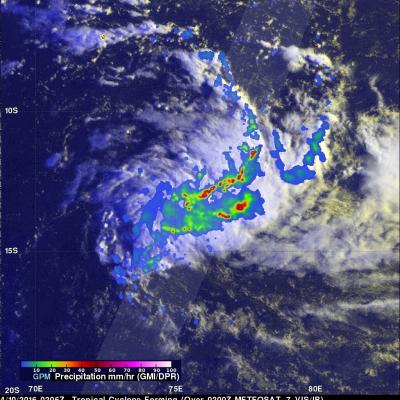
The GPM Core Observatory satellite saw possible tropical cyclone formation in the South Indian ocean on March 15, 2016 at 0900 UTC. A rainfall analysis using data collected by GPM's Microwave Imager (GMI) and Dual-Frequency Precipitation Radar (DPR) shows rain bands wrapping around a tropical low. GPM's DPR measured rain falling at the extreme rate of over 220 mm (8.7 inches) per hour in powerful storms south of the low's center of circulation. GPM's radar (DPR Ku Band) data were able to show the 3-D structure of precipitation within the tropical low. Storm tops heights were measured by GPM