
Extreme Weather News

Jump to a Year

2024 | 2023 | 2022 | 2021 | 2020

2019 | 2018 | 2017 | 2016 | 2015

2014 | 2013 | 2012 | 2011 | 2010

2009 | 2008 | 2007 | 2006 | 2005

2004 | 2003 | 2002

GPM Views Still Energetic Tropical Depression Karl

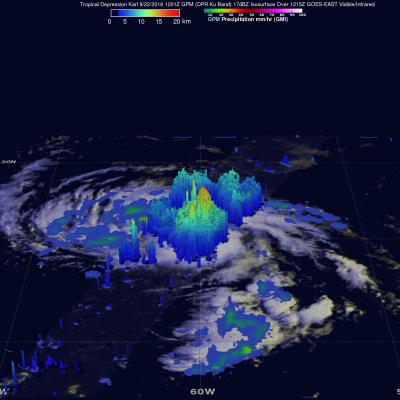
Tropical Depression Karl's strength has fluctuated. Karl formed on September 14th in the eastern Atlantic, strengthened to tropical storm intensity on September 16th and was downgraded to a tropical depression yesterday. The GPM core observatory satellite had an outstanding view of Karl when it passed above today at 1201 UTC (8:01 AM EDT). Data collected by GPM's Microwave Imager (GMI) and Dual-Frequency Precipitation Radar (DPR) instruments uncovered heavy rainfall inside storms within the tropical depression. DPR found that powerful convective storms near Karl's center of circulation were

Remnants Of Post Tropical Storm Julia Checked By GPM

The National Hurricane Center (NHC) issued the last advisory on post tropical storm Julia on September 19, 2016 but the remnants have persisted off the Southeast coast. The remnants of the low are interacting with a slow moving frontal system and are now dropping rain over eastern North Carolina and Virginia. The GPM core observatory satellite flew over this area on Tuesday September 20, 2016 at 7:31 PM EDT (2331 UTC). The satellite's Microwave Imager (GMI) and Dual-Frequency Precipitation Radar (DPR) instruments showed the location and intensity of heavy rainfall within this area of low

GPM Sees Typhoon Malakas Starting To Batter Japan

September 19, 2016 0046 UTC September 19, 2016 1031 UTC After causing high winds and heavy rainfall over northern Taiwan, typhoon Malakas is now starting to batter the islands of southern Japan. The GPM core observatory satellite passed above typhoon Malakas twice on September 19, 2016. The first time was at 0046 UTC when the typhoon was starting to cause light to moderate rainfall over the island of Kyushu. At 1031 UTC GPM showed that moderate to heavy rainfall was moving over Kyushu and the typhoon's appearance had changed significantly. The change in appearance was credited to increased

3D Precipitation Structure Within Hurricane Orlene Examined By GPM Satellite

Orlene, the 9th hurricane of the 2016 eastern Pacific season has weakened to a tropical storm. The GPM core observatory satellite flew over on September 15, 2016 at 1801 UTC when Orlene was still a hurricane with winds reaching about 70 kts (81 mph). Hurricane Orlene's rainfall was examined in 3-D using data collected by the GPM satellite's Dual-Frequency Precipitation Radar (DPR). This digital "CAT scan" like view inside hurricane Orlene shows the locations of the most intense rainfall. An area of heavy downpours was uncovered near the center of Orlene's center of circulation. Radar

GPM Observes Weakening Tropical Storm Julia

Tropical storm Julia was recently downgraded to a tropical depression. The GPM core observatory satellite had an excellent view of tropical storm Julia on September 14, 2016 at 9:36 PM EDT ( September 15, 2016 0136 UTC). Julia was barely a tropical storm at that time with maximum sustained winds of about 40 mph ( 35 kts). Over the past few days Julia has dropped heavy rain along the Atlantic coastline from northeastern Florida to North Carolina. Some areas have received over 8 inches (203 inches) during the past few days. The GPM satellite measured Julia's rainfall and found that intense