
Extreme Weather News

Jump to a Year

2024 | 2023 | 2022 | 2021 | 2020

2019 | 2018 | 2017 | 2016 | 2015

2014 | 2013 | 2012 | 2011 | 2010

2009 | 2008 | 2007 | 2006 | 2005

2004 | 2003 | 2002

Tropical Depression Nine Forms

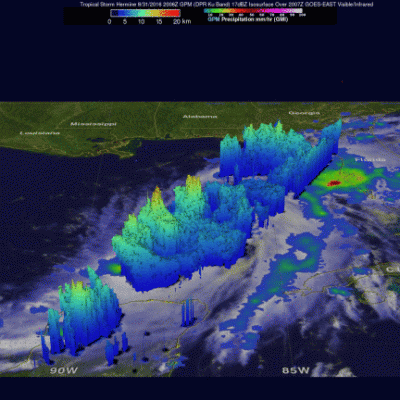
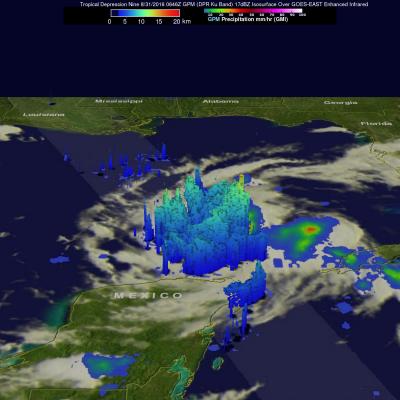
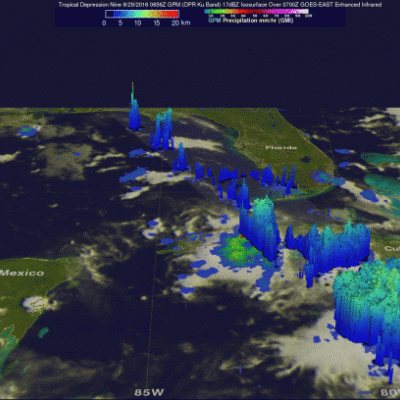
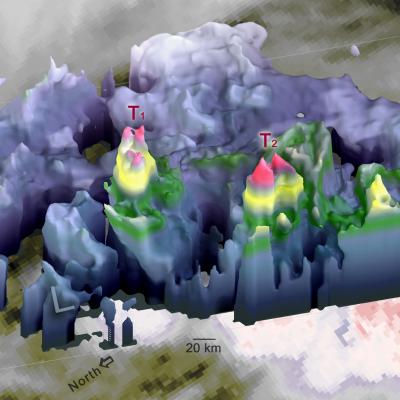
The frequency of tropical cyclone formation has definitely increased in the Atlantic Ocean basin. A tropical wave that the National Hurricane Center (NHC) had been monitoring for development since it left the African coast almost two weeks ago was upgraded to Tropical Depression Nine (TD09L) on August 28, 2016. The low pressure became a little better organized after moving into the Florida Strait and that led to the upgrade. The GPM core observatory satellite passed above the still relatively poorly organized tropical depression on August 29, 2016 at 2:56 AM EDT (0656 UTC). Maximum sustained

GPM Examines Tropical Storm Lester

Lester became the 12rd named storm of the 2016 eastern Pacific Ocean hurricane today. Lester was far away from the Mexican coast early today and headed toward the west-northwest. Low vertical wind shear and warm sea surface temperatures are expected to assist Lester's intensification to hurricane status tomorrow. Tropical storm Lester had wind speeds of about 35 kts (40 mph) when the GPM core observatory satellite passed over on August 25, 2016 at 1026 UTC. Data from GPM satellite's Microwave Imager (GMI) and Dual-Frequency Precipitation Radar (DPR) instruments showed that Lester was getting

Gaston Hovers Around Hurricane Intensity as it Moves into the Central Atlantic

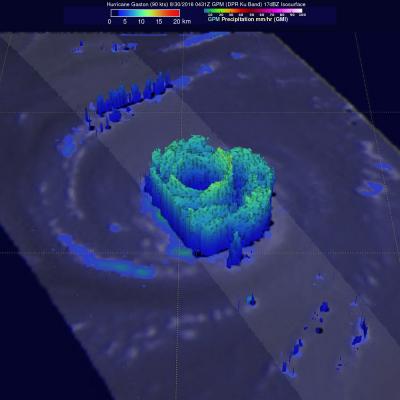
Gaston became the 3rd hurricane of the season early this morning (just after midnight EDT) as the storm was moving northwestward into the Central Atlantic about midway between the Leeward Islands and the Cape Verde Islands before weakening back into a tropical storm less than 12 hours later. Gaston is continuing to battle relatively strong environmental wind shear brought about by an upper-level low pressure center positioned to the west of Gaston. Winds flowing counter-clockwise around the upper low are blowing from the southwest while Gaston is moving northwest. These opposing winds are

GPM Examines Threatening Tropical Disturbance

On August 25, 2016 at 0716 UTC (3:16 AM EDT) the GPM core observatory satellite had an excellent look at an area of low pressure associated with a tropical wave moving past the northern Dominican Republic. The National Hurricane Center (NHC) has been monitoring this area of disturbed weather for potential development into a tropical cyclone. This low is predicted by the NHC to produce heavy rainfall as it continues moving toward the northeast. The development of a tropical storm or hurricane moving in this direction could pose future danger to the Bahamas and the southeastern United States

Typhoon Lionrock's Intensification Seen By GPM

Since August 15, 2016 Japan has been by hit by three tropical cyclones called Mindulle, Chantu and Kompasu. Tropical cyclone Lionrock may be the next to affect Japan. Lionrock formed east of Japan on August 18, 2016 and passed by to the south of Japan as a tropical storm. Loinrock then interacted with tropical storm Mindulle which spun by to the east. Mindulle, although somewhat weakened by Lionrock's outflow, hit Tokyo killing at least 2 people. Lionrock then moved to the southeast of Okinawa and became a powerful typhoon. The GPM core observatory satellite recently passed over typhoon