
Date Last Updated
July 1st, 2022
Document Description

The GPM Combined Radar-Radiometer Algorithm performs two basic functions: first, it provides, in principle, the most accurate, high resolution estimates of surface rainfall rate and precipitation vertical distributions that can be achieved from a spaceborne platform, and it is therefore valuable for applications where information regarding instantaneous storm structure are vital.

Date Last Updated
July 1st, 2021
Document Description

The Level-3 radar products provide daily and monthly global statistics of the Level-2 Ku, Ka and DPR products on a latitude-longitude grid. In version 7 (V07), the organization of the products has changed with the highest-level categorization into FS (full swath), MS (matched or inner swath) and HS (high sensitivity) swath products. The next level of division is into high and low spatial resolution grids that are defined such that the low-resolution grid (G1) is 50×50 (lat×lon) while the high-resolution grid (G2) is 0.250× 0.250.

File Downloads
Document Description

Latent heating (LH) cannot be measured directly with current techniques, including current remote sensing or in situ instruments, which explains why nearly all satellite retrieval schemes depend heavily on some type of cloud-resolving model or CRM (Tao et al. 2006, 2016). This is true for the current CSH algorithm (Tao et al. 2010).

Input: Combined 2BCMB (DPR + GMI) rainfall products

GPM Satellite Reveals Intensity Of Powerful Storms In The Timor Sea

The GPM satellite flew over a stormy area of the Timor Sea northwest of Australia on February 7, 2017 at 1926Z. GPM found that this stormy area contained some extremely powerful convective storms. GPM's Dual-Frequency Precipitation Radar (DPR) found that the most intense storms were dropping rain at a rate of over 268 mm (10.6 inches) per hour. Data received by GPM's Radar (DPR Ku Band) also revealed the 3-D anatomy of precipitation hidden inside these unusually powerful storms. GPM's radar found that these storm tops were pushing to altitudes greater than 19 km (11.8 miles). GPM radar data

GPM Sees Carlos Moving Past Reunion Island

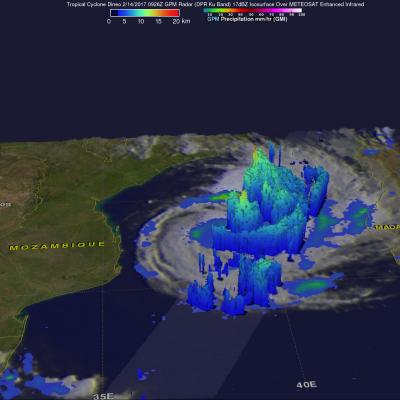
The GPM core observatory satellite flew above tropical cyclone Carlos on February 7, 2017 at 1056 UTC. Carlos was moving past Reunion Island with maximum sustained winds estimated at 45 kts (51.8 mph). GPM's Microwave Imager (GMI) and Dual-Frequency Precipitation Radar (DPR) data show that rain bands west of Carlos' center were producing heavy rainfall. GPM's DPR swath is shown in a lighter shade. DPR measured a few downpours in the bands west of the Carlos' center of circulation dropping rain at a rate of over 120 mm (4.7 inches) per hour. GPM's radar (DPR Ku Band) found that a few storm tops