
Extreme Weather News

Jump to a Year

2024 | 2023 | 2022 | 2021 | 2020

2019 | 2018 | 2017 | 2016 | 2015

2014 | 2013 | 2012 | 2011 | 2010

2009 | 2008 | 2007 | 2006 | 2005

2004 | 2003 | 2002

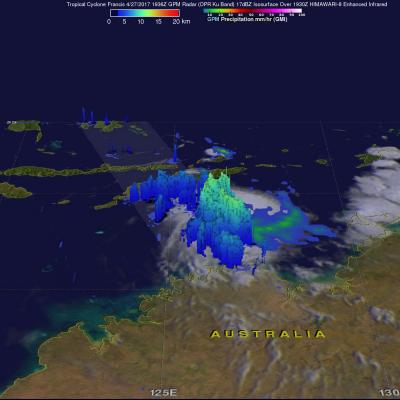
Intensifying Tropical Cyclone Francis Inspected By GPM

Tropical cyclone Francis formed north of Melville Island, Australia on April 27, 2017. Francis has been gradually intensifying while moving south-southwestward through the Timor Sea. Francis had maximum sustained winds estimated at 50 kts (57.5 mph) when the GPM core Observatory flew over on April 27, 2017 at 1936 UTC. The rainfall analysis shown here used data collected by GPM's Microwave Imager (GMI) and Dual-Frequency Precipitation Radar (DPR) instruments. DPR data indicated that strong convective storms near the center of the tropical storm were dropping rain at a rate of over 70 mm (2.8

Tropical Depression 03W In The Pacific Examined By GPM

Tropical Depression 03W formed in the Pacific Ocean west of Guam on April 24, 2017. The GPM core observatory satellite had an excellent view of TD03W when it flew over on April 14, 2017 at 1901 UTC. The GPM satellite found that the newly formed tropical depression contained some very powerful convective storms. Intense storms in the middle of the organizing convective cluster were dropping precipitation at extreme rates. GPM's Microwave Imager (GMI) and Dual-Frequency Precipitation Radar (DPR) instruments unveiled tall convective storm towers on the eastern side of this cluster of storms that

Arlene Becomes Rare Atlantic Tropical Cyclone

Tropical storms are quite rare in the Atlantic at this time of the year, which is why the formation of Tropical Storm Arlene in the north Central Atlantic yesterday, Thursday April 20th at 5:00 pm EDT, was so unusual. The National Hurricane Center (NHC) noted that Arlene became only the 2nd tropical storm to form in the Atlantic during the month of April in the entire satellite era, the other being Tropical Storm Ana back in 2003. GPM captured this timely image of Arlene just after the NHC officially designated it to be a tropical storm. The image was taken at 21:56 UTC (5:56 pm EDT) on

GPM Sees the Formation of Early Atlantic Ocean Tropical Depression 1

A low pressure area in the Atlantic Ocean, located southwest of the Azores was designated as Subtropical Depression One on April 19 as NASA examined its rainfall. By April 20 it had become the Atlantic's first tropical depression. Just as the subtropical depression was forming in the North Atlantic Ocean on April 19 at 11 a.m. EDT (1500 UTC) the Global Precipitation Measurement Mission or GPM core observatory satellite flew directly over it and identified areas where rainfall was heaviest in the system. Data collected by GPM's Microwave Imager (GMI) and Dual-Frequency Precipitation Radar (DPR)

GPM Sees Tropical Cyclone Maarutha Develop

Tropical Storm Maarutha became the first tropical cyclone of 2017 in the Bay of Bengal when it formed on April 15, 2017. Maarutha intensified slightly as it moved northeastward toward Burma (Myanmar). Maarutha reached it's maximum sustained wind speed of 45 kts (52 mph) over the open waters of the Bay Of Bengal. The GPM core observatory satellite had a good view of the forming tropical cyclone on April 14, 2017 at 0121 UTC when it was in the Bay Of Bengal west of the Andaman Islands. GPM had another excellent view just before the organizing tropical cyclone was designated tropical storm