
Extreme Weather News

Jump to a Year

2024 | 2023 | 2022 | 2021 | 2020

2019 | 2018 | 2017 | 2016 | 2015

2014 | 2013 | 2012 | 2011 | 2010

2009 | 2008 | 2007 | 2006 | 2005

2004 | 2003 | 2002

GPM Measures Tropical Cyclone Debbie
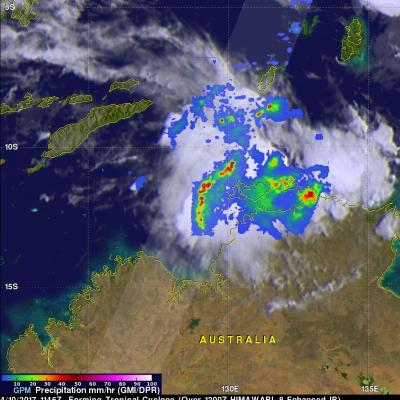
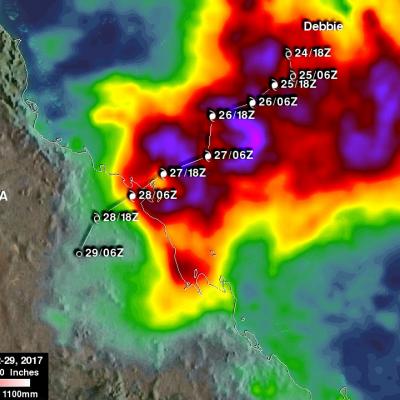
Tropical cyclone Debbie formed in the Coral Sea northeast of Australia om March 24, 2017. Debbie intensified and had hurricane force wind speeds within a day of formation. While headed toward northeastern Australia Debbie reached it's maximum sustained wind speeds estimated at over 100 kts (115 mph) on March 27, 2017 (UTC). Tropical cyclone Debbie came ashore on March 28th and brought destructive winds and extremely heavy rain to northeastern Australia. It was reported that heavy rainfall caused flash flooding that cut off a coastal town and covered several roads in Queensland. The GPM...

Tropical Cyclone Caleb's Rainfall Revealed By GPM

Tropical cyclone Caleb formed today in the South Indian Ocean southwest of the Indonesian Island of Sumatra. The GPM core observatory satellite had a fairly good view of the the newly formed tropical cyclone when it flew over on March 23, 2017 at 0756 UTC. The satellite's Microwave Imager (GMI) revealed the locations of rainfall within the tropical cyclone. Rainfall measurements derived from the GMI showed that convective storms's were dropping rain at a rate of almost 84 mm (3.3 inches) per hour on Caleb's eastern side. The Joint Typhoon Warning Center (JTWC) predicts that tropical cyclone

Peru's Deadly Rainfall Examined With NASA's GPM Data

This year unusually heavy rainfall has caused extensive flooding and loss of life in Peru. Extreme flooding and frequent landslides that occurred this month have forced many from their homes. An El Niño like condition with warm ocean waters developed near Peru's coast. This extremely warm water off Peru's western coast has been blamed for promoting the development of these storms. Equatorial sea surface temperatures (SSTs) are about average elsewhere in the central and east central Pacific. This image shows the locations of storms that were dropping heavy rainfall over northwestern Peru when

GPM Sees Powerful Convective Storms In The Timor Sea

The GPM core observatory satellite passed above some energetic storms in the Timor Sea north of Australia on March 20, 2017 at 0726 UTC. These powerful storms were being invigorated by very warm sea surface temperatures and low vertical wind shear aloft. Balmy water in the Timor Sea was reaching temperatures of 30 to 32 degrees Celcius (86 to 89.6 Fahrenheit). Data collected by GPM's Microwave Imager (GMI) and Dual-Frequency Precipitation Radar (DPR) instruments showed that these storms contained some very heavy downpours. GPM's DPR found rain falling at a rate of over 238 mm (9.4 inches) per

Tropical Cyclone's Remnants Examined By GPM

The GPM core observatory satellite flew above the remnants of tropical cyclone 11S on March 14, 2017 at 2356 UTC. The remnants were located south-southeast of Madagasgar and were rapidly transforming into an extra-tropical low. GPM showed the locations of intense rainfall still being produced by the low. GPM's Dual-Frequency Precipitation Radar (DPR) data showed that rain was falling at a rate of over 205 mm (8 inches) in a few storms. GPM's radar (DPR Ku Band) found that some storm tops in the remnants were reaching heights above 13 km (8 miles). GPM satellite radar (DPR Ku Band) data were