

tropical storms

GPM Extreme Weather Photo Contest
Powerful weather systems like thunderstorms and tornadoes are awesome displays of the force of nature. Now NASA wants to display YOUR photos of extreme weather! Post your coolest photographs and we'll pick the best ones to feature on the NASA Precipitation Measurement Missions websites (http://pmm.nasa.gov/ & http://www.nasa.gov/GPM). While we want extreme weather, we don't want YOU to be too extreme. So before you take that photo, please make sure you're keeping safe. Submission Guidelines: Submit your photo's to the GPM Extreme Weather Flickr group: http://www.flickr.com/groups/gpm-extreme...

Tropical Storm Ernesto In The Gulf Of Mexico
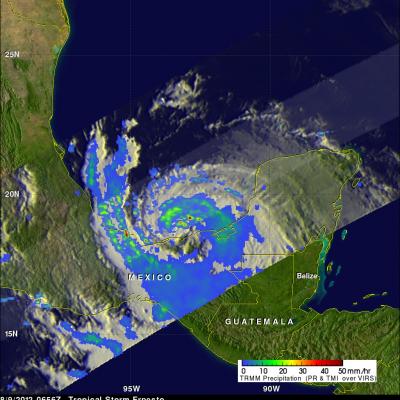
The TRMM satellite saw Ernesto on August 9, 2012 at 0656 UTC ( 2:36 AM EDT) after the tropical storm had moved from the Yucatan Peninsula into the Gulf of Mexico. An analysis of TRMM Microwave Imager (TMI) and Precipitation Radar (PR) rainfall is shown in the image above. This analysis shows that powerful convective thunderstorms were dropping rain at a rate greater than 50mm/hr (~2 inches) north of the storm's center. TRMM Precipitation Radar (PR) data were used in the image below to show a 3-D view of Ernesto's vertical structure. This PR view shows that a few of the powerful convective
Tropical Storm Ernesto Approaches The Yucatan

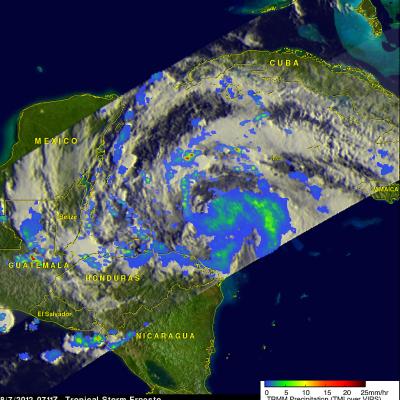
The TRMM satellite passed over tropical storm Ernesto on 7 august 2012 at 0711 UTC ( 3:11 AM EDT) as it was heading toward the Yucatan Peninsula. TRMM's Microwave Imager (TMI) and Precipitation Radar (PR) instruments show that Ernesto was a little better organized with bands of moderate to occasionally heavy rainfall spiraling into the center of the storm's circulation. A few powerful convective storms are shown located in these widely separated rain bands. The National Hurricane Center (NHC) predicts that Ernesto will be a category one hurricane on the Saffir-Simpson scale with winds of about

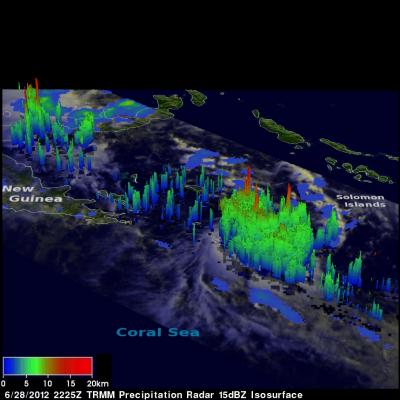
TRMM Sees South Pacific Tropical Cyclone 21P

The South Pacific hurricane season normally ends in April but tropical cyclone 21P has developed in the South Pacific Ocean between Papua New Guinea and the Solomon Islands. The center of the tropical cyclone was directly beneath the TRMM satellite when it passed over on 28 June 2012 at 2225 UTC (~8:25 AM Local time). A rainfall analysis using data from TRMM's Microwave Imager (TMI) and Precipitation Radar (PR) instruments shows that the tropical cyclone, although small, was well organized and contained some intense convective storms dropping rainfall at a rate of over 50mm/hr (~2 inches). A 3

Debby's Remnants Will Slightly Affect Bermuda

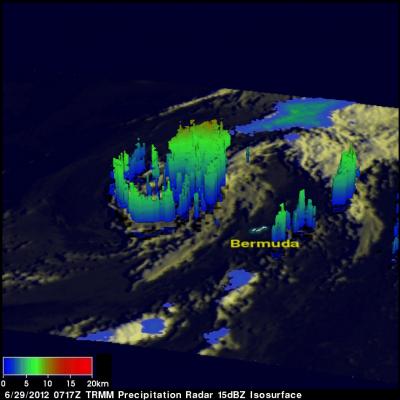
The remnant low pressure center from tropical storm Debby is predicted to kick up winds to gale force and cause a few showers today as it passes to the northwest of Bermuda. The TRMM satellite passed over the low early this morning at 0717 (4:17 AM ADT). TRMM Microwave Imager (TMI) and Precipitation Radar (PR) data show that Debby's remnant low contained a few light to moderate showers. A 3-D view using TRMM PR data shows that the most powerful of these storms were only reaching heights of about 10km (~6.2 miles).

Tropical Storm Debby Drenches Florida

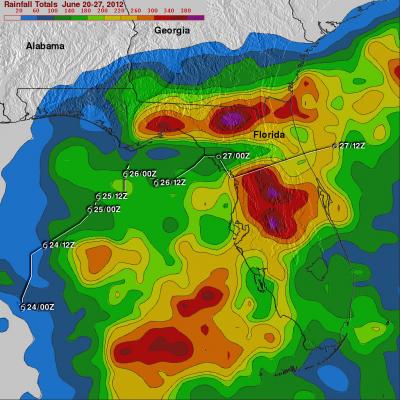
Even though it never became more than a tropical storm, the residents of northern and central Florida will remember Debby. Debby, which formed as a tropical storm on the 23rd of June 2012 in the central Gulf of Mexico, took three full days to reach the Big Bend of Florida just 350 miles away. Although the center didn't make landfall until around 5 pm on the afternoon of the 26th when it crossed the coast near Steinhatchee, Florida, Debby's effects were felt well away from the center. Most of the rain and weather associated with Debby were well to the north and east of the center over Florida

Tropical Storm Debby Threatens Florida Gulf Coast

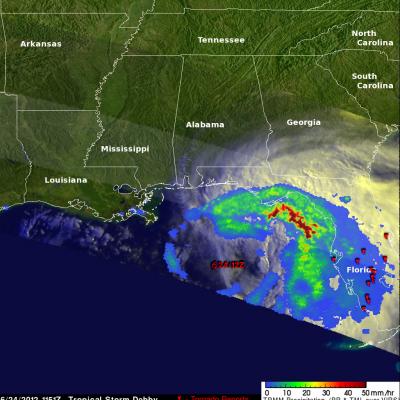
Tropical Storm Debby formed on the 23rd of June 2012 in the central Gulf of Mexico, becoming the earliest 4th named storm on record. Debby began as an area of low pressure that moved out of the northwestern Caribbean and into the Gulf. After forming on the afternoon of the 23rd, Debby has moved very slowly under the influence of weak steering currents. Debby drifted ever so slowly northward on the night of the 23rd before turning northeast later on the morning of the 24th towards the northeast Gulf Coast of Florida. Despite its slow forward progress and lack of intensification, Debby has

Tropical Storm Debby

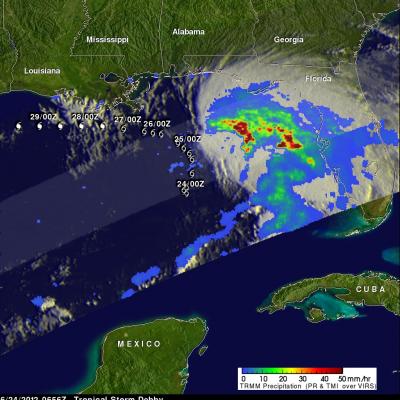
The TRMM satellite traveled directly above tropical storm Debby's location early this morning at 0656 UTC ( 2:56 AM EDT). TRMM Microwave Imager (TMI) and Precipitation Radar (PR) data from that pass shows that Debby was dropping heavy rainfall in a large area on the eastern side of the Gulf Of Mexico. Most of the powerful convective storms producing this rainfall are shown by TRMM to be located well to the northeast of Debby's center of circulation. A forecast track from the National Hurricane Center (NHC) was overlaid on the image above. It shows that Debby is expected to stengthen and travel

Tropical Storm Talim Weakens, Moves Over Japan

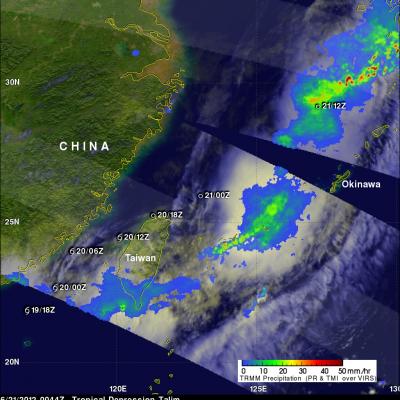
Both Taiwan and Southern Japan have had extreme amounts of rainfall contributed by tropical cyclones during the past week. Tropical storm Talim weakened to a tropical depression on June 18, 2012 after passing over the northern tip of Taiwan. Flooding, landslides and at least one death in Taiwan were reportedly caused by Talim. The weakening tropical depression is now affecting Japan in areas that were just drenched by Typhoon Guchol's passage. This image shows rainfall from data collected with two TRMM satellite orbits as it passed over that area. TRMM passed over on June 20, 2012 at 2308 UTC

Tropical Storm Talim's Heavy Rainfall Over Taiwan

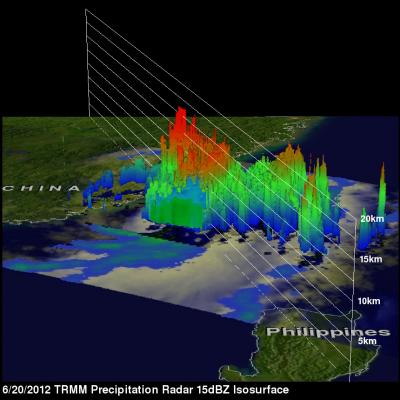
Tropical storm Talim has produced torrential rainfall over southern Taiwan as it pumped warm moist air from the South China Sea over mountainous terrain. The TRMM satellite flew over tropical storm Talim in the Taiwan Strait on 20 June 2012 at 0140 UTC. TRMM Precipitation Radar (PR) data from this orbit shows that tropical storm Talim was dropping rainfall at a rate of almost 50mm/hr over Taiwan. TRMM data captured with that orbit shows that the most intense rainfall of over 50mm/hr (~2 inches) was located over the Strait Of Taiwan. Flash flooding and landslides are probable in southern Taiwan