
tropical storms

Guchol's Rainfall Drenching Japan
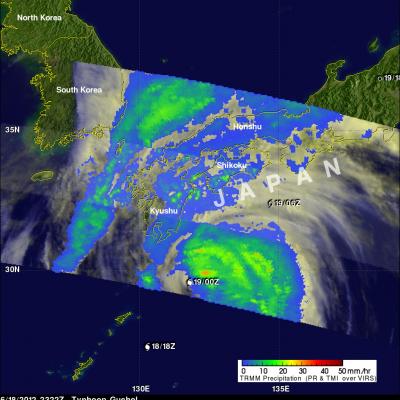
The TRMM satellite passed above weakening typhoon Guchol on 18 June 2012 at 2322 UTC as it moved toward Japan's main island of Honshu. Guchol's past and predicted locations are shown overlaid in white. A precipitation analysis from TRMM's Microwave Imager (TMI) and Precipitation Radar (PR) instruments show that the Japanese islands of Kyushu and Shikoku were getting rainfall from Guchol at the time of that orbit. Guchol was shown by TRMM to be enhancing rainfall in parts of Japan over 500 km (~310.7 miles) from the typhoon's center.
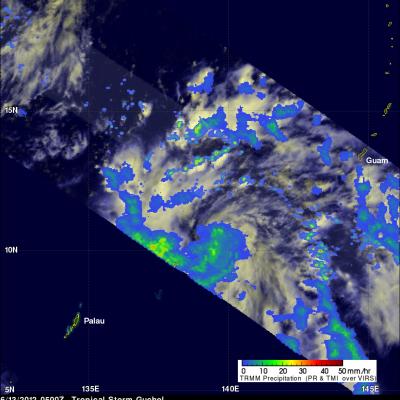
Tropical Storm Guchol Slowly Strengthens

The tropical depression (05W) that became tropical storm Guchol yesterday formed southeast of Guam on June 11, 2012. TRMM had a fairly good daytime look at Guchol on June 13, 2012 at 0500 UTC. TRMM's Microwave Imager (TMI) data revealed that Guchol contained a large area of moderate to heavy rainfall. Guchol is expected to continue moving toward the northwest, slowly intensify and reach minimal typhoon strength on June 14, 2012.

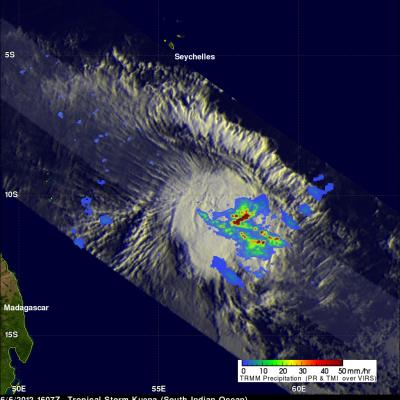
Late Season Tropical Storm Kuena Forms

A tropical storm called Kuena formed in the southwest Indian Ocean east of Madagascar on June 6, 2012. This is a little unusual because the tropical cyclone season in that area normally ends on May 15. The TRMM satellite had an excellent view of Kuena when it flew directly above the newly formed storm on June 6, 2012 at 1607 UTC. A rainfall analysis that used data from TRMM's Microwave Imager (TMI) and Precipitation Radar (PR) instruments is shown overlaid on an enhanced infrared image from TRMM's Visible and InfraRed Scanner (VIRS) instrument. This analysis shows that heavy convective storms

Tropical Storm Beryl Brings Some Much Needed Drought Relief to Southeast US

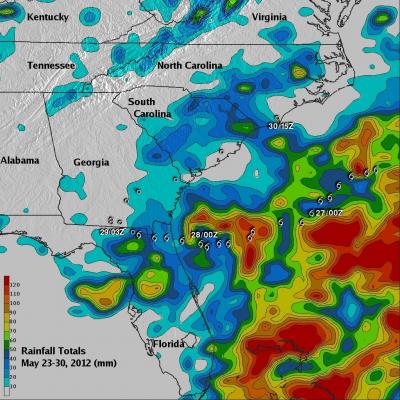
Tropical Storm Beryl was actually a welcome sight in parts of the Southeast. Tropical cyclones are not always bad news. Sometimes they can be quite beneficial, especially when it comes to relieving drought conditions. Tropical Storm Beryl made landfall just after midnight (local time) on the night of 27 May 2012 near Jacksonville Beach, Florida as a strong tropical storm with sustained winds of 70 mph, making it the strongest tropical cyclone to make landfall in the US before the official June 1st start of the Atlantic hurricane season. Prior to the arrival of Beryl, many parts of the

Tropical Cyclone Season Gets Started in the Northern Hemisphere

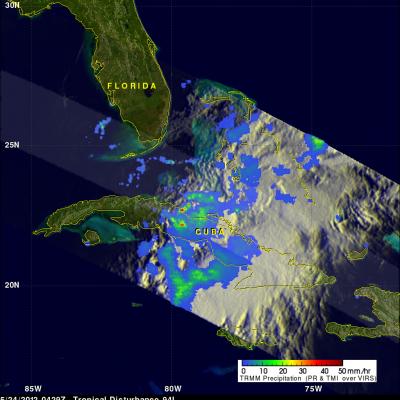
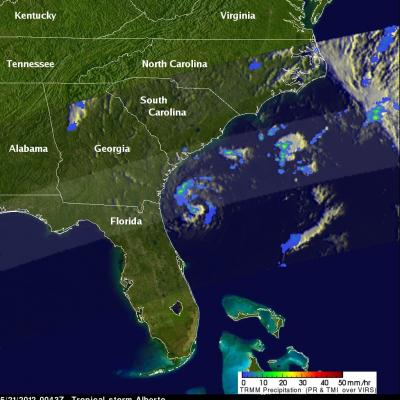
Summer has not yet arrived, and yet there are currently 3 active tropical systems in the Northern Hemisphere spread across three different ocean basins. Perhaps, the most unusual of the three is Tropical Storm Alberto in the Atlantic. Alberto formed in the western Atlantic from a stationary low pressure system off of the coast of South Carolina on the 19th of May 2012, two weeks before the official June 1st start of the Atlantic hurricane season. Alberto is the first tropical storm to form this early in the season since Tropical Storm Ana in 2003, which formed on the 20th of April west of

TRMM Sees First Atlantic Tropical Storm Forming

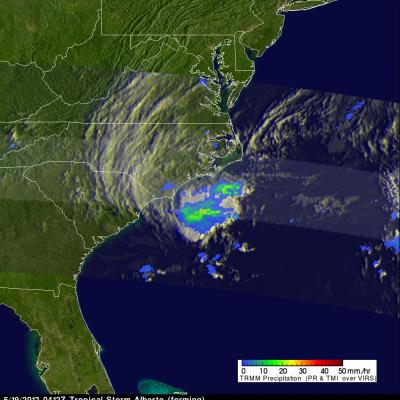
The TRMM satellite flew above tropical storm Alberto when it was forming off the coast of South Carolina today. TRMM Microwave Imager (TMI) and Precipitation Radar (PR) data captured at (12 minutes after midnight EDT) were used in the rainfall analysis shown above. It shows a large area of moderate to heavy rainfall with a small area of heavy rainfall located near the center of the forming tropical cyclone.

TRMM Sees Disorganized Aletta

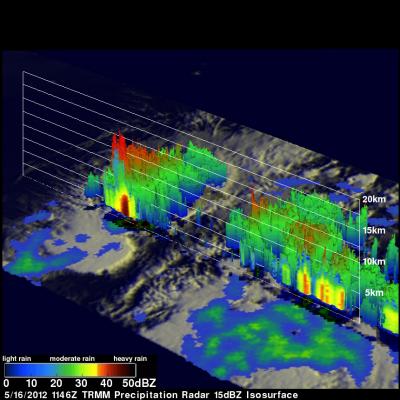
The TRMM satellite passed almost directly above tropical storm Aletta in the eastern Pacific Ocean on 16 March 2012 at 1146 UTC. Data from TRMM's Microwave Imager (TMI) and Precipitation Radar (PR) instruments were used in the rainfall analysis shown above. Aletta's past and future positions are shown overlaid in white. Aletta looks disorganized in this orbit but some very heavy thunderstorms, producing rainfall at a rate greater than 50mm/hr (~2 inches), were located near the storm's center. TRMM's Precipitation Radar (PR) found that some thunderstorms contained very heavy rainfall with a

Tropical Storm Aletta Forms

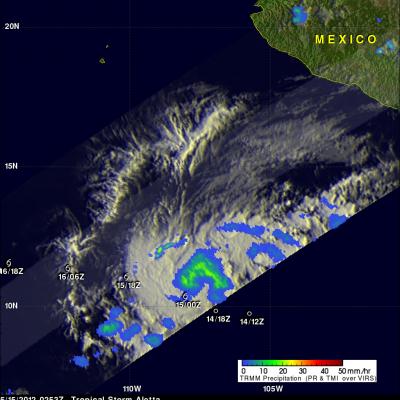
The eastern Pacific hurricane season starts today. Just slightly ahead of schedule tropical storm Aletta formed yesterday well to the southwest of the Mexican coast. The image above uses data captured when the TRMM satellite passed above Aletta on 15 May 2012 at 0253 UTC. TRMM's Microwave Imager (TMI) instrument had a good look at the newly formed storm and showed that Aletta had a large area of light to moderate rainfall north of the storm's center of circulation. The TMI rainfall analysis is shown overlaid on an enhanced infrared image from TRMM's Visible and InfraRed Scanner (VIRS)

TRMM Sees Tropical Storm Lua's Formation

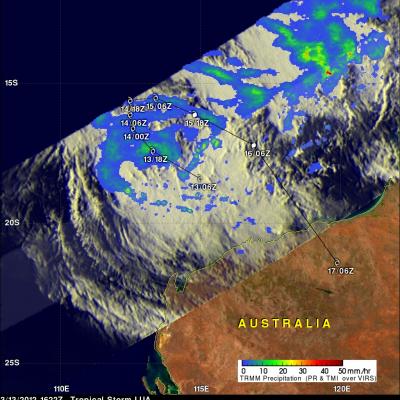
A tropical storm called LUA formed in the Indian Ocean off Australia's northwestern coast on 13 March 2012. This area of Australia is sparsely populated but LUA caused the shutdown of over one quarter of the country's crude oil production. The TRMM satellite flew over this area on 13 March 2012 at 1622 UTC. A Rainfall analysis using TRMM's Microwave Imager (TMI) and Precipitation Radar (PR) instruments is shown overlaid on an enhanced infrared image from TRMM's Visible and InfraRed Scanner (VIRS). This analysis indicates that rainfall intensity was mainly in the moderate range of 20 to 30 mm