
GPM

Content which is affiliated solely with the Global Precipitation Measurement Mission.

GPM Examines Weaker Tropical Storm Yutu in the South China Sea
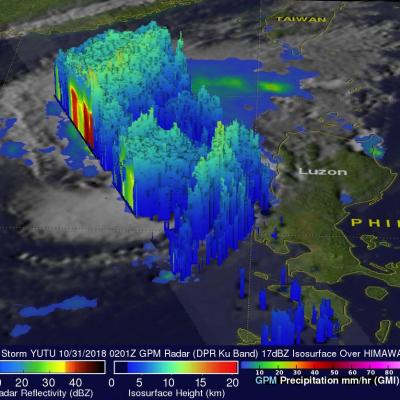
Typhoon YUTU (known as Rosita in the Philippines) is now threatening the Philippine Island of Luzon. On October 24, 2018 YUTU devastated the northern Mariana Islands of Tinian and Saipan as a super typhoon. One death has been attributed to the typhoon in the Marianas with many structures including schools and hospitals being destroyed. Typhoon YUTU weakened as it moved toward the Philippines and had maximum sustained winds of about 90 kts (103.5 mph) when the GPM core observatory satellite passed above the Philippine Sea on October 29, 2018 at 0212 UTC. This rainfall analysis was developed
GPM Catches Typhoon Yutu Making Landfall
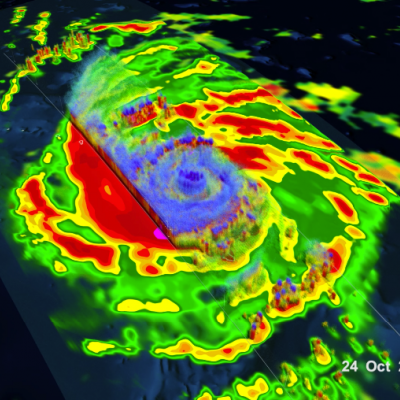
NASA's GPM Core observatory satellite captured an image of Super Typhoon Yutu when it flew over the powerful storm just as the center was striking the central Northern Mariana Islands north of Guam. Early Thursday, Oct. 25 local time, Super Typhoon Yutu crossed over the U.S. commonwealth of the Northern Mariana Islands. It was the equivalent of a Category 5 hurricane. The National Weather Service in Guam said it was the strongest storm to hit any part of the U.S. this year. Download this video in high resolution from the NASA Goddard Scientific Visualization Studio Download video without...

Dangerous Hurricane Willa Probed By GPM Satellite

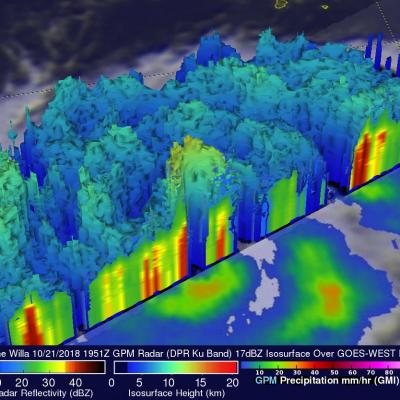
Hurricane Willa was moving northward toward the western coast of Mexico when the GPM core observatory passed above on October 21, 2018 at 1:51 PM MDT (1951 UTC). The hurricane had maximum sustained winds of about 95 mph (109 kts). Since then Willa has rapidly intensified and today has winds of 155 mph (135 kts) making it a dangerous category four on the Saffir-Simpson hurricane wind scale. GPM's Microwave Imager (GMI) and Dual-Frequency Precipitation Radar (DPR) instruments collected data showing that hurricane Willa and feeder bands were producing heavy rainfall over a large area. The

GPM Views Downgraded Hurricane Michael Soaking the Eastern U.S.

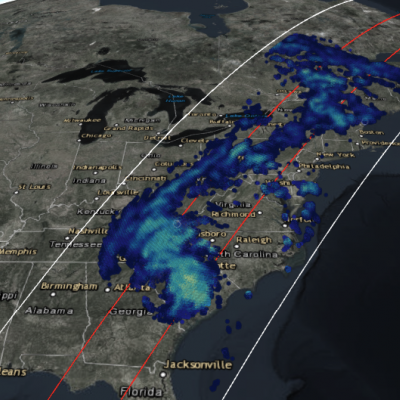
View fullscreen in STORM Event Viewer Hundreds of miles way from its landfall in Mexico Beach, Florida, Michael has been downgraded to a tropical storm, but it continues to pack a punch. Waterlogged regions of the Carolinas from Hurricane Florence are seeing trees toppled in the gusty winds, while rain falling in the Appalachian Mountains is leading to flash flooding and water rescues. Widespread power outages and flooding remain likely as the storm moves to the northeast through the rest of the day.

GPM Scans Tropical Storm Nadine

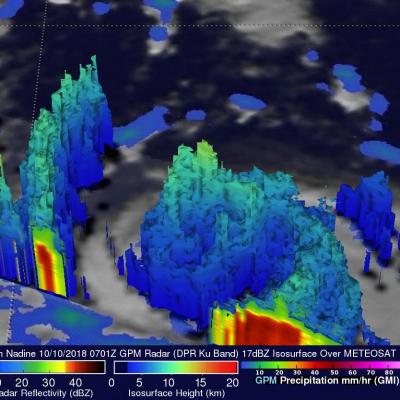
Tropical Depression fifteen was located southwest of the Cabo Verde Islands when it became tropical storm Nadine early on October 9, 2018. The GPM core observatory collected significant information about Nadine when it scanned the tropical storm's center of circulation on October 10, 2018 at 3:01 AM EDT (0701 UTC). Nadine was a small tropical storm but GPM's Microwave Imager (GMI) and Dual-Frequency Precipitation Radar (DPR) data revealed that extreme rainfall was occurring in areas around the center of the tropical cyclone. GPM's radar (DPR Ku Band) measurements indicated that rain was

GPM's GMI Measures Weakening Kong-Rey's Rainfall

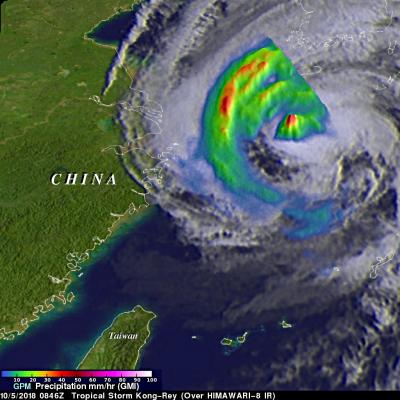
The GPM core observatory passed above tropical storm Kong-Rey on October 5, 2018 at 0846 UTC. Kong-Rey was a powerful category five typhoon just a few days ago but increased vertical wind shear and cooler sea surface temperatures have caused the tropical cyclone to weaken dramatically. Tropical storm Kong-Rey had maximum sustained winds of about 55 kts (63 mph) when it was scanned by the satellite. GPM's Microwave Imager (GMI) data were used to gauge the intensity of precipitation around Kong-Rey's center of circulation. Energy observed through clouds by GMI's microwave channels was used to
Dive Into a 360-View of Hurricane Maria
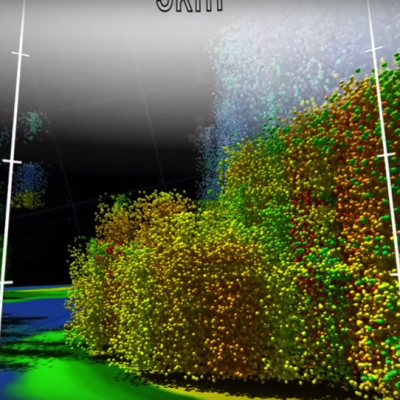
Two days before Hurricane Maria devastated Puerto Rico, the NASA/JAXA Global Precipitation Measurement Core Observatory satellite captured a 3D view of the 2017 storm. At the time Maria was a category 1 hurricane. The 3-D view reveals the processes inside the hurricane that would fuel the storm’s intensification to a category 5 storm within 24 hours. For the first time in 360 degrees, this data visualization takes you inside the hurricane. The precipitation satellite has an advanced radar that measures both liquid and frozen water. The brightly colored dots show areas of rainfall, where green...

GPM Examines Upgraded Hurricane Leslie

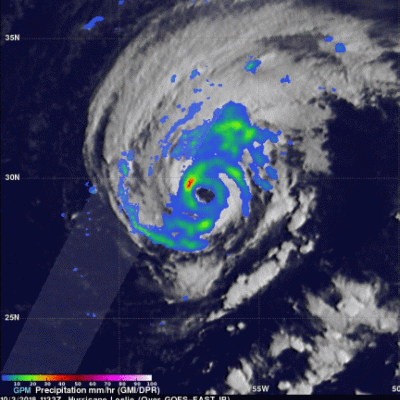
The GPM core observatory satellite passed above hurricane Leslie on October 3, 2018 at 7:33 AM EDT (1133 UTC). Leslie had just been upgraded to a hurricane by the National Hurricane Center (NHC). GPM's Microwave Imager (GMI) instrument collected data that revealed light to moderate convective rainfall in Leslie's clearly evident eye wall. Very little precipitation was shown by GPM in the center of the hurricane's nearly circular eye. Algorithms developed by NASA's Precipitation Measurement Missions (PMM) science team indicated that rain was falling at over 1.8 inches (45.7 mm) per hour within

GPM Sees Walaka Becoming A Powerful Hurricane

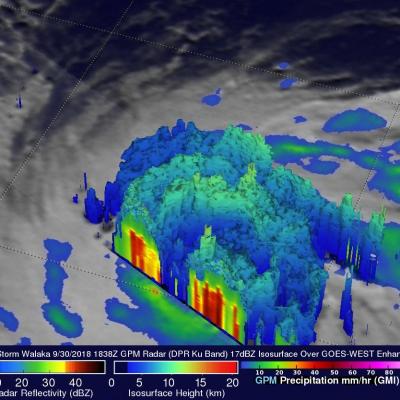
The GPM core observatory recently had a couple good looks at tropical storm Walaka as it was intensifying into a powerful hurricane. GPM passed directly over tropical storm Walaka when it was located south of the Hawaiian islands on September 30, 2018 at 8:38 AM HST (1838 UTC). Data collected by GPM's Microwave Imager (GMI) and Dual-Frequency Precipitation Radar (DPR) instruments showed that Walaka was well organized and very close to hurricane intensity. GPM's Radar (DPR Ku Band) data revealed intense convective storms in a large feeder band that was wrapping around the tropical storm's
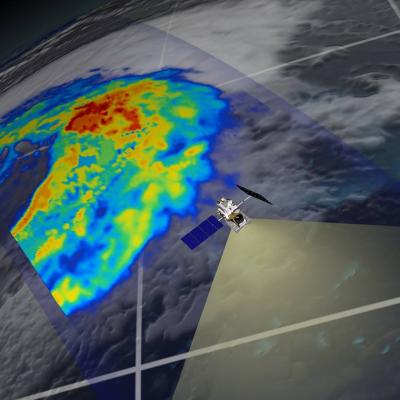
GPM flying over Earth with a data swath visualized.
We Want You to Go to Class! Our students desperately need to have some face to face time with scientists and engineers who are doing amazing things to make their world a better place. That means you guys! From time to time, you may be invited to give a presentation on your work to kids in some context- and we want to make it easier for you. You might even reach out yourself to your local school and offer to come in and give a talk. Having been a classroom teacher across all grade levels by the time I finished my illustrious career, I know personally the joy of having real STEM professionals...