

Alaska Rainfall 2019 and 2020
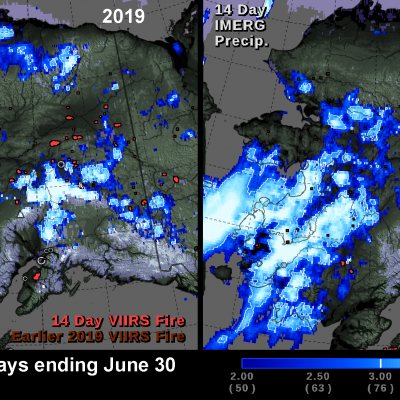
NASA's multi-satellite precipitation algorithm, known as IMERG, is a tool that can help us understand recent fluctuations in Alaska's wildfires. In the summer of 2020, wildfires burned fewer acres in Alaska than in any other year during the past 10 years. In contrast, wildfires burned a record number of acres in Alaska in the summer of 2019. The image below shows the locations of satellite-detected fires and precipitation during the last two weeks of June for both years. The above image shows IMERG rainfall totals overlaid with fire hot spot detections from the Visible Infrared Imaging
Average Precipitation Daytime vs. Nighttime
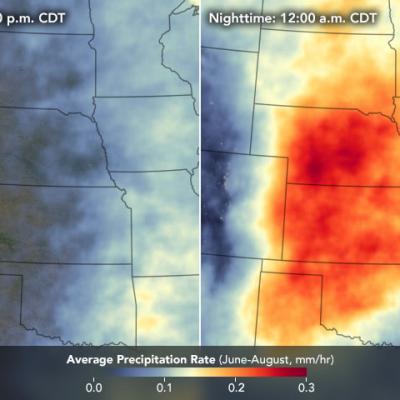
During the summer, the U.S. Great Plains routinely experiences nighttime thunderstorms unlike anywhere else in the country. These large-scale storms—sometimes spanning entire states—account for more than 40 percent of annual rainfall in some areas. They can bring much-needed rain to farms and help recharge aquifers, but extremely severe events can also destroy fields, homes, and lives. Scientists have been studying the region for decades to learn the underpinnings of this distinct, repetitive weather pattern.

2020 PMM Science Team Meeting

Dates
Location
Virtual (Microsoft Teams)

The meeting is by invitation to Precipitation Measurement Mission (PMM) Science Team members and specified affiliates. Monday, October 19, 2020, is devoted to working group meetings. Tuesday – Thursday, October 20-22, will consist of general oral and poster sessions covering mission/program status, partner reports, science activities, field campaign results, and other science team business.  Friday, October 23, is devoted to algorithm team meetings (all Science Team Meeting attendees are invited).

Mission Affiliation

How are the TMPA and IMERG algorithm designs the same and different?

Both TMPA and IMERG use a constellation of passive microwave satellites, and within the general umbrella groups of "sounder" and "imager" the inputs are much the same, although at the end of the TRMM era the TMPA was not upgraded to include the newer satellites. The direct inputs of the TMI and GMI are swamped by the amount of data from the rest of the microwave sensors, so the absence of TMI in the last 4.5 years of TMPA was not a major problem.

Assessing the skill of NCMRWF global ensemble prediction system in predicting Indian summer monsoon during 2018

Submitted by LisaN on
Publication Year
Authors
Chakraborty, P., A. Sarkar, R. Bhatla, and R. Singh
Journal
Atmospheric Research
Volume
248
Page Numbers
105255
DOI
10.1016/j.atmosres.2020.105255
Publication URL
https://www.sciencedirect.com/science/article/pii/S0169809520311923
Mission Affiliation
Major Category