
Extreme Weather News

Jump to a Year

2024 | 2023 | 2022 | 2021 | 2020

2019 | 2018 | 2017 | 2016 | 2015

2014 | 2013 | 2012 | 2011 | 2010

2009 | 2008 | 2007 | 2006 | 2005

2004 | 2003 | 2002

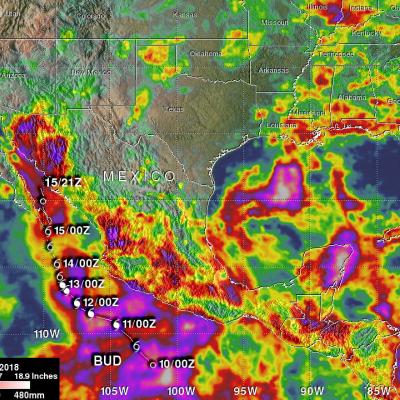
GPM Flies Over Hurricane Bud off the Coast of Mexico

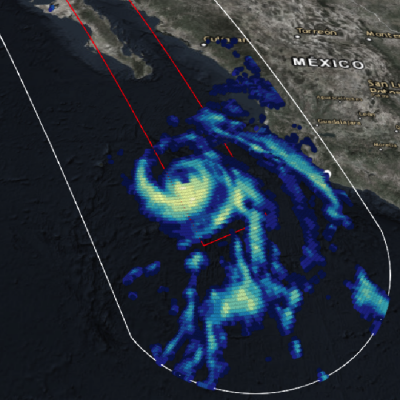
View full-screen in STORM Event Viewer The GPM core observatory satellite passed above hurricane BUD in the eastern Pacific Ocean on June 12, 2018 at 5:27 PM MDT (2327 UTC). BUD's movement over colder waters had caused it's eye to become less defined. Data collected by GPM's Microwave Imager (GMI) showed that moderate to heavy precipitation was only present in the southeastern quadrant of the weakening hurricane. GPM's GMI also indicated that the heaviest rainfall in the area, of over 78 mm (3.1 inches) per hour, was occurring near Mexico's coastline well to the northeast of BUD's center of

GPM Radar Views Powerful Convective Storms over Saudi Arabia

V iew full-screen in STORM Event Viewer Saudi Arabia is not thought of as a region rife with intense thunderstorms, but its southwestern region features an abrupt orographic incline from the Red Sea coast toward the interior. Here, warm moist air can be forceably lifted up the slope of the Sarawat Mountains resulting in torrential downpours and flash flooding. In this overflight, we see an occasion of this, with DPR cloud top heights up to 20km and 89 GHz brightness temperatures near 55K, suggesting the likelihood of hail within the deep convective plume.

GPM Probes Tropical Storm Maliksi

The GPM core observatory satellite had an excellent view of tropical storm MALIKSI when it passed over southern Japan on June 10, 2018 at 1759 UTC. GPM's Microwave Imager (GMI) and Dual Frequency Precipitation Radar (DPR) instruments collected data that revealed the horizontal and vertical extent of precipitation within the tropical storm. GPM's GMI showed that heavy downpours were occurring in a rain band wrapping around MALIKSI's northeastern side. GPM's radar (DPR Ku Band) found that bands of storms moving around the northwestern side of the tropical storm were dropping rain at a rate of

GPM Flies Over Intensifying Hurricane Aletta

As expected, tropical storm Aletta intensified and became a hurricane. Aletta was a powerful hurricane with winds of about 85 kts (98 mph) when the GPM core observatory satellite passed over head on June 7, 2018 at 18:38 PM MDT (June 8, 2018 at 0038 UTC). GPM's Microwave Imager (GMI) and Dual Frequency Precipitation Radar (DPR) instruments showed that hurricane Aletta contained powerful storms that were producing heavy precipitation. Very strong convective storms were producing heavy rainfall in Aletta's eye wall while the most extreme downpours were shown in a large feeder band wrapping

Tropical Storm Aletta Forms In Eastern Pacific

Early today Tropical Depression Two-E was upgraded to tropical storm Aletta. This is the first tropical storm of the 2018 eastern North Pacific season. Aletta was located well southwest of Mexico. The National Hurricane Center (NHC) predicts that Aletta will become a hurricane tomorrow as it moves westward over the open waters of the eastern North Pacific ocean. The GPM core observatory satellite passed above developing tropical storm Aletta on June 6, 2018 at 0046 UTC. This image shows precipitation measurements that were calculated from data collected by GPM's Microwave Imager (GMI) and Dual