
Extreme Weather News

Jump to a Year

2024 | 2023 | 2022 | 2021 | 2020

2019 | 2018 | 2017 | 2016 | 2015

2014 | 2013 | 2012 | 2011 | 2010

2009 | 2008 | 2007 | 2006 | 2005

2004 | 2003 | 2002

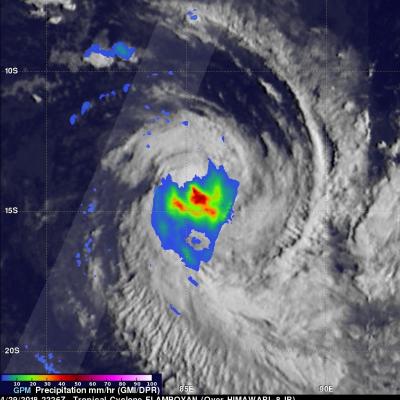
GPM Satellite Views Tropical Cyclone Flamboyan's Rainfall

Tropical cyclone FLAMBOYAN formed in the middle of the South Indian Ocean well to the west of Australia on April 28, 2018. Today FLAMBOYAN's wind speeds have increased to about 70 kts (81 mph) as the tropical cyclone curved toward the south-southwest around the subtropical ridge. The Joint Typhoon Warning center (JTWC) predicts that FLAMBOYAN will start weakening soon as it moves even farther to the south and encounters increasing vertical wind shear and colder ocean temperatures. The GPM core observatory satellite had a good view of the rainfall in tropical cyclone FLAMBOYAN when it flew over

GPM Satellite Sees Storms Over Israel

An upper level low generated stormy weather for a few days as it moved through the southeastern Mediterranean. Heavy rainfall in these storms resulted in deadly flash floods that killed ten teenagers in southern Israel. The GPM core observatory satellite passed above intense storms that were moving through the eastern Mediterranean on April 25, 2018 at 1409 UTC (4:09 PM IST). Data collected by the satellite's Microwave Imager (GMI) and Dual Frequency Precipitation Radar (DPR) instruments revealed the location of heavy rainfall that was approaching Israel. GPM's radar (DPR Ku Band) measured

GPM Sees Tropical Cyclone Fakir Forming Near Madagascar

The southwest Indian Ocean cyclone season started on November 15, 2017 and will officially end on April 30, 2018. A tropical cyclone labeled FAKIR by Meteo France formed today near northeastern Madagascar. FAKIR is expected to intensify as it moves toward the southeast and could be a significant tropical cyclone tomorrow. This cyclone season has already seen Madagascar battered and drenched by tropical cyclones Ava, Dumazile, and Eliakim. The GPM core observatory satellite flew above the forming late season tropical cyclone near northeastern Madagascar on April 22, 2018. The satellite's

GPM Data Used to Evaluate Hawaii's Flooding Rainfall

A low pressure trough moving slowly westward through the northwestern Hawaiian Islands caused destructive flooding and mudslides over the past weekend. The trough disrupted the normal northeast trade winds flow north of Oahu on April 12, 2018. This caused extremely heavy rainfall as the trough deepened and moved very slowly over Kauai during the weekend. The 28.1 inches (713 mm) of rain reported in Hanalei within a 24 hour period was close to a record for the small town on Kauai's northern coast. Almost 32.4 inches (822 mm) of rain was reported during the same period over Wainiha, Kauai

GPM Catches Line of Strong Storms Responsible For Tornadoes in Eastern U.S.

Yesterday, Sunday April 15th, a line of strong storms at one point stretched from the Florida Straits below the Florida Keys all the way up the East Coast and into Ohio. Many of the storms were strong with wide spread reports of wind damage from north Florida up through the Carolinas and into central Virginia. Among these were several reports of tornadoes from Florida to Virginia. The most significant were an EF-2 tornado that stuck Greensboro, NC, killing one person, and a tornado near Lynchburg in Amherst County Virginia that injured 8 people. GPM captured this image of the advancing line of