
Extreme Weather News

Jump to a Year

2024 | 2023 | 2022 | 2021 | 2020

2019 | 2018 | 2017 | 2016 | 2015

2014 | 2013 | 2012 | 2011 | 2010

2009 | 2008 | 2007 | 2006 | 2005

2004 | 2003 | 2002

GPM Sees Tropical Depression SIX-E Forming

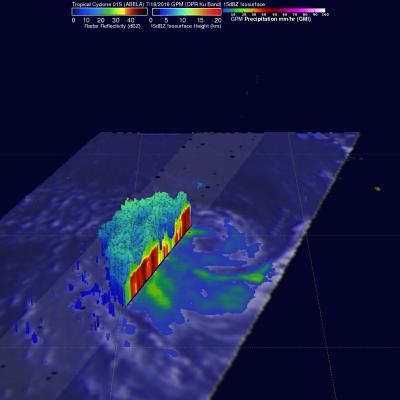
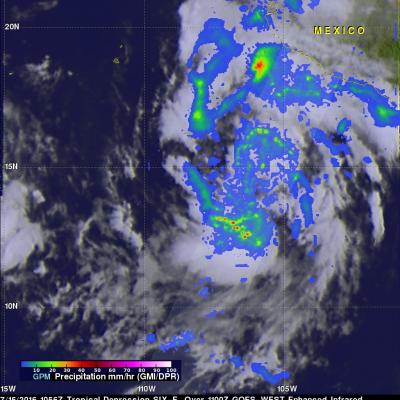
A large area of low pressure in the eastern Pacific Ocean was sufficiently organized and developed that the National Hurricane Center (NHC) designated it as tropical depression SIX-E on July 15, 2016 at 1500Z (9:00 AM MDT). With the development of tropical depression SIX-E there are currently three active tropical systems in the eastern Pacific Ocean. The GPM core observatory had a good view of forming tropical depression SIX-E when it flew over on July 15, 2016 at 1056 UTC (4:56 AM MDT). Precipitation data were calculated from data collected by GPM's Microwave Imager (GMI) and Dual-Frequency

Rainfall Measured By GPM In Weakening Tropical Storm Celia

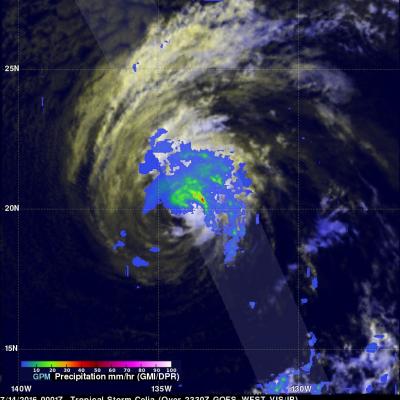
Celia was a powerful hurricane with winds of 85 kts (98 mph) a couple days ago but has recently been moving over cooler ocean waters that are contributing to a weakening trend. Hurricane Celia had weakened to a tropical storm with winds of about 45 kts (52 mph) when the GPM core observatory satellite flew over on July 14, 2016 at 0001 UTC. GPM found that convective storms were mainly located to the north and northeast of Celia's center of circulation. GPM's Microwave Imager (GMI) and Dual-Frequency Precipitation Radar (DPR) found that rain was falling at over 164 mm (6.4 inches) per hour

Forming Tropical Storm Darby Analyzed By GPM

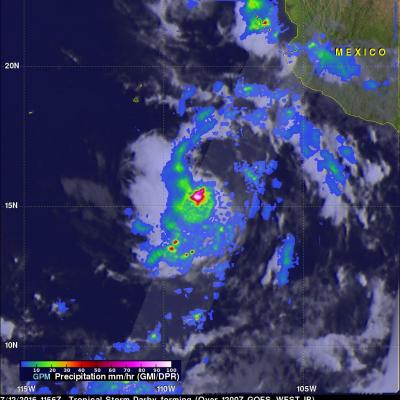
Tropical storm Darby became the fourth eastern Pacific Ocean tropical storm to form on July 12, 2016. Last year was an El Nino year and this year is transitioning to a La Nina year with cooler sea surface temperatures (SST) expanding across the eastern equatorial Pacific Ocean. Fewer tropical storms are normally expected to develop in the eastern Pacific Ocean during La Nina years but so far this year tropical cyclones are forming in the eastern Pacific Ocean at about the same pace as last year. The GPM core observatory satellite flew above tropical depression five (TD05E) on July 12, 2016 at

GPM Sees Hurricane Celia Twice

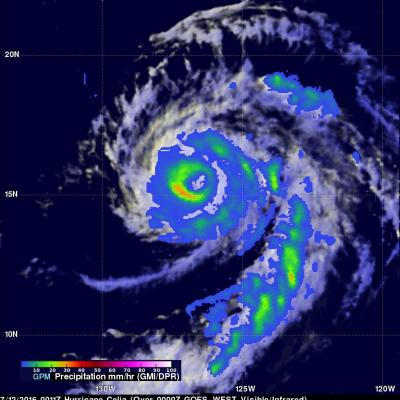
The GPM core observatory satellite twice flew almost directly above hurricane Celia in the eastern Pacific Ocean on July 12, 2016. The first time was on July 12, 2016 at 0011 UTC and the second view was on July 12, 2016 at 1326 UTC. With both passes GPM's Microwave Imager (GMI) clearly showed the location of rainfall around hurricane Celia's well defined eye. The hurricane had maintained intensity during this period with sustained maximum wind speeds estimated at 80 kts (92.8 mph). With the first pass GMI measured rain in the southwestern side of Celia's eye wall falling at a rate of close to

Nepartak Causes Havoc Then Dissipates Over China

Nepartak was a powerful category four typhoon when it hit Taiwan last week but weakened to a tropical storm as it moved into the Taiwan Strait. Nepartak's winds and heavy rains caused severe problems when it moved ashore over southeastern China. Thousands of homes in China were destroyed by the storm. At least three deaths in Taiwan and six fatalities in China were attributed to Nepartak. Torrential rain caused flash flooding and mudslides in both Taiwan and China. NASA's Integrated Multi-satellitE Retrievals for GPM (IMERG) were again used to estimate the total amount of rain that Nepartak