
Extreme Weather News

Jump to a Year

2024 | 2023 | 2022 | 2021 | 2020

2019 | 2018 | 2017 | 2016 | 2015

2014 | 2013 | 2012 | 2011 | 2010

2009 | 2008 | 2007 | 2006 | 2005

2004 | 2003 | 2002

GPM Sees Ockhi's Rain Reaching India's Western Coast

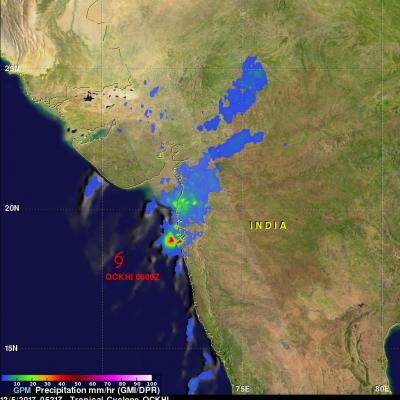
NASA's GPM Core Observatory satellite passed over western India on December 5, 2017 at 0521 UTC. GPM's Microwave Imager (GMI) and Dual-Frequency Precipitation Radar (DPR) instruments showed precipitation from dissipating tropical cyclone OCKHI reaching India's western coast. GPM's radar (DPR Ku band) indicated that rain was falling at a rate of over 101.6 mm (4 inches) per hour in a few storms near India's coast. OCKHI's low level center of circulation, shown with a red tropical cyclone symbol, was located well to the southwest of the storms that were moving onto India's western coast. This 3

Tropical Cyclone Ockhi's Rainfall Examined By GPM

On December 2, 1027 OCKHI became the first tropical cyclone of the year to form in the Arabian Sea. Fortunately for India the tropical cyclone remained off India's southwestern coast. OCKHI intensified to the equivalent of a category 3 hurricane on the Saffir-Simpson hurricane wind scale before it started to weaken. Vertical wind shear caused OCKHI to weaken as the tropical cyclone started moving north-northeastward toward India's Gulf of Khambhat. NASA's GPM Core Observatory satellite passed over tropical cyclone OCKHI on December 4, 2017 at 0616 UTC. The rainfall coverage shown here was

GPM Observes Tropical Cyclone Dahlia In Southwest Indian Ocean

Yesterday tropical Cyclone Dahlia became the first tropical cyclone of the 2017-2018 Southwest Indian Ocean season. Today, Dahlia was moving toward the southeast and was passing to the south of the Indonesian islands of Java and Sumatra with wind speeds of about 35 kts (40.3 mph). Tropical cyclone Dahlia was passing over the warm ocean waters (28-29 degrees Celsius) of the Indian Ocean. On November 29, 2017 at 1731 UTC NASA's GPM Core Observatory satellite passed above forming tropical cyclone Dahlia. Data collected by GPM's Microwave Imager (GMI) and Dual-Frequency Precipitation Radar (DPR)

GPM Views Severe Rain Storms Over Western Saudi Arabia

Intense rain storms have moved into Jeddah, Saudi Arabia today. Heavy downpours caused schools and universities to close. The General Authority of Meteorology and Environment Protection predicts that Heavy rain will continue for a couple days. NASA's GPM Core Observatory satellite measures precipitation from space with the first space-borne Ku/Ka-band Dual-frequency Precipitation Radar (DPR) and a multi-channel GPM Microwave Imager (GMI). The satellite passed over western Saudi Arabia on November 21, 2017 at 0123Z. GPM's Microwave Imager (GMI) and Dual-Frequency Precipitation Radar (DPR)

GPM Sees Remnants Of Tropical Storm Haikui Affecting Vietnam

The GPM core observatory satellite provided information about rainfall associated with the remnants of tropical storm Haikui on November 2017 at 0929 UTC. Earlier this month, typhoon Damrey caused widespread destruction when it hit Vienam on November 4, 2017. Fortunately tropical storm Haikui dissipated over the South China Sea before it reached Vietnam. Rainfall data collected by GPM's Microwave Imager (GMI) and Dual Frequency Precipitation Radar (DPR) instruments revealed that some storms with tropical storm Haikui's remnants contained light to moderate precipitation. A small cluster of